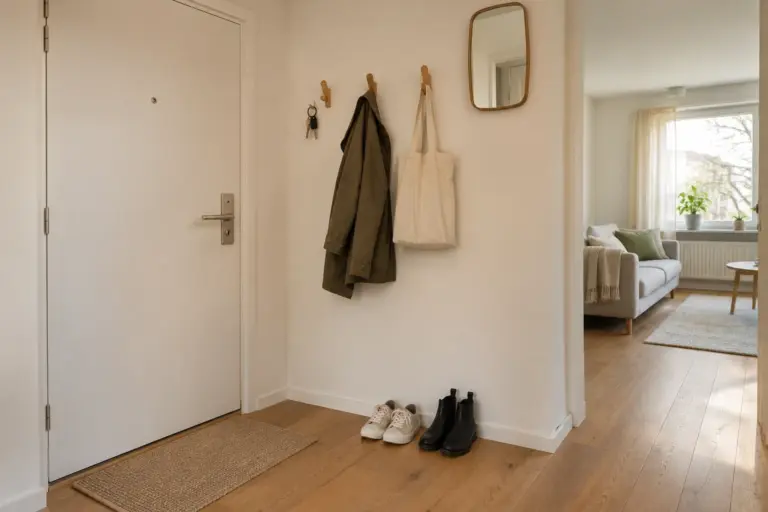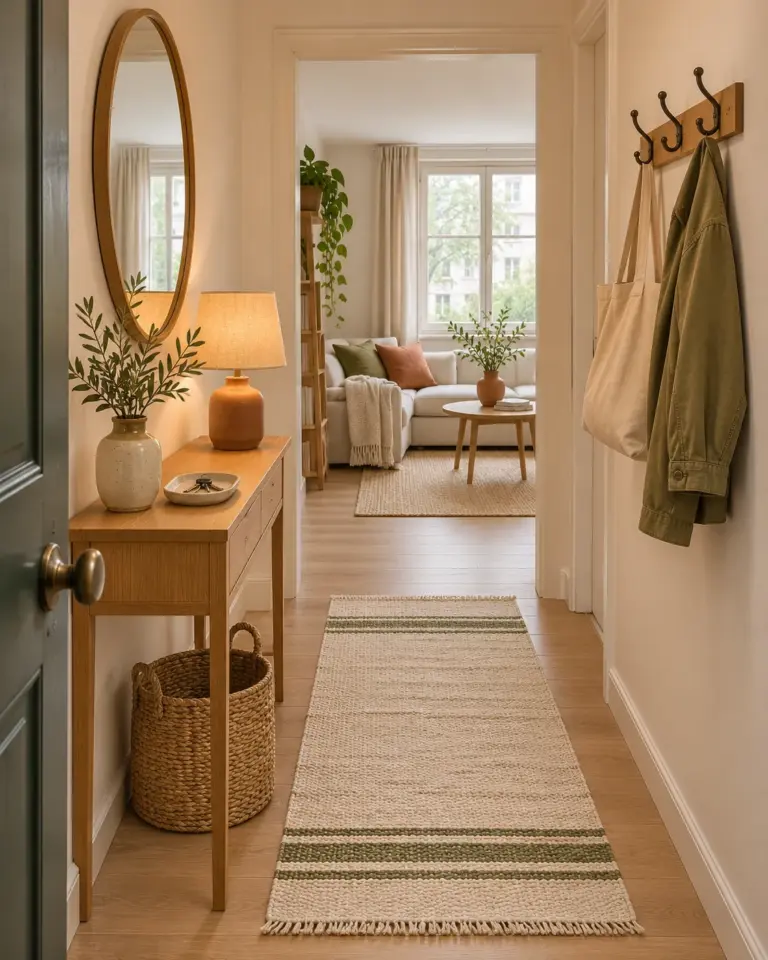
Keep the entryway focused on the next ordinary departure: the coats, bags, shoes and small essentials currently in use. Give seasonal and occasional items another home, and reserve a clear place to arrive and leave. Without a hall closet, the entry cannot quietly absorb an unlimited backlog behind a door.
Start by counting the daily set for the people using the entrance. Then choose the storage formats. Buying a rack before deciding what belongs there often leads to filling every hook and shelf, followed by another layer of objects on the floor.
Build the Daily Set from Actual Departures
For each person, identify the coat or outer layer currently used, the everyday bag, the footwear normally worn and the small essentials needed to leave. Add a specific recurring activity, such as a school bag or dog-walking kit, only when it genuinely starts at that door.
Separate spares from the active set. Several backup coats and occasional formal shoes do not need the same prime position as tomorrow's footwear. Keep the entry's useful capacity visible: if the active objects already fill it, another household member's arrival needs a revised plan rather than another bag hung on the nearest handle.
Use the first normal week as a reality check. Weather and routines can require more than one active outer layer. The goal is a deliberate daily set, not an artificially tiny one that nobody can maintain.
Put Bags and Coats Where Their Loaded Shape Fits
Hold the full bag at the intended hook position. Check its projection, straps and the height needed to lift it on and off. Place the coat beside it with enough room to remove either object without pulling the other down.
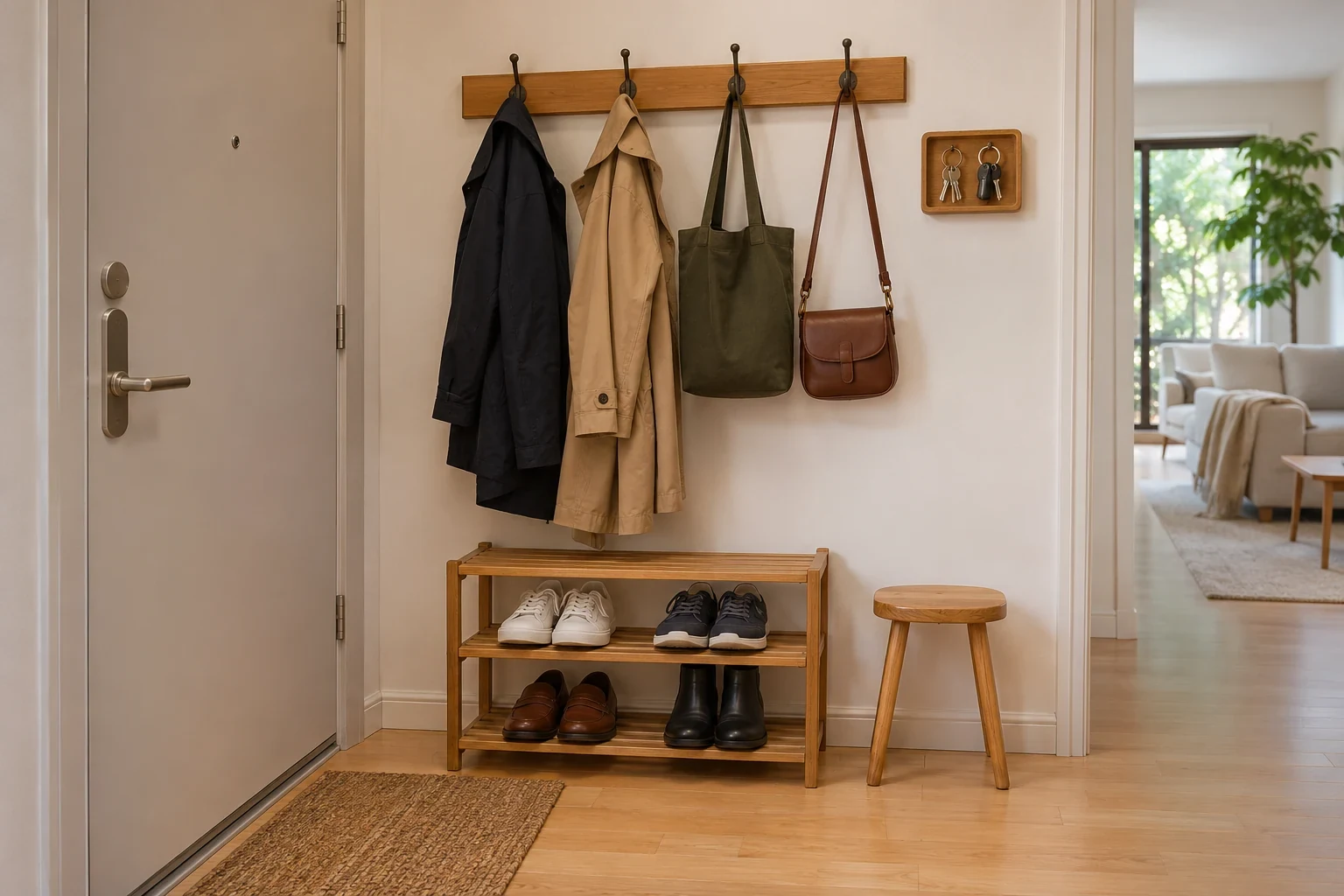
For two users, assign recognizable positions rather than building a mixed stack on one hook. The labels can be as simple as consistent left and right positions. What matters is that each person can return the item without sorting everyone else's belongings first.
Use hooks and fixings suitable for the wall and the intended loads, and follow their instructions. Confirm any rental restrictions before installation. Avoid letting the hanging arrangement interfere with switches, door handles or the full door swing.
Give Shoes a Limited, Usable Home
Choose the number of pairs that must stay at the entrance and measure those shoes. Low open storage makes the active set visible, but it still needs enough room for the actual shoe shapes and access while someone stands nearby. Keep the route clear with the shoes in place, not just after they are put away perfectly.
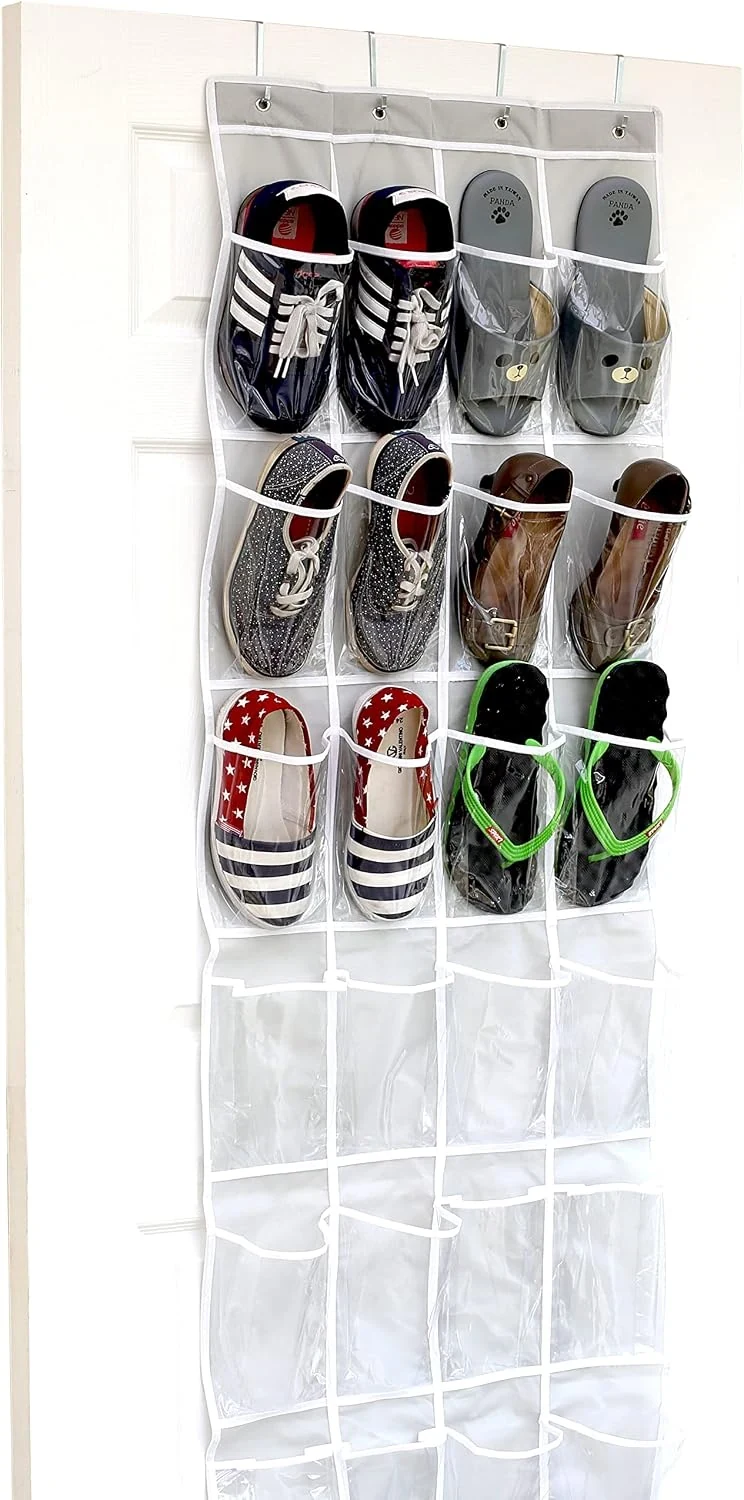
A door-back organizer in another suitable location can move some footwear off the entry floor. The gray Simple Houseware 24-pocket organizer, ASIN B01D58DRVC, is listed as 19 inches wide by 64 inches high with hooks for doors up to 1⅜ inches thick. Check the frame gap, loaded pocket depth and shoe fit as well as door thickness. Twenty-four pockets do not mean twenty-four pairs of all sizes.
Choose a location and surface suitable for wet footwear, and follow the care requirements of both shoes and storage. Do not move damp shoes into a closed fabric container solely to keep the entrance looking empty.
Add a Landing Surface Only for Items That Need It
Keys can hang, while glasses in a case, a phone or today's envelope may need a flat surface. Choose the landing point from the way you enter with your hands full. Leave a free patch for the arriving object rather than filling the whole top with permanent decoration.
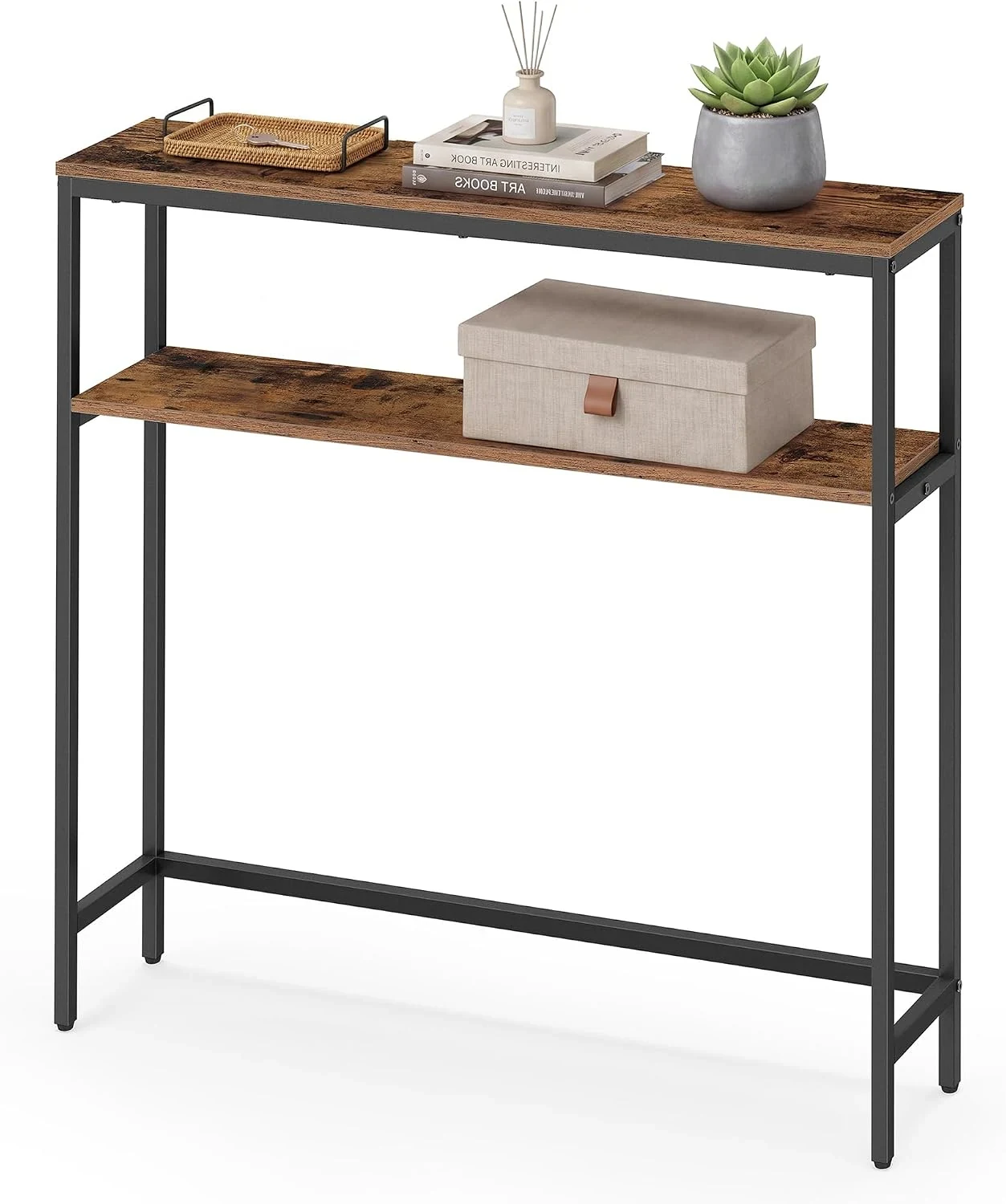
A shallow console can combine that surface with a lower shelf when the passage allows it. The VASAGLE narrow console, ASIN B0FC279283, is listed with a 7.9-by-31.5-inch footprint and a 31.5-inch height. Tape out the selected dimensions and include the storage container's own projection. Follow the supplied anti-tip and assembly instructions.
The table is not a seat. If someone needs to sit to put on shoes, consider suitable seating and its occupied footprint first. A narrow entry may have room for a useful seat or a table without having room for both.
Decide Where the Overflow Goes Before It Appears
Assign a real location for off-season outerwear, occasional footwear and bags not currently in use. It might be a wardrobe, shelf or other appropriate storage area elsewhere in the home. Check that it actually has available space; “put it away elsewhere” is not a destination.
Use containers matched to those objects and their access frequency. Keep the next item you expect to rotate in reachable without unloading unrelated possessions. The overflow location should make changing seasons manageable instead of turning it into a full-house reorganization.
For incoming mail or returns, use a small defined holding area with a separate onward destination. These are passing tasks rather than permanent entryway contents. If the holding area keeps expanding, reduce the backlog or move the sorting activity, rather than buying a larger console by default.
Rehearse Two People Using the Entrance
Try one person arriving while another prepares to leave, using safe lightweight stand-ins for any heavy load. Check where both stand, which door moves and whether a bag or shoe basket must be shifted. Keep required exit and accessibility needs available throughout.
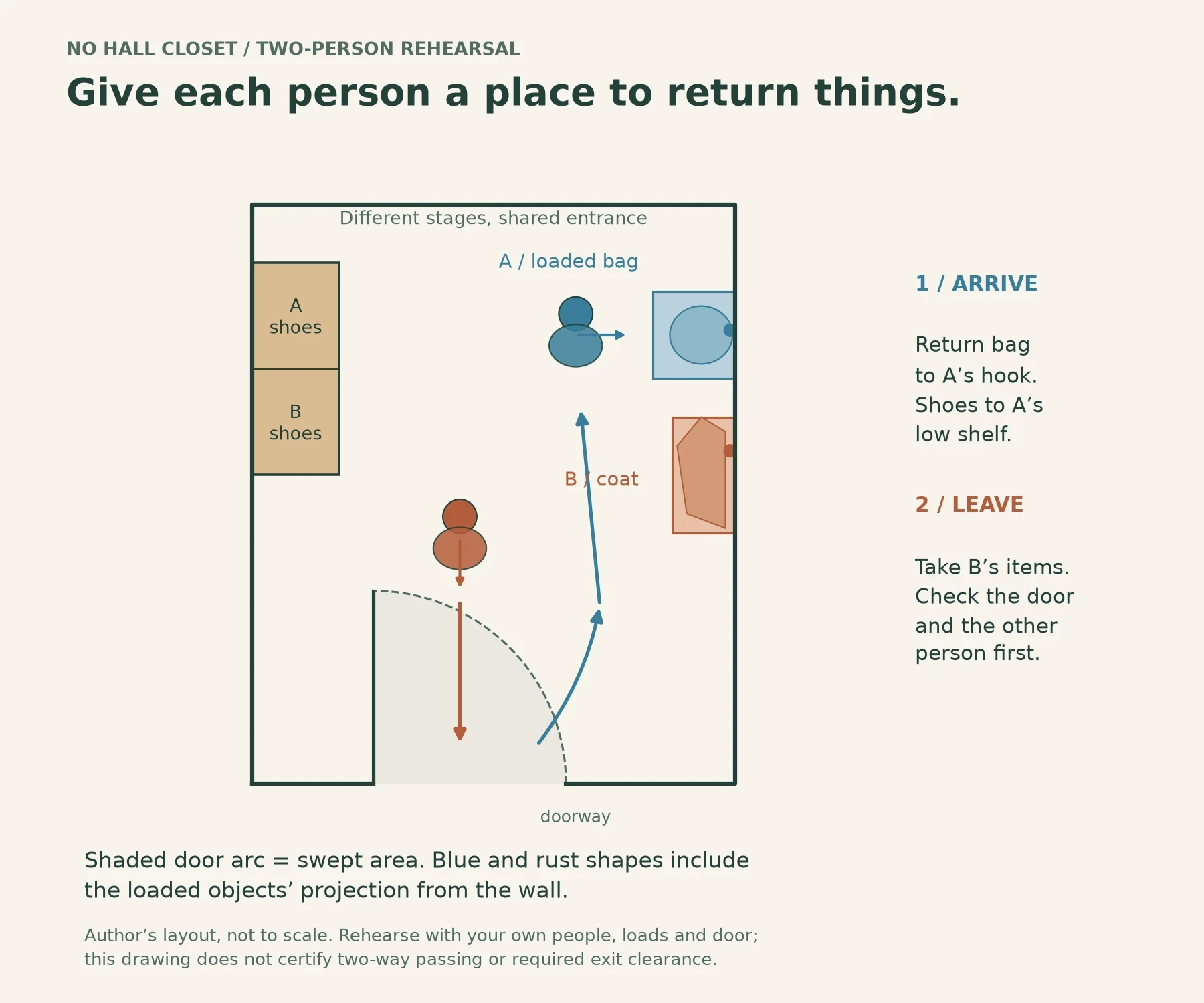
The shared-arrival scene illustrates separate hanging positions and a limited low shoe area, with the center left open. Transfer the relationship to your own objects and measurements rather than copying its proportions as a guarantee of space for two people.
At the end of a normal day, return the active set and move passing items onward. A no-closet entry works best when it has a clear assignment: support the next arrival and departure, while the rest of the home's storage carries the longer-term load.