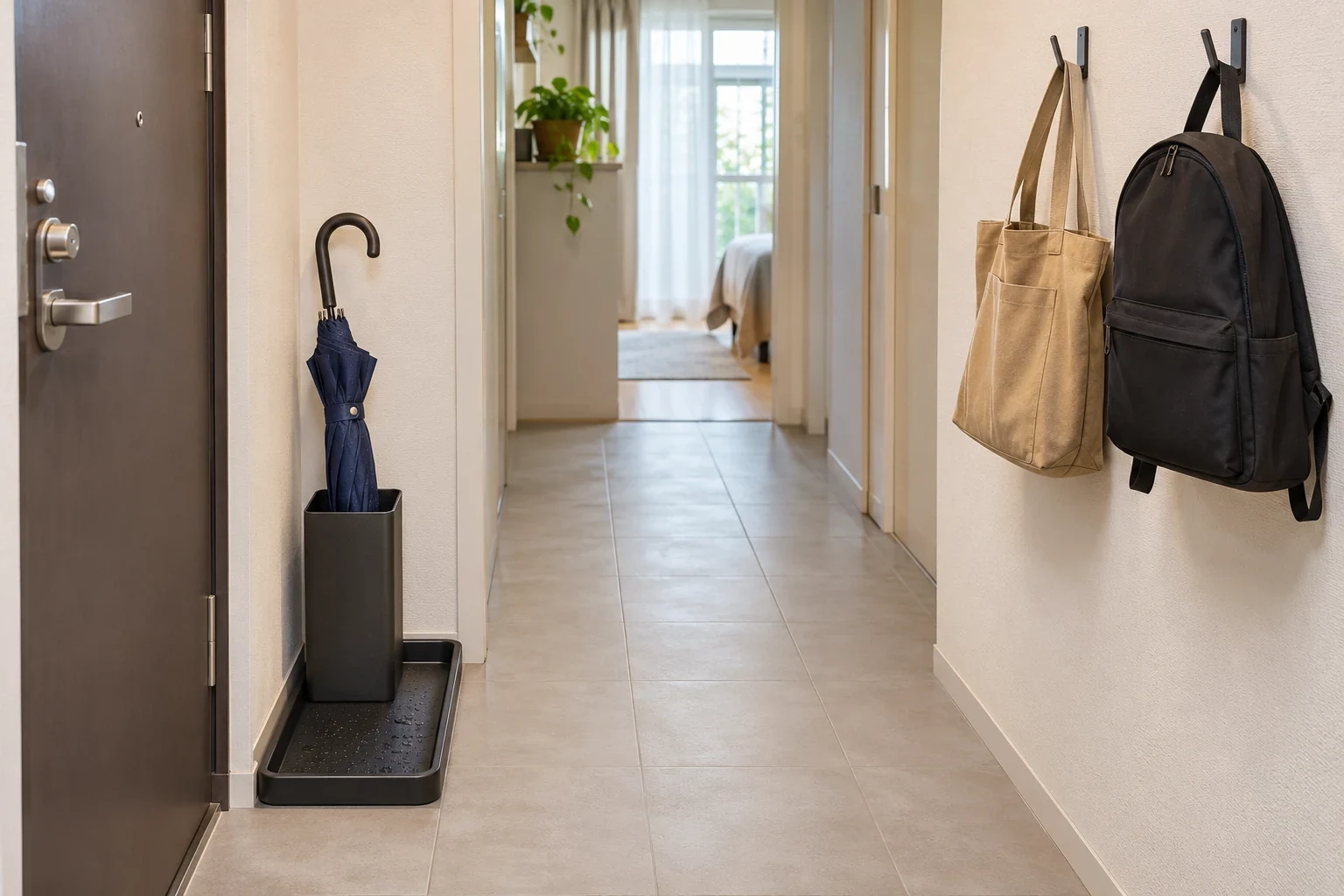
Give a wet umbrella a temporary landing place that catches its water, and give dry bags a separate home outside its drip path. Then arrange somewhere suitable for the umbrella to dry before it returns to ordinary storage. A narrow stand beside the door can help with arrival, but it does not finish the job.
The useful layout has three parts: catch water on arrival, dry the umbrella according to its instructions, and reset the storage for the next person. Keeping those stages distinct helps you avoid a crowded corner where damp fabric, school bags and shopping totes all lean together.
Trace the Arrival with Both Hands Occupied
Start outside the door with the objects you normally carry. Where can you close the umbrella without splashing another person or an area that must stay dry? Where will you put it while handling your keys and bag? Use a dry umbrella for this rehearsal, and follow its opening and closing instructions.
Locate the first indoor catch point close enough that you do not carry a dripping canopy across the room. It must also stay clear of the full door swing, latch and route into the home. Check the umbrella's hooked handle and leaning canopy, not just the footprint of the container.
Choose a separate first landing for a bag. It might be a properly supported hook or an existing suitable shelf, provided the loaded bag is reachable and does not project into the umbrella's route. IKEA's small-hallway examples use hooks and shallow storage to make use of wall space; the placement still has to suit the objects and the entrance.
Try the sequence with your real bag filled as usual. If reaching its hook pulls the umbrella across its fabric, move one of the destinations. A wet coat or umbrella hanging above a dry bag can drip onto it even though the hooks themselves are separate.
Choose a Receptacle for the Umbrella You Own
Long and folding umbrellas need different support. A tall umbrella needs a stable holder that keeps its tip contained without letting its handle lean across the passage. A short folding umbrella can disappear into a deep stand, making you reach among other wet canopies to retrieve it.
Adjustable internal trays are one relevant format: placing a short umbrella's support at a higher level can keep it within easier reach, while a long umbrella uses the lower position. That is a support arrangement to compare, rather than assuming every four-slot stand suits four of your umbrellas. Check the actual canopy bulk, handle shape and access.
For a new holder, check the outside dimensions, the usable openings and the way water is collected. Confirm whether its water-catching parts can be removed for cleaning, and whether you can remove them with the stand in its proposed position. A decorative woven basket or a container with drain holes is not automatically a water-catching surface.
Use a receptacle and any protective tray that are suitable for the floor, following their care instructions. A raised edge helps define a catch area, but it does not prove a tray is watertight or that splashes will stay inside. Check for leakage, overflow and moisture underneath during normal use. Keep the holder stable with the actual loaded umbrellas, especially when you remove one.
Keep the Wet and Dry Projections Apart
Put the umbrella holder and dry bags beside different usable parts of the entry, with no overlapping drip path. Opposite walls can work, but only if their loaded projections leave the passage you need. A bag's base, front pocket and straps may extend farther than its hook.
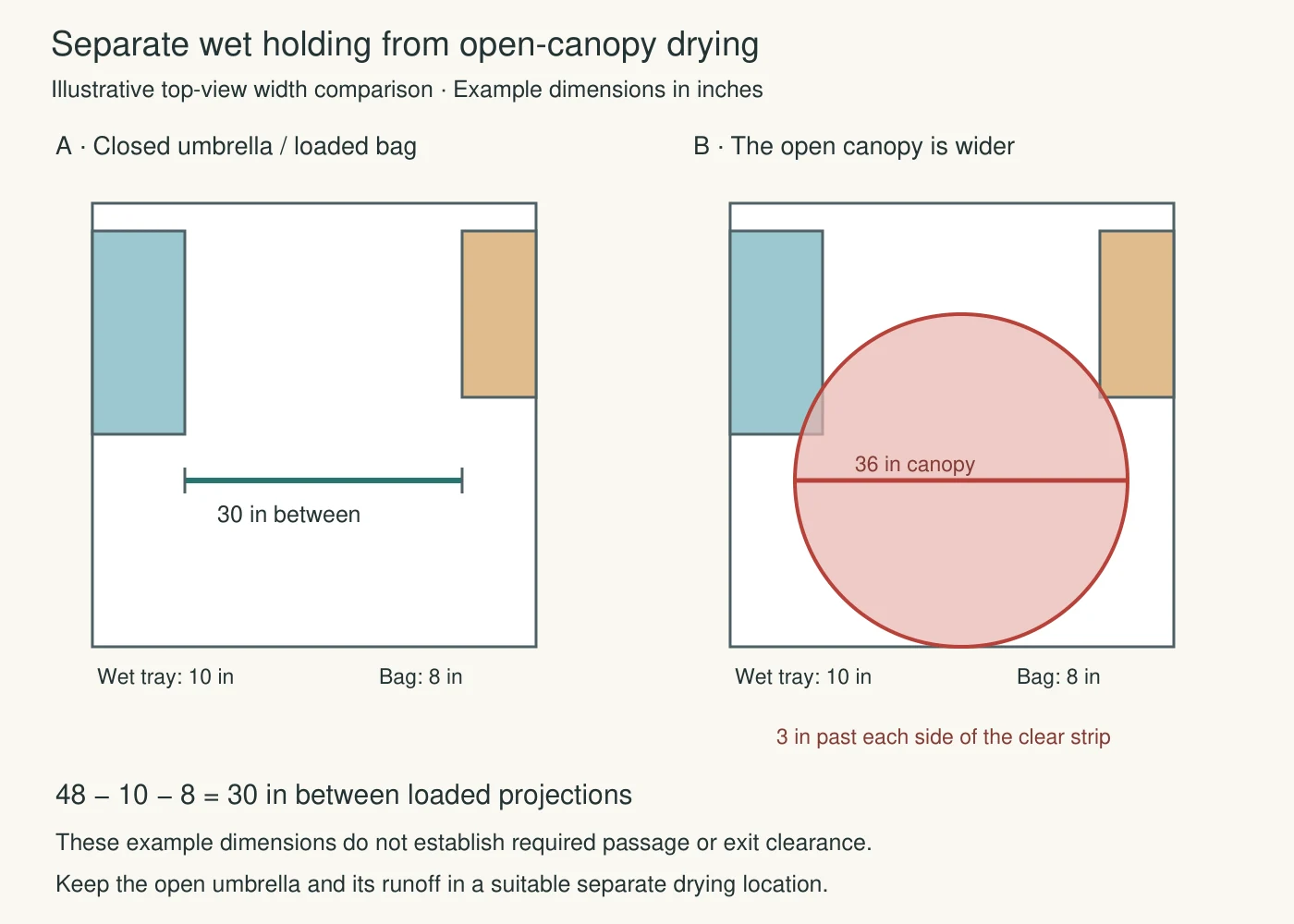
Consider an illustrative hall that is 48 inches wide. A wet tray projects 10 inches from one wall, and the loaded dry bag projects 8 inches from the other. Where they face each other, 48 minus 10 minus 8 leaves 30 inches between them. That calculation describes the example; it is not a required or recommended passage width. Check your household's movement, exit and accessibility needs independently.
Do not treat a higher bag hook as a solution if the bag still hangs over wet fabric. Nor should a holder's slim base hide the widest part of an umbrella resting at an angle. Measure the loaded arrangement, then carry your normal bag through it and open the door fully.
Include a second arrival in the test. Two wet umbrellas may occupy more width than one, and the next person still needs somewhere to put a dry bag. If the entry cannot accommodate the active set, assign another suitable wet-handling location rather than expanding into the route.
Move from Temporary Holding to Proper Drying
An umbrella standing closed in a compact holder is in a temporary arrival state. Arrange the next step before rain makes that corner busy. MPM-QUALITY's umbrella instructions call for letting the umbrella drip and dry open, with the fastening strap secured after drying. Follow the instructions for your own umbrella.
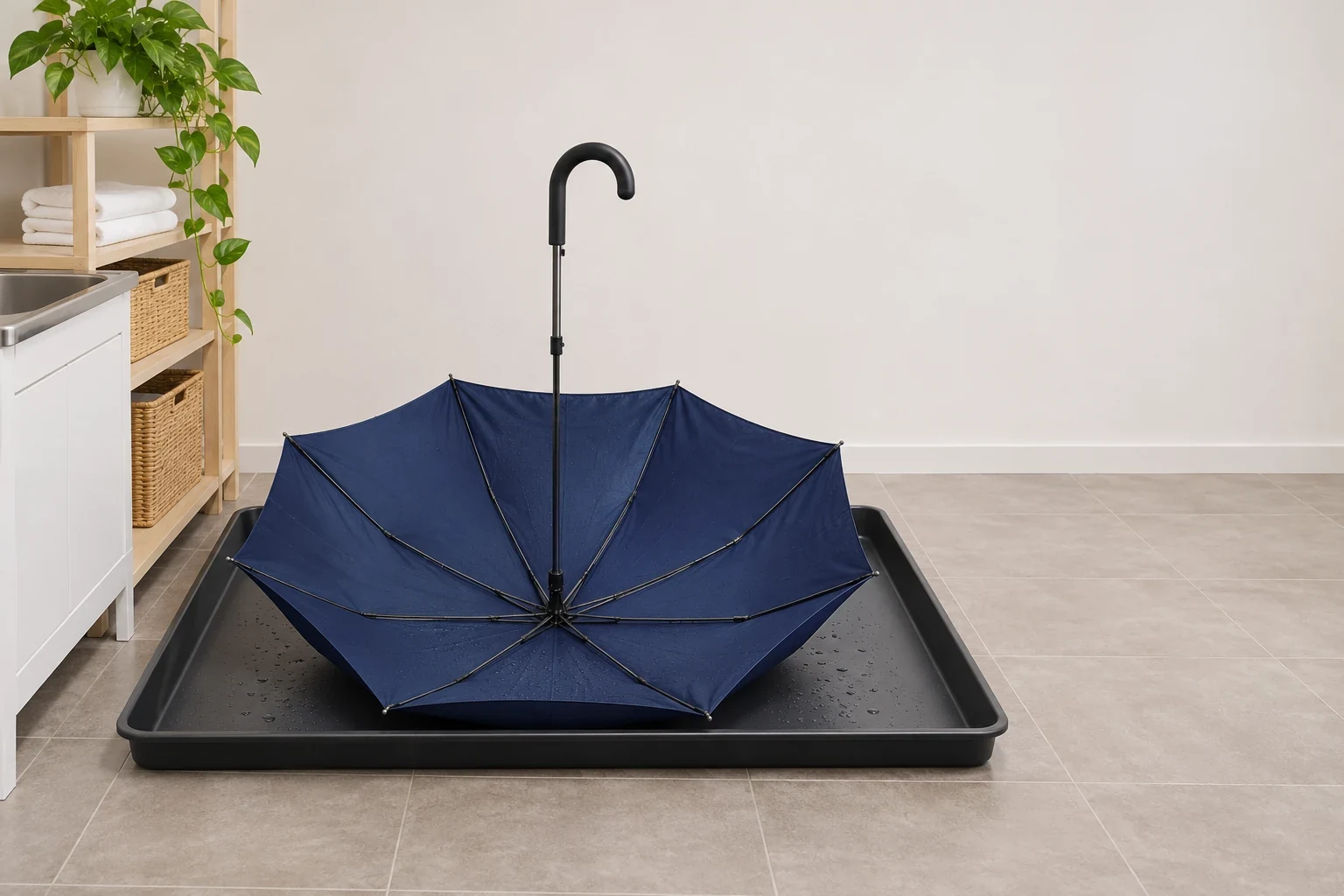
Choose a drying location where the open canopy fits, people can remain clear of its ribs and tip, and runoff is contained on a suitable surface. It may be in a laundry or another appropriate part of the home. Do not use the only passage or a door's operating area simply because the umbrella was easy to leave there.
The pictured drying example places the open canopy over a larger raised-edge tray, away from the entrance. Check that the actual runoff footprint fits within the catcher and that the support position follows the umbrella's care requirements. An ordinary small entry tray may be much too narrow for an open umbrella.
For example, a 36-inch open canopy cannot occupy a 30-inch clear strip without extending beyond it. In the illustrated width comparison it reaches 3 inches past each side when centered. The answer is a different drying location, not asking people to squeeze around or step over it. Carry the wet umbrella there with its water contained as appropriate, and keep dry bags out of that transfer path.
Empty and Reset the Catch Area
Check the catch tray after a wet arrival, and empty collected water before it can overflow or become an obstacle to the next use. Remove the umbrella first when necessary, support the water-catching part securely, and carry it without dripping across the route. Empty it at a suitable sink or drain rather than tipping it onto the floor or outside someone else's door.
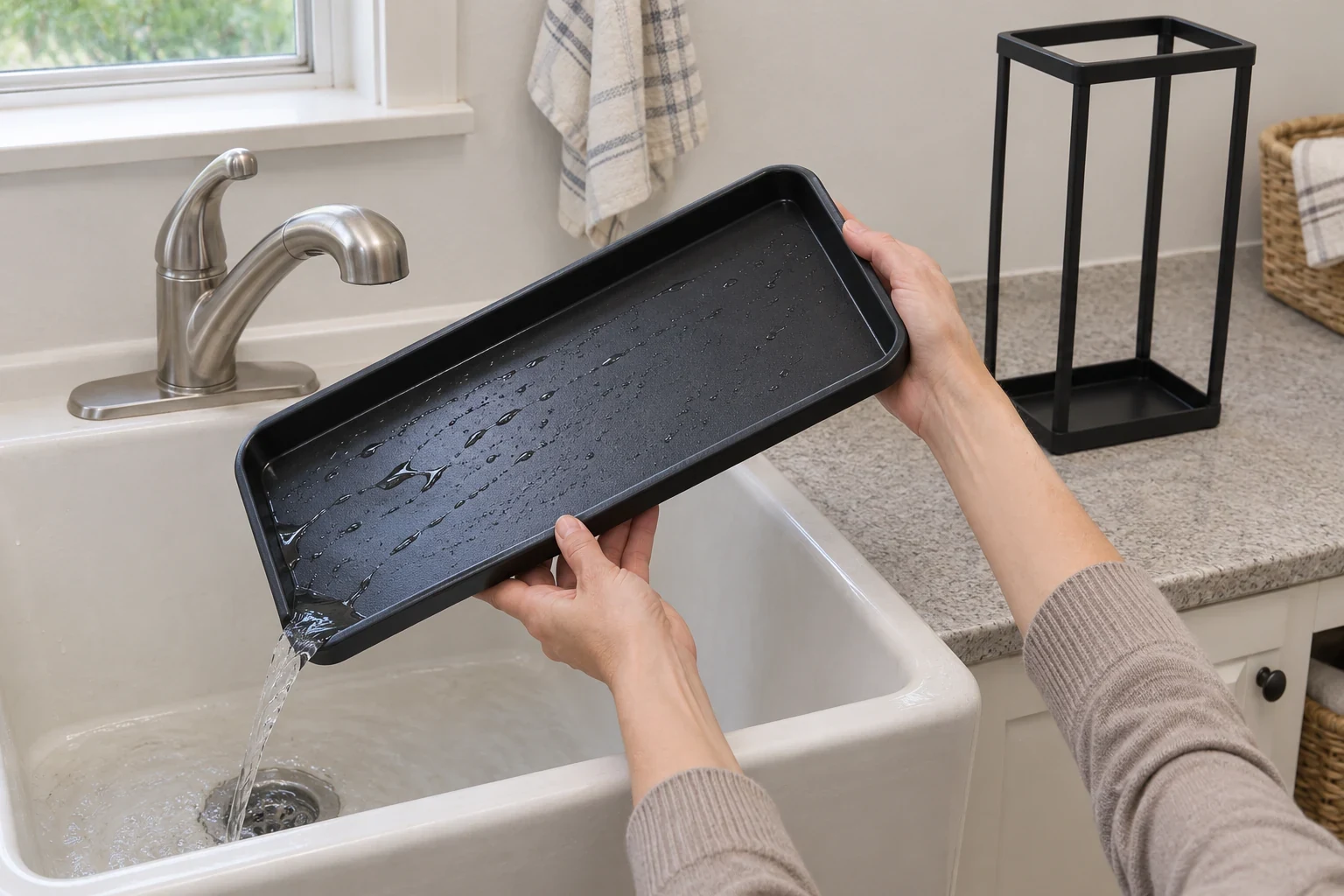
Clean the holder and tray according to their materials and instructions. Allow the relevant parts and the floor beneath them to dry before replacing them. A tray can look tidy from above while concealing moisture underneath, so include that surface in the check.
Keep the cleaning step possible in the finished arrangement. If a tall bag stand must be dismantled before you can remove the drip tray, the location is asking for water to be left there. Prefer a position where the removable parts can lift out without knocking bags or blocking the entrance.
Return the umbrella to its normal storage only when dry, securing it as its instructions require. Dry its sleeve separately if it is wet. Do not seal damp fabric in a bag pocket or closed cover just to clear the view of the entry.
Give Overflow a Destination Before the Next Shower
Count the umbrellas normally arriving together, including a visitor or a child returning at the same time as you. Keep the catch point within the holder's instructions and the entrance's usable space. A nominal capacity does not settle stability, water volume or the shape of several wet canopies.
Assign one suitable overflow location and a way to reach it without wetting dry belongings. Then make the ordinary return simple: dry bags on their own supports, umbrellas dry and ready, and the catch tray empty and clean.
After the next rainy day, check what actually happened. Water on a bag, a tray shifted into the route or an umbrella left closed overnight each identifies a step to improve. Adjust the destination or the sequence so the entrance supports a real arrival, followed by drying and reset, rather than just looking organized before anyone comes home.