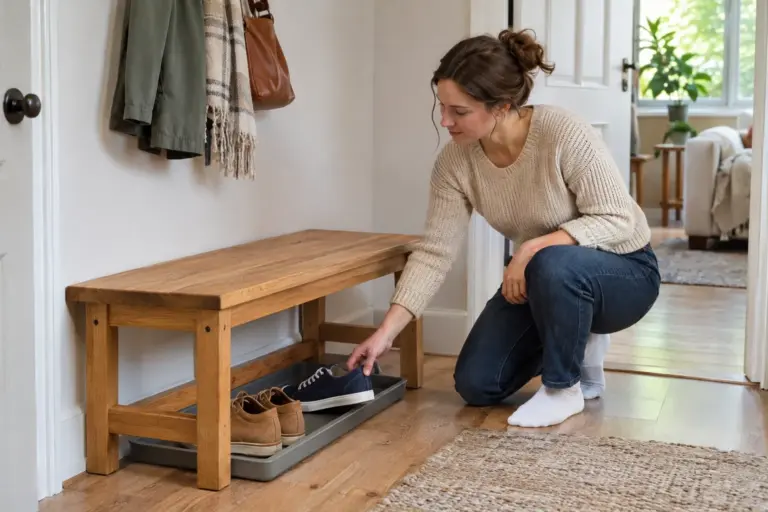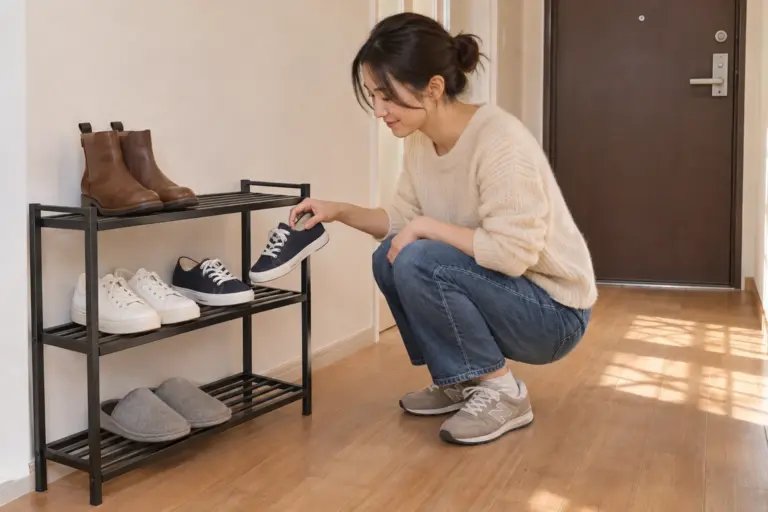
A row of shoe boxes can fit a shelf and still be frustrating to use. The problem often appears when you want the bottom pair: the lid cannot open until two other boxes move, and there is nowhere convenient to put them. The useful capacity is the footwear you can remove and return in the space available, rather than the number of containers that fit when closed.
Start with one representative pair and one box. Rehearse the complete retrieval before buying a matching set or building a stack. For everyday footwear, that simple trial can reveal more than a tidy photograph of closed doors.
Decide Which Pairs Belong in Boxes
Separate the shoes you reach for frequently from the pairs used only occasionally. Boxes may suit the latter without being the easiest home for wet outdoor footwear or the shoes you take off several times a day. IKEA's shoe-storage ideas describe boxing occasional or seasonal shoes as one way to reduce the hallway's workload.
Work with actual pairs, including the bulkiest one you intend to store. A low sneaker, a heel, and an ankle boot do not present the same shape at an opening. Keep a pair together where it fits appropriately; do not force boots down merely to make every container hold the same number of shoes.
Use footwear and container care instructions to decide when shoes are ready to put away. A mesh panel or ventilation hole is not evidence that a closed arrangement will dry wet footwear, prevent odor, or solve a moisture problem. Keep any needed care or drying process separate from the space calculation.
Compare Top Access with Front Access
A top-opening box needs room above the lid and a way to reach its contents. If another box rests on that lid, retrieving the lower pair usually involves moving the upper box first. Include that temporary landing place in the plan. Setting it in the hallway is still an interruption even if the stack looks compact afterward.
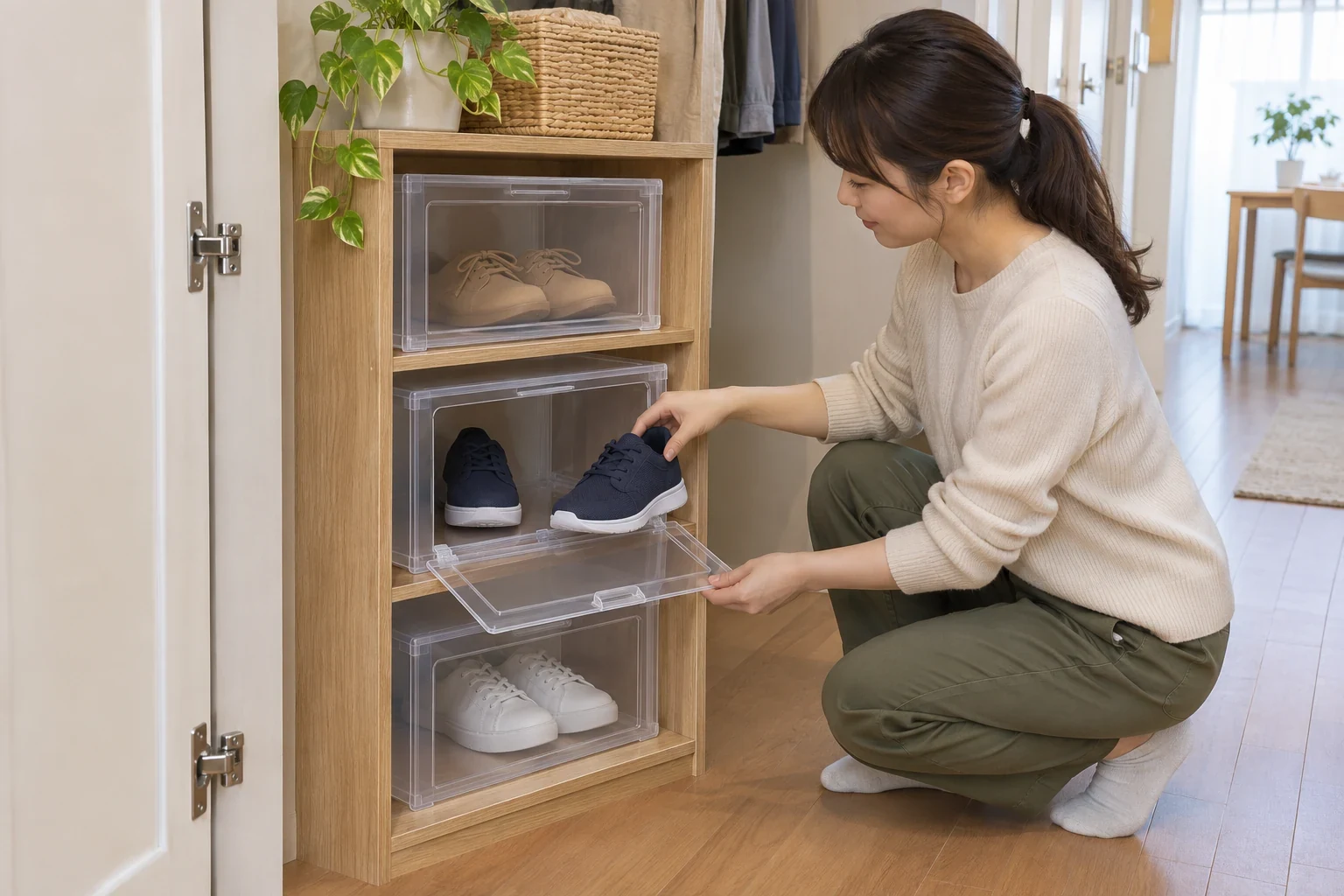
A front-opening box changes the sequence. You may be able to open the selected container without removing those above it, provided the product is intended for that arrangement and the front remains accessible. The door still needs its full movement, your hand needs room, and the shoe must pass through the opening. A shelf lip or cabinet hinge can interfere with that operation.
Do not treat every transparent panel as a door. Identify the actual hinge, removable lid, fastening, or flap in the selected product information. Check which way it opens and how it closes with the shoes inside. A visible pair behind a clear wall is not necessarily a directly accessible pair.
Draw the Stack and the Shelf Opening
The illustration uses three generic top-lid boxes, each 7 inches high, in a shelf opening 24 inches high. Their combined height is 21 inches, leaving 3 inches above the stack. That subtraction describes the closed objects. It does not establish that the top lid can open, and the lower lids remain covered by the boxes above them.
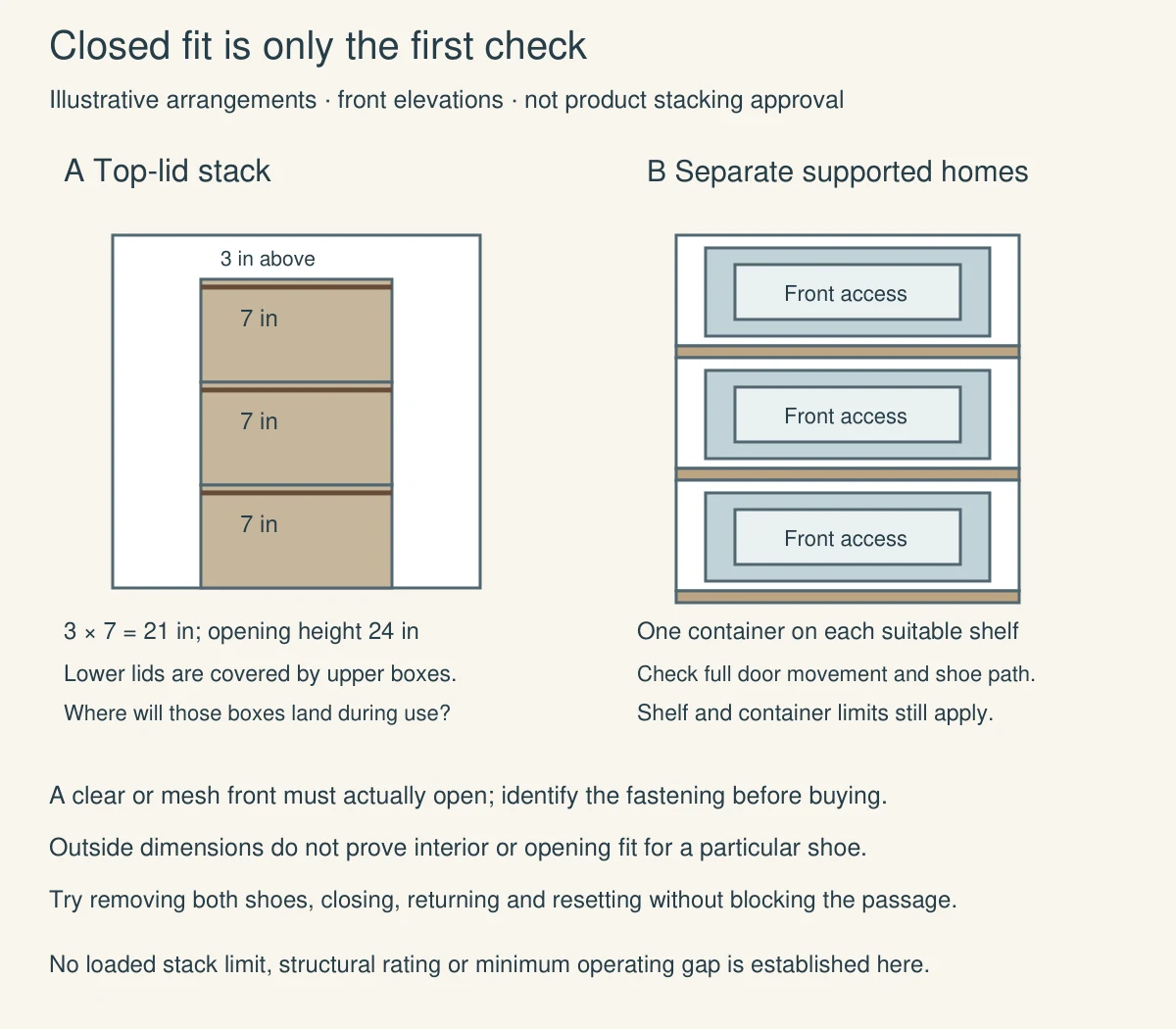
Beside it, three independently supported shelf positions each hold one generic front-opening box. Each shelf carries its own container, rather than making the lowest container support the other two. The drawing compares access arrangements; it does not approve a shelf load, a box stack height, or the construction of a storage unit.
Measure the clear opening at its narrowest point, the shelf depth, and anything immediately in front. If the whole box must slide out, check the complete withdrawal and a suitable supporting place for it. If its door opens in place, check that movement and the shoe's path instead. Do not assume the two operations need equal space.
Check Interior Fit and the Real Opening
External dimensions describe the outside of the container. They do not account for wall thickness, a sloping front, a hinge, or a fastening that narrows the entrance. A shoe 13 inches long is not proven to fit simply because a box is advertised as 14 inches deep.
Compare the actual usable interior and opening with your pair. Try lifting the heel, turning the shoe, and returning it in the orientation you will normally use. Allow the door or lid to close without pressing against the footwear. If only one shoe fits, count that as one shoe's storage instead of silently doubling the practical capacity.
For a stackable design, follow its assembly, connection, placement, and loading instructions. Do not infer an unlimited stacking height from interlocking edges or a staged photograph. Place the arrangement where the intended person can operate it normally without climbing on nearby furniture.
A Fabric Option to Examine Closely
The current US white IKEA SKUBB shoe box, article 403.002.85, comes as four boxes. Each is listed at 8¾ inches wide, 13½ inches deep, and 6¼ inches high. These are assembled box dimensions; the flat retail package has different measurements.
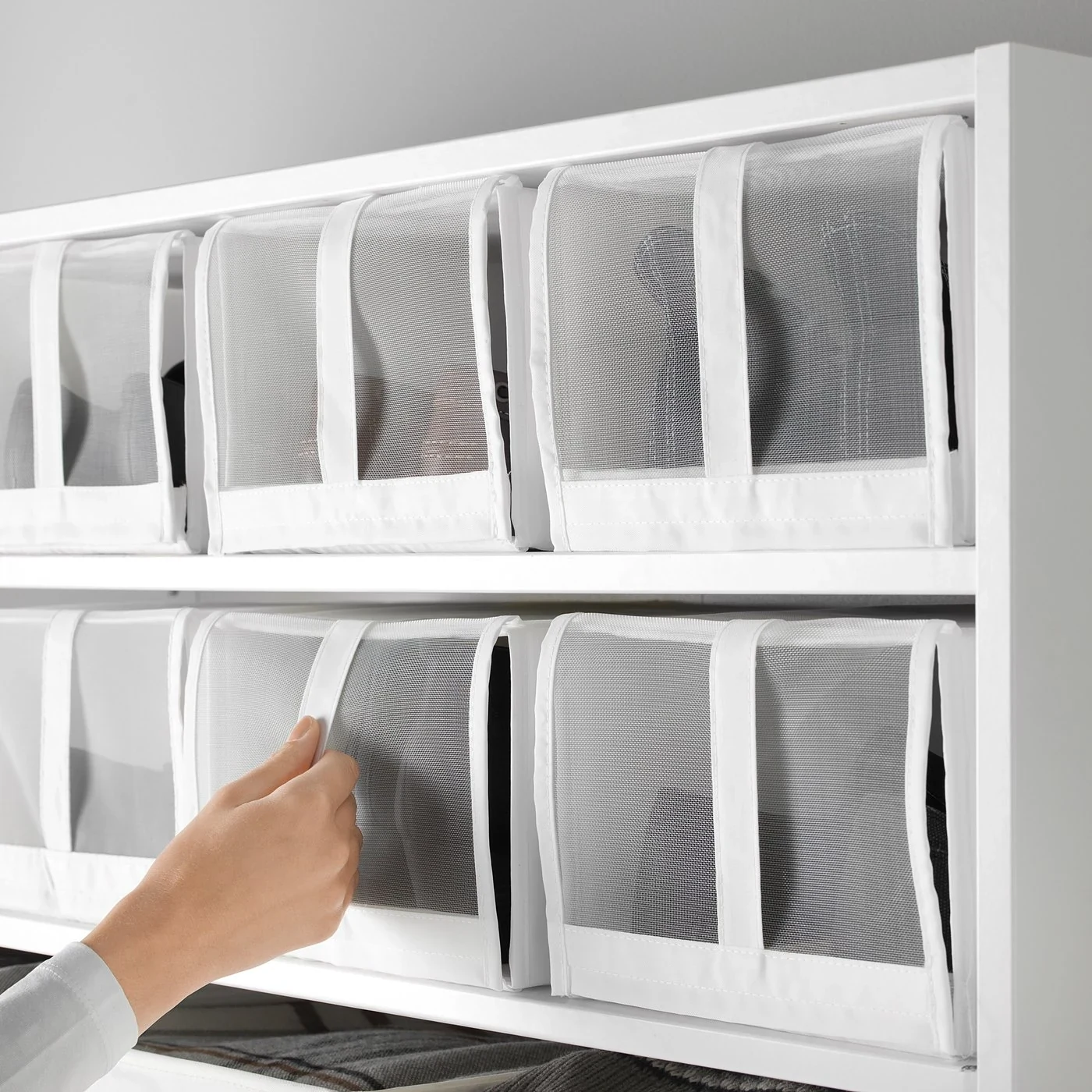
Its mesh front window opens with a hook-and-loop fastening. A zipper in the bottom serves a different purpose: opening it allows the unused box to fold flat. Check that distinction when judging how you would retrieve shoes. Neither the outside dimensions nor the mesh establishes the usable opening for your particular pair.
The product page does not establish a loaded stacking limit. Do not treat it as approval for a freestanding tower. A suitable individual shelf position may be more useful than relying on the strength of the container below it. If you prefer a rigid stackable design, verify its own instructions rather than borrowing these fabric-box details.
Finish with Removal, Return, and Reset
Put the most frequently used boxed pairs in positions the intended user can reach and identify. For an opaque box, a simple pair description or photo on the accessible face can prevent unnecessary opening. Keep the label with the same pair when rearranging storage.
Then try the full sequence: approach, open the storage, remove both shoes, close it, use the pair, and return it after appropriate care. Keep the empty home reserved rather than filling it with unrelated belongings. If returning the shoes requires balancing another container or blocking a doorway, change the arrangement before adding more boxes. The successful setup is the one you can restore after ordinary use.