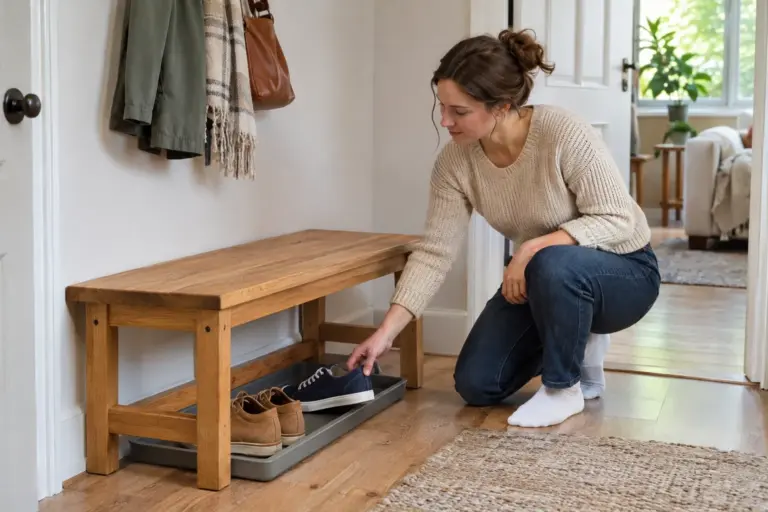
Choose between a shoe cabinet and an open rack by testing your actual footwear and the way you retrieve and return it. A cabinet can conceal the shoes, but its compartments need room to open. A rack removes that opening step, but the stored shoes may project beyond its frame. Include the person using either format before deciding which leaves the entryway workable.
Use the daily shoe set you already need at this entrance. The comparison is about its storage format, not increasing the number of pairs until a new unit looks full. Keep a suitable existing arrangement if it already handles that set well.
Test the Shoes That Are Hardest to Store
Take representative pairs rather than judging a unit from identical small shoes in a photograph. Include the longest sole, tallest shaft, bulkiest upper and any narrow heel that might sit poorly on spaced bars. Check their actual condition and care requirements before putting them into the chosen storage.
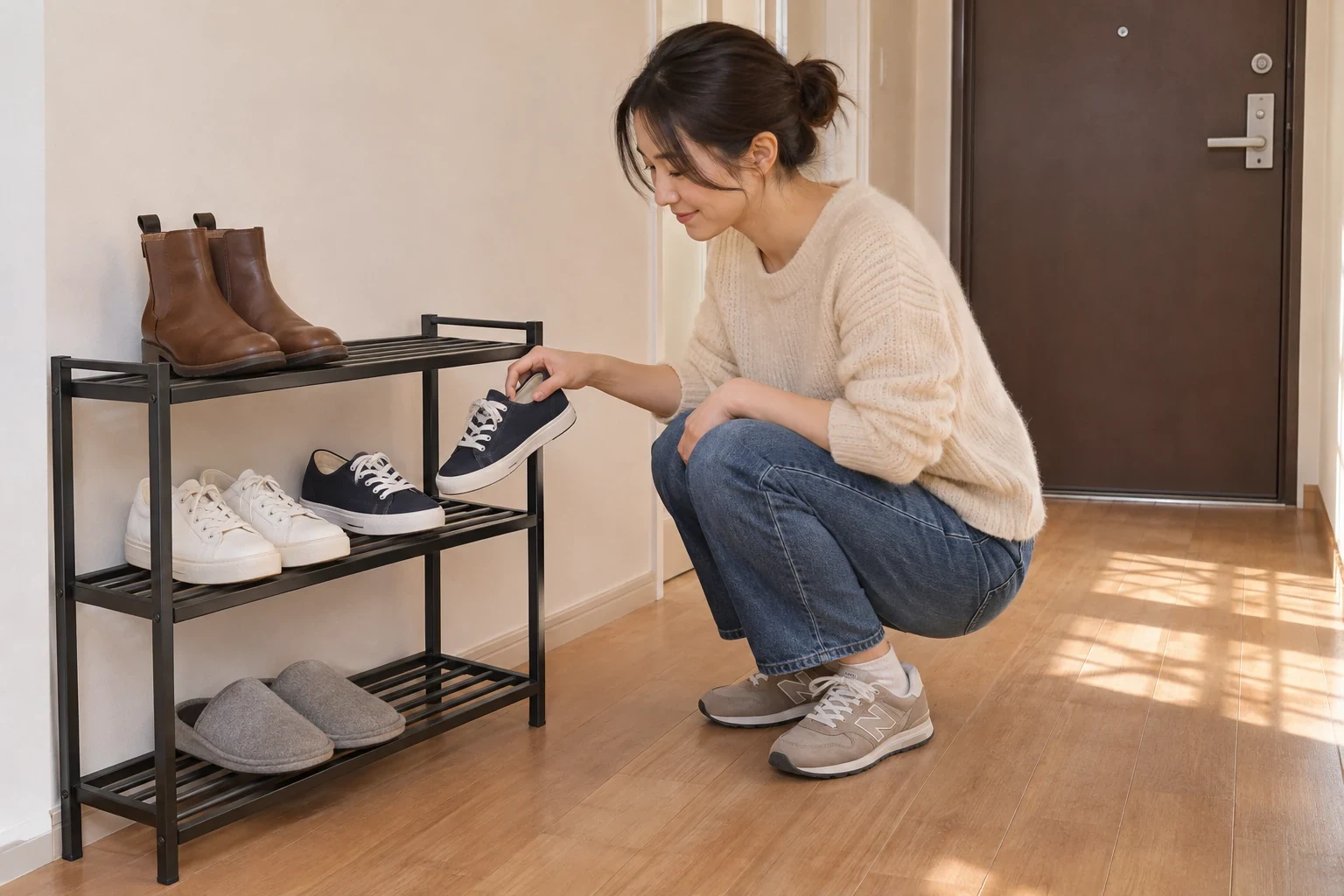
An illustrative adult household keeps two pairs of sneakers, one pair of slippers and one pair of ankle boots at the entrance. All four pairs need recognizable homes. The ankle boots may control compartment height even though there are fewer of them; the longest sneakers may control usable depth.
For a rack, place each shoe on the actual shelf surface and check its support, overhang and removal. For a cabinet, put the pair into the intended compartment and follow the permitted opening and closing movement. A shoe that enters with the compartment open may prevent it from closing normally.
Do not turn an advertised pair count into a promise for this mixed set. A capacity estimate can help shortlist furniture, but it does not show how your boots and sneakers occupy its particular dividers or shelves.
Choose a Cabinet When Concealment Also Works in Use
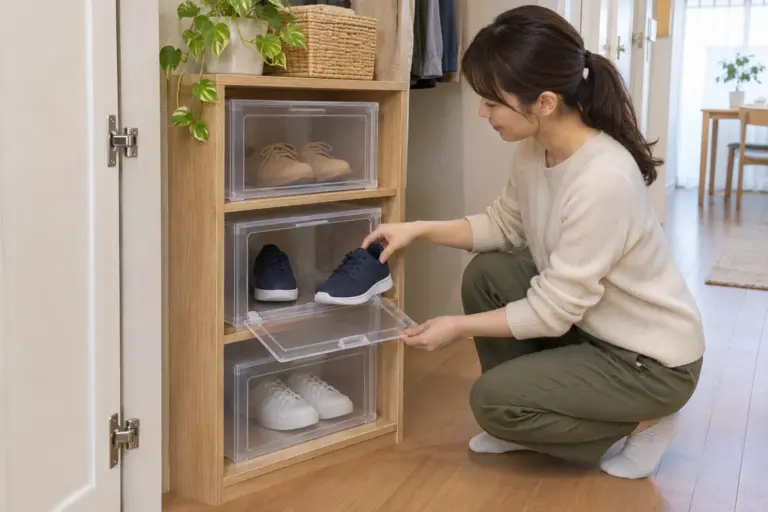
A shoe cabinet is worth considering when you want the footwear out of view and can still retrieve it easily. IKEA's hallway guidance presents concealed shoe storage as one option for a visually calmer entry. The practical question is whether the cabinet supports the daily return as well as the closed appearance.
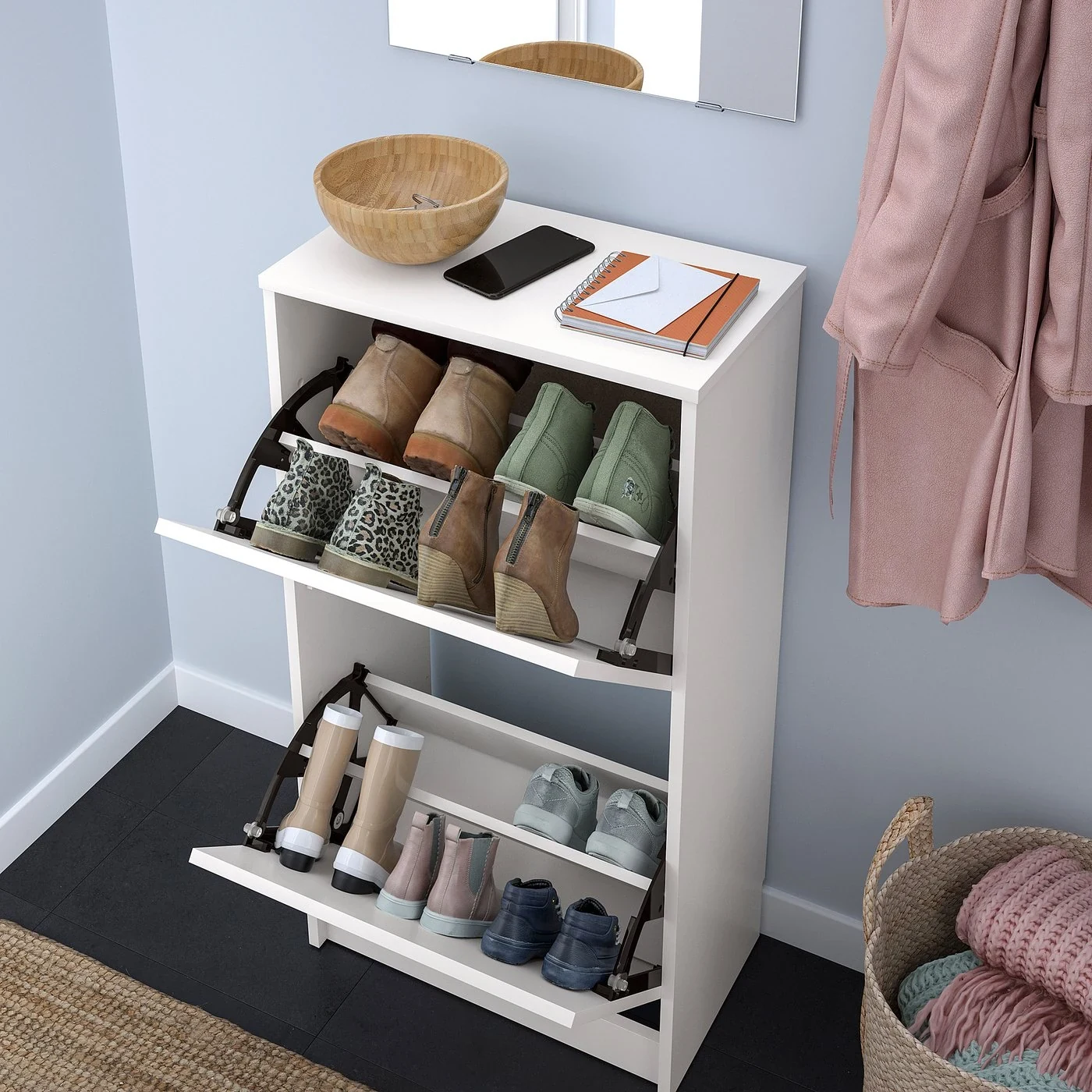
Check the full compartment movement and the space for your hands and body. Include handles, adjacent doors and any shoes temporarily in your hand. Do not approve the position from the closed depth alone or expect the person arriving behind you to squeeze around an open compartment.
Check installation before purchase. Follow the selected cabinet's fixing instructions and confirm that the proposed wall and location can accommodate them. A unit requiring wall fastening is not a freestanding alternative simply because it appears upright in a product photo.
If the actual shoe types fit only after a permitted internal divider adjustment, check the resulting arrangement with all the pairs together. Removing a divider may change the usable grouping; it does not automatically add capacity. Do not remove structural components to accommodate one boot.
The open manufacturer photograph of BISSA shows footwear supported in rows inside tilted compartments, with their fronts brought outward for access. The pictured shoes are a styling example. They do not prove that your own footwear fits, closes normally or leaves enough hand and body space.
Choose a Rack When Visible, Direct Access Helps
An open rack can make a frequently used pair easy to identify and pick up without opening a compartment. It may suit the example household if everyone reliably returns the four pairs to assigned positions and the loaded rack remains within the space available.
Check the tallest footwear under each shelf above it. An open top can accommodate a taller shape only if the surrounding location permits it; overhead hooks, hanging coats and a shelf may still limit access. Do not add a new storage position to the floor beyond the rack simply because the tiers are full.
Look at the loaded front and sides. A toe projecting beyond the front edge is part of the entry's occupied space, even if the metal frame is shallow. Long laces and footwear left diagonally can change that boundary after an ordinary return.
The rack's openness does not establish a drying process or a guarantee against odor. Use an appropriate place and care method for wet or dirty footwear, considering both the shoes and storage surface. Do not place unsuitable damp shoes inside a cabinet just to restore its closed appearance.
Compare Loaded and Open Depths in the Same Passage
The generic comparison starts with a 48-inch-wide passage. A cabinet occupies 10 inches from the wall when closed, leaving 38 inches geometrically. In a chosen open state, its outermost part reaches 18 inches from that wall, leaving 30.
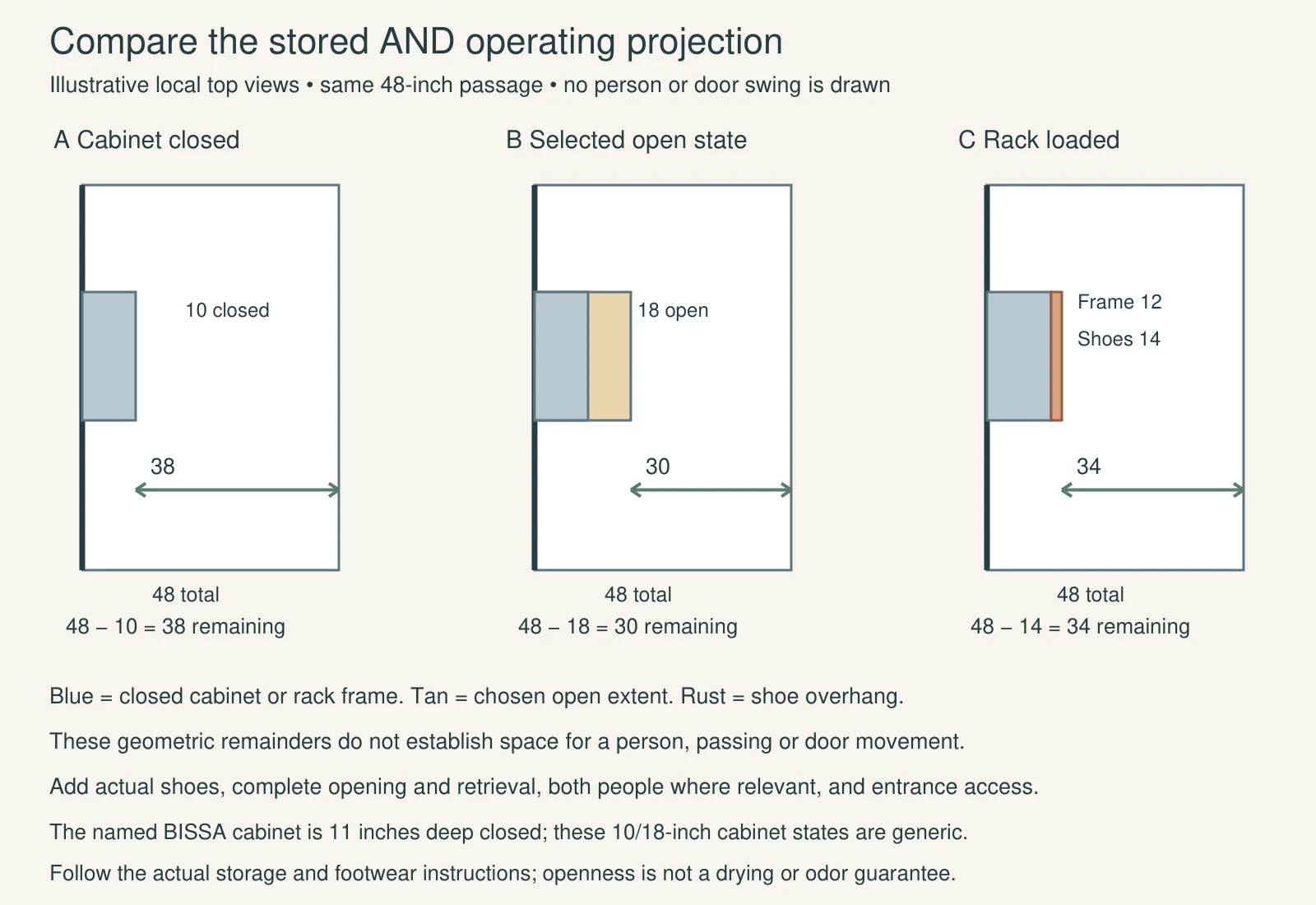
The alternative rack frame occupies 12 inches, but the selected shoes reach 14 inches from the wall. Its loaded remainder is therefore 34 inches, rather than the 36 suggested by the empty frame. These are illustrative dimensions and selected states, not minimum passage widths or measurements of the named cabinet below.
The comparison is not finished until the user is included. Try retrieving a pair, putting it on in the normal appropriate place and returning it. Check another household member's ordinary arrival, the complete entrance-door movement and any access requirements. A favorable subtraction does not prove those actions fit.
Check a Specific Cabinet Before Deciding
One size reference is IKEA's US white BISSA shoe cabinet with two compartments, article 705.302.56. The listed assembled dimensions are 19¼ inches wide, 11 deep and 36⅝ high. It is one cabinet in one package; “two compartments” does not mean two units.
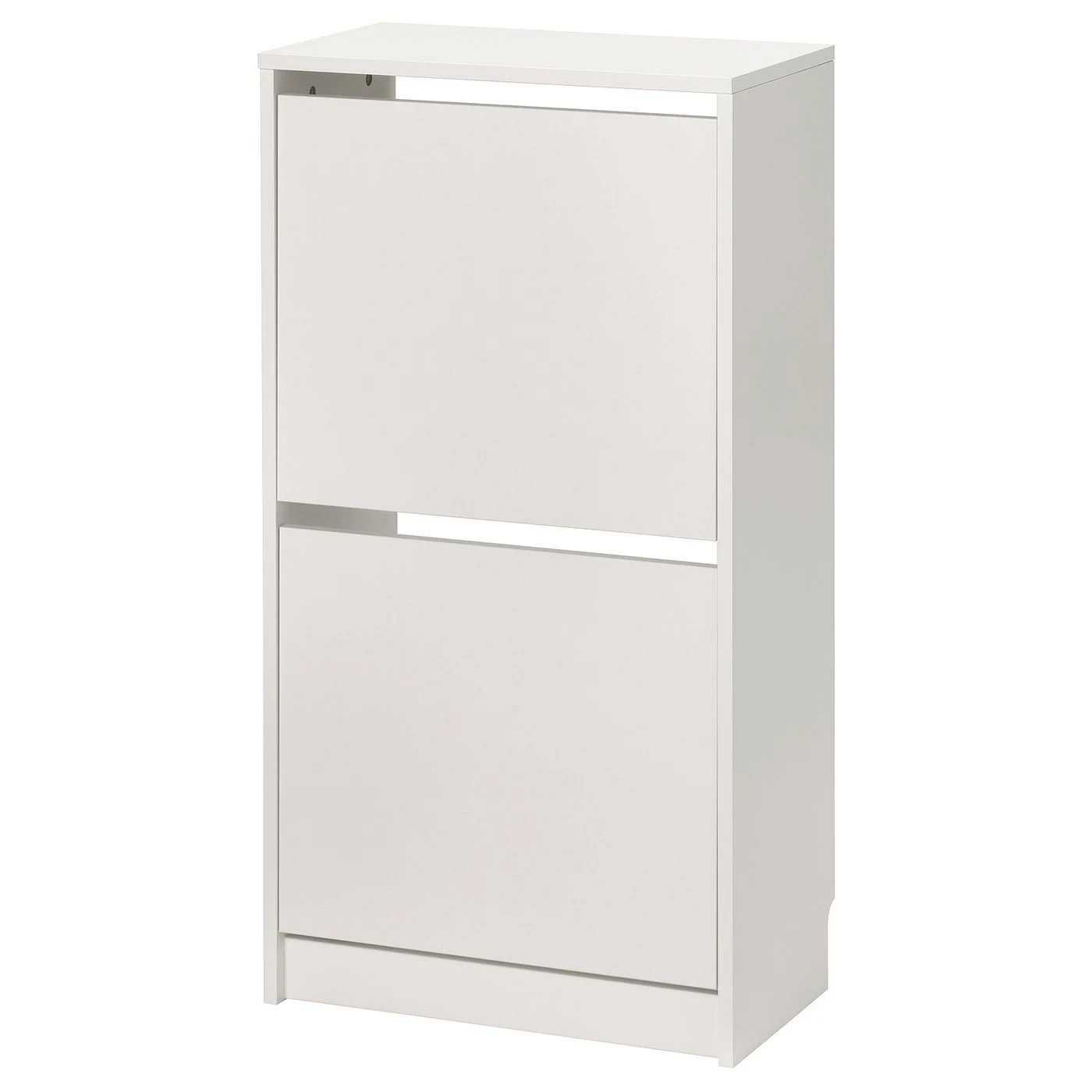
The manufacturer requires fastening this cabinet to the wall and specifies suitable fasteners for the wall material. Its product information permits moving or taking away the internal shoe dividers. Check the actual instructions, shoes and open projection before selecting the position. The 11-inch closed depth is not its full open operating space, and the generic ten-inch cabinet in the diagram is a different example.
Choose the format only after completing the same take-and-return routine with the actual pairs. Keep daily shoes accessible, leave suitable places for footwear that needs separate care, and restore the passage without shifting storage out of the way. Concealment and quick access are useful only when the household can maintain them during an ordinary departure and arrival.