Give keys a permanent home and incoming mail a temporary one. Keep those destinations physically separate, then move papers through a short review routine away from the entrance. A small drop zone stays useful when things leave it, rather than when a bigger organizer hides what has accumulated.
Begin with an existing suitable surface or landing place outside the door swing and walking route. A dish for keys and a modest mail holder can be enough. The important addition is a destination for the next step: papers needing attention should not remain mixed with tomorrow morning's keys.
Define What Is Allowed to Land
List the objects you actually bring through the door. Keys, a few envelopes, a bag, groceries and a parcel are different loads. Assign the bag and larger arrivals their own appropriate destinations rather than sizing the key-and-mail surface to hold everything at once.
Keep the key home predictable. It can be a small dish, an existing suitable hook or a defined compartment, provided the intended user can reach it during the arrival sequence. Do not let it become the place for loose coins, receipts and unknown small parts simply because they also fit.
IKEA's hallway guidance includes a place for emptying pockets. That makes a useful arrival function, but it does not make the whole entrance a filing area. The arrangement here adds a separate temporary paper position and a route onward.
Try coming in with your normal load, closing the door and setting down the keys and mail. Keep the items clear of the door handle and the space needed to pause. If the surface cannot be reached without stepping over shoes or blocking another person, change its location before adding organizers.
Give Keys and Papers Separate Physical Spaces
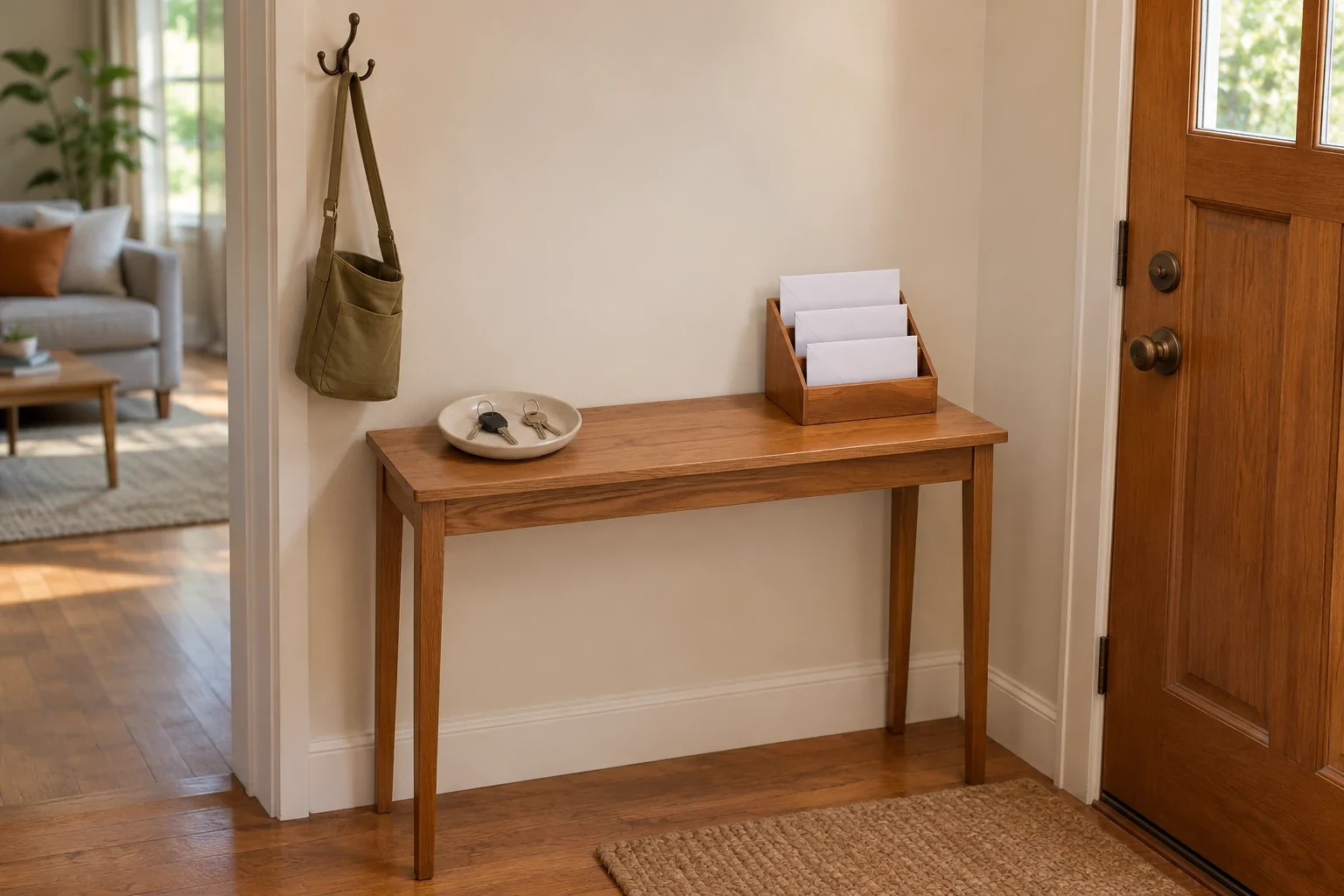
In the opening scene, the key dish sits on one side of a shallow console and the mail holder sits on the other. Some empty surface remains between them. You can see whether the keys are present without lifting a stack of envelopes.
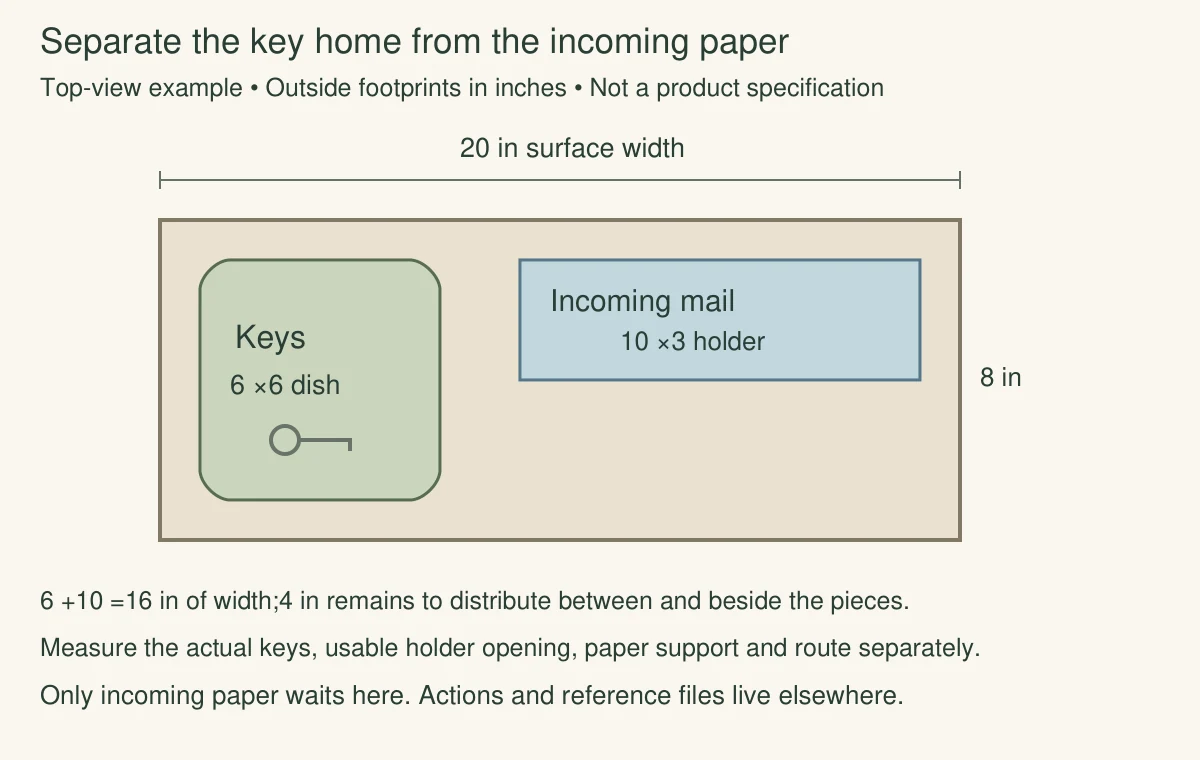
Measure the actual key rings and the papers you expect. A bulky fob can fill a dish that looks generous when empty. A mail holder needs to support the envelopes or folder without letting them fall into the key area. Check its usable opening as well as its outside footprint.
For an example, a surface 20 inches wide and 8 inches deep could hold a 6-by-6-inch key dish and a mail holder with a 10-by-3-inch outside footprint. Their widths total 16 inches, leaving 4 inches to distribute between and beside them. Both depths fit inside the example's 8-inch surface depth.
That calculation only checks the rectangles. It does not establish that the holder's interior fits your longest envelope, that a tall folder is stable or that the console works in your doorway. Measure those relationships separately. Keep papers and key rings from projecting into the route when they are in use.
Make the Mail Position an Inbox, Not an Archive
Use the arrival holder for incoming papers waiting to be reviewed or passed to the intended recipient. It should not also hold manuals, old statements, school keepsakes and envelopes you have already dealt with. Those categories need their own homes elsewhere.
Agree what happens in a shared household. A paper for someone else goes to that person's agreed private inbox or handover point. Do not open another person's mail as part of a general tidy-up routine. The entrance does not need to display private correspondence to prove the system is organized.
Use a visible limit that matches the actual holder, such as keeping the small incoming group supported without compressing or overflowing it. The limit is a prompt to process the papers, not permission to throw away something important when the slot fills.
Illinois Extension's decluttering guidance emphasizes giving each retained item a clear home and returning things to their correct places. The mail routine below applies that principle; it does not require reproducing the source's whole sorting setup at the door.
Review Papers at a Separate Working Surface
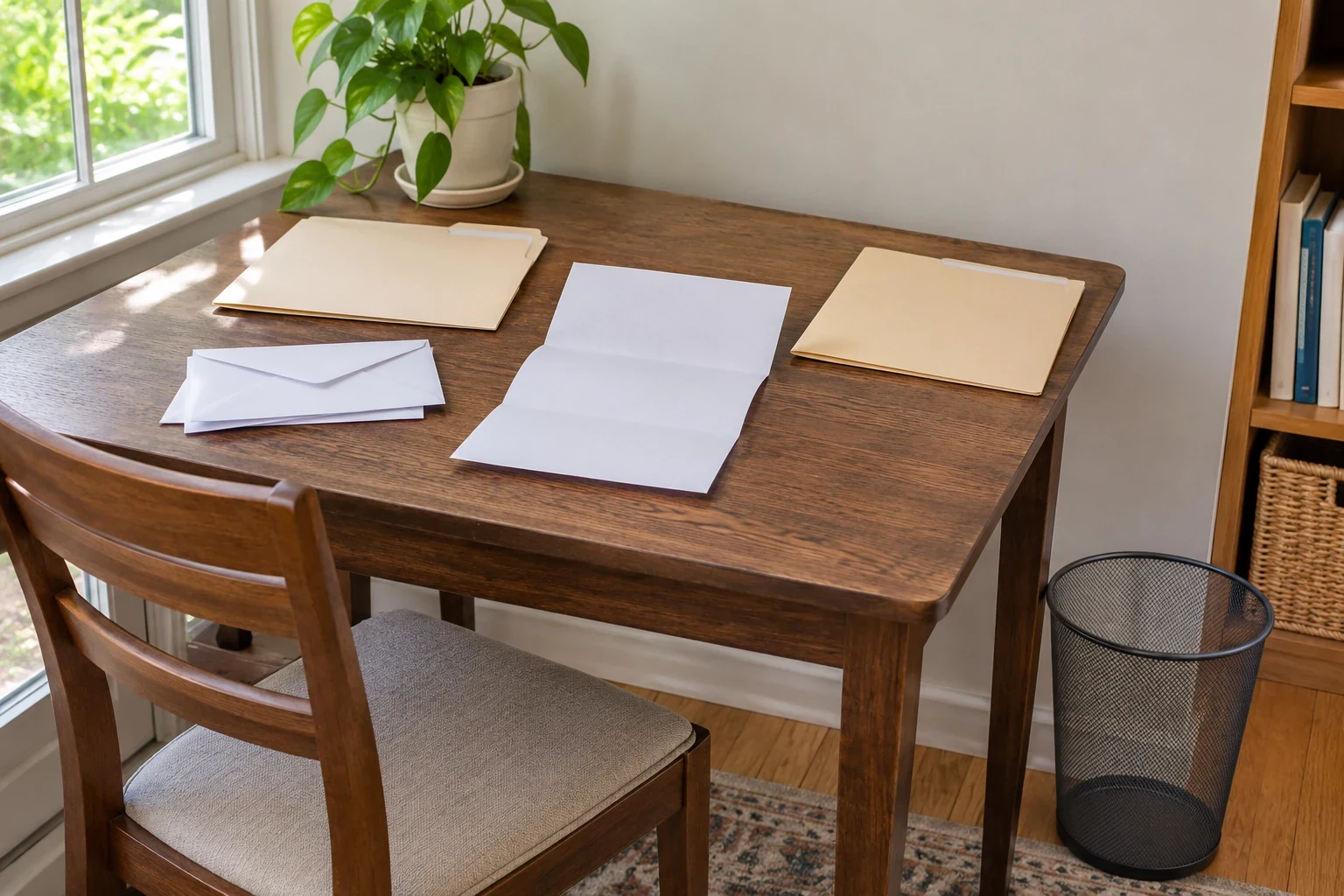
Choose a normal place where you can open and read your own mail, reach the relevant files and complete the next step. An existing desk or suitable table can do that job. The processing scene shows a few papers and separate folders away from the key dish.
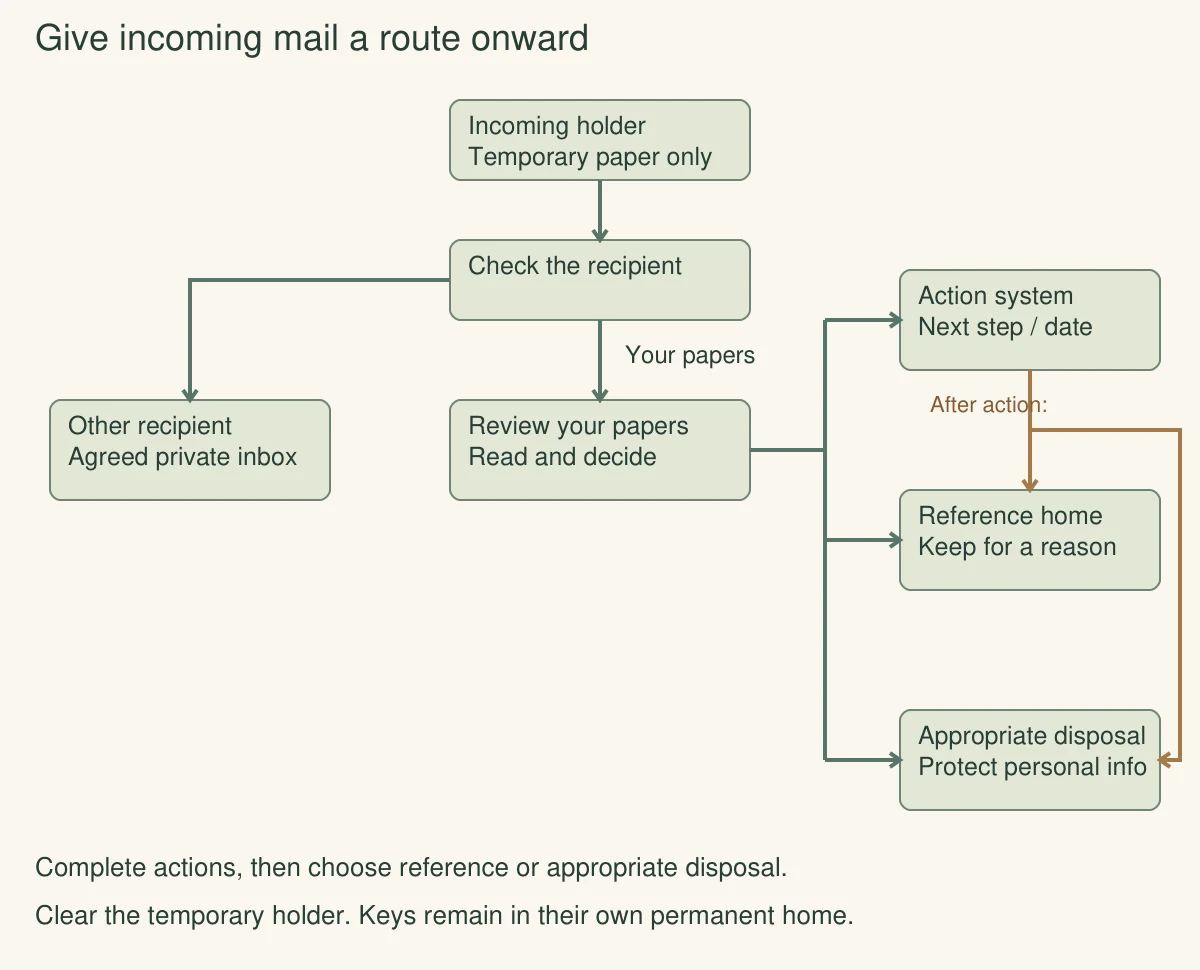
At the chosen review time, take the small incoming group to that surface. Identify the recipient first. For papers you are responsible for, read enough to decide whether there is an action, a reason to retain it or an appropriate disposal route. Do not classify an unopened envelope merely from its appearance.
Keep the next destinations distinct. Something needing a reply, appointment or other task goes into your ordinary action system. Record the actual next step and any relevant date there; simply transferring it to a folder called “important” can leave the decision undone.
Reference material goes to its established file only when you know why you are keeping it. Unwanted ordinary paper goes through the appropriate local disposal or recycling route. For discarded papers containing personal information, use suitable document destruction rather than leaving them exposed in a public-facing bin. Illinois Extension specifically calls attention to personal-information documents when discarding.
This is a routing method, not a document-retention schedule. If you are unsure whether something must be kept, put that decision into the review process and check the requirement before discarding it. Uncertainty should be visible to its owner rather than hidden at the bottom of the entrance pile.
Complete the Action and Give the Paper Its Final Home
An action folder is another temporary stop. Review it through the system you normally use, complete the task and then decide whether the paper belongs in a reference file or can be disposed of appropriately. Keeping a completed task in the action group makes the remaining work harder to see.
For example, an invitation may need a calendar decision before you choose what to do with the paper. A household notice may need someone to read it, then go into a relevant home file if there is a reason to keep it. These examples illustrate different next steps; they are not rules about legal or financial records.
Keep papers that must leave the house in an agreed outgoing position outside the incoming slot. Otherwise the same envelope can repeatedly look like new work. If the entrance is too small for another supported compartment, put outgoing items at the existing departure point instead of balancing them on the key dish.
Return the emptied incoming holder to service. That visible reset is the link between the paperwork routine and the small entrance: the next arrival has somewhere to go without covering the keys.
Use Overflow to Find the Missing Decision
Choose a review trigger you can repeat, such as when the day's mail is brought inside or during an existing evening reset. Match it to the amount arriving and the people responsible. A fixed weekly label is not useful if the holder fills long before that session.
When papers spill out, inspect the cause. Are they waiting for the correct person? Does an action lack an owner or next step? Are finished papers waiting to be filed? Does the home lack a reference location? Each problem needs a destination or follow-through rather than a deeper container.
Handle unrelated objects the same way. Put a receipt into its intended process and return a misplaced small object to its home. Avoid adding a miscellaneous bowl beside the key dish unless it has a defined purpose and an emptying routine of its own.
Test Arrival and Departure for a Normal Week
Use the arrangement during ordinary arrivals. Check whether keys remain visible, the door and route stay usable and the holder empties at the chosen trigger. Include the household members who actually bring in mail, rather than assuming one person sees every delivery.
Try leaving with your usual bag and anything outgoing. You should not need to sort the post to find the keys. If the routine repeatedly fails, simplify the handover or move the processing step to a place you already use.
Keep the drop zone small by limiting its job: permanent key storage, temporary incoming mail and a reliable route onward. The result comes from those clear destinations and completed decisions, whether the physical pieces are new or things you already own.