A hallway corner is useful storage space only if it remains easy to turn past. A cabinet may leave your feet clear while its top catches a coat sleeve. A wall shelf can free the floor and still meet the bag on your shoulder. Check the occupied turn at the heights that matter before choosing anything for the corner.
Start with the bend clear, observe your normal route in both directions, and then compare the proposed storage with that movement. If keeping the turn comfortable means placing storage farther along a straight wall—or leaving the corner empty—that is a useful decision about the space.
Watch the Turn Before Assigning the Corner a Job
Walk the existing clear route at an ordinary pace. Notice where you begin turning, how close your shoulder comes to the wall and whether you can see someone approaching from the other direction. Include the people who use the hall rather than planning around one person's unladen walk.
Repeat with a normal coat and the bag, laundry basket or other object you routinely carry. Carry it as you normally would; changing hands or holding it unusually tightly just to pass a proposed shelf can conceal a poor arrangement. If the route is already tight or obstructed, clear and reassess it before adding storage.
IKEA's small-space planning guidance starts with measuring the layout and noting doors and other fixed features before purchasing furniture. At a hallway bend, extend that exercise to the path through the corner. The empty patch against the walls is only part of what you are allocating.
Decide what actually needs to be there. A few everyday objects may be easier to retrieve farther along the hall. Storage for occasional items is less convincing if it interrupts every trip between rooms.
Compare a Turn with a Straight Passage
A straight passage check holds your direction relatively constant. A turn changes the relationship between your body, carried objects and both walls. The point closest to a storage piece may occur partway around the bend, even though the approach and departure look clear.
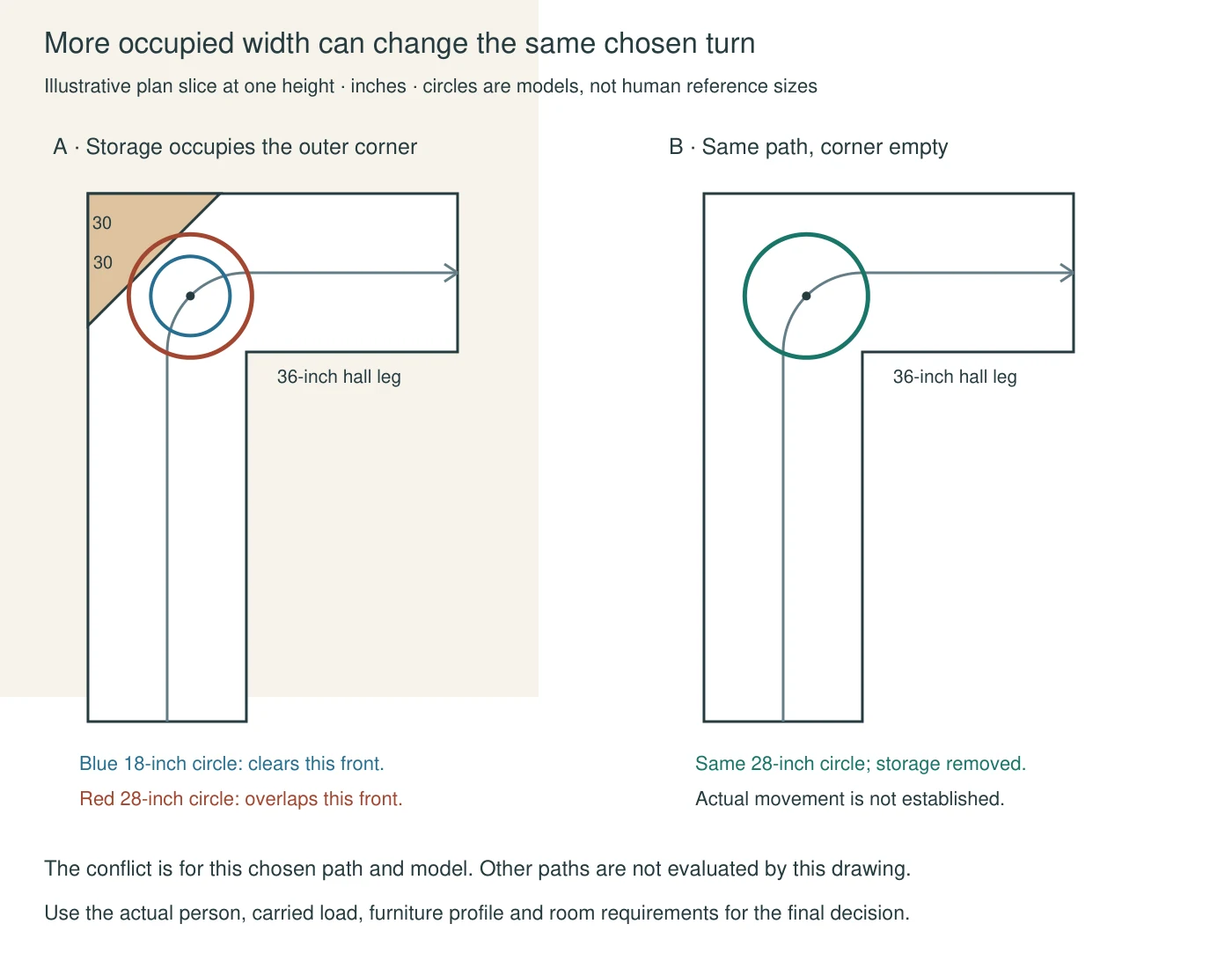
The illustrative plan uses an L-shaped hall with two 36-inch-wide legs. An imaginary triangular storage outline occupies the outer corner, extending 30 inches along each wall. A chosen curved center path passes through the bend. These are example dimensions, not a recommended hall width or furniture size.
Two imaginary circles, 18 and 28 inches across, represent smaller and larger occupied outlines at one height. They are simplified models, not silhouettes or reference sizes for people. At the illustrated midpoint, the smaller circle clears the storage front while the larger one overlaps it. Walking the same center path with more width around you changes the result.
The drawing establishes that this chosen larger outline and path conflict. It does not prove that all possible paths through the furnished corner fail, or that a different line would be comfortable in use. The empty-corner comparison retains the same larger circle and path to show the obstruction removed. Neither plan certifies a real person's movement or any passage requirement.
Measure the Whole Occupied Profile
Check the proposed storage from the floor upward. Include feet, plinth, handles, upper shelves and the objects that will sit or hang on it. A small base is not the maximum projection of a loaded unit.
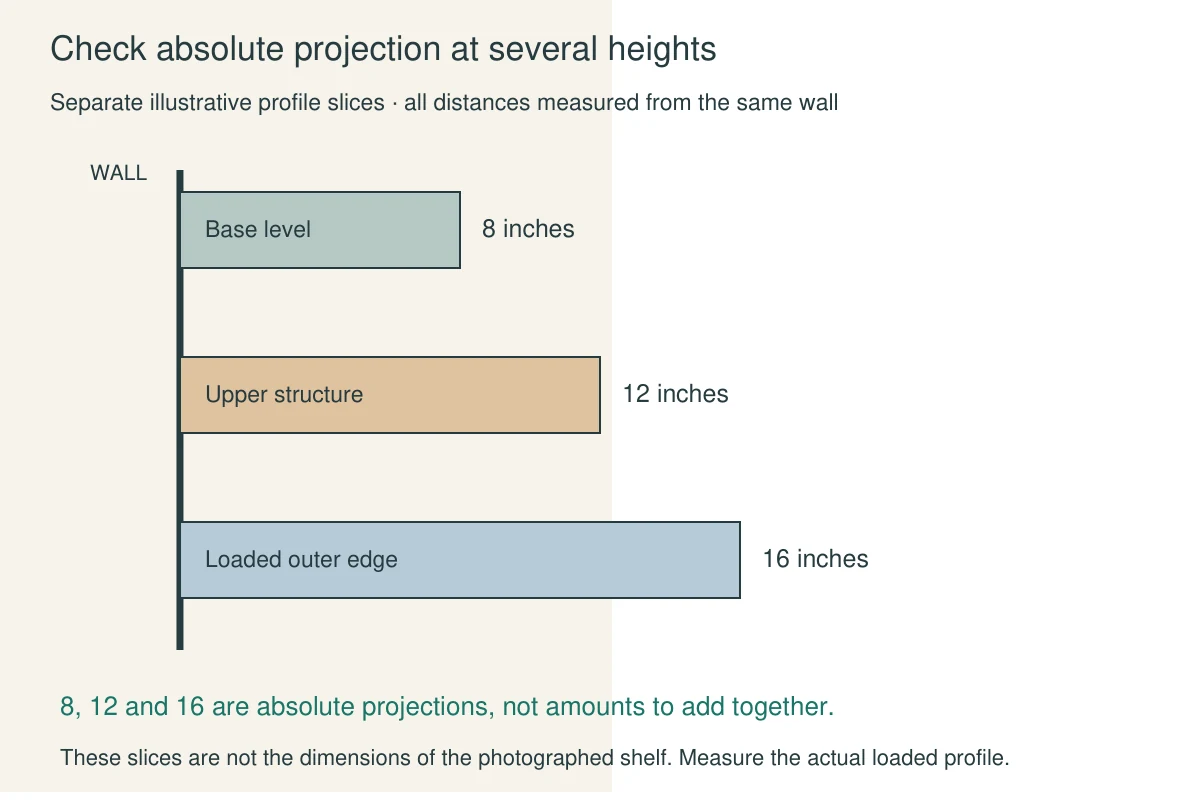
In the separate illustrative cross-section, a base projects 8 inches from the wall, an upper part projects 12, and the outer edge of a loaded hanging object reaches 16. Those are three absolute distances from the same wall. Do not add them together. The relevant outline changes with height and with what is stored.
Measure the real objects rather than assuming they stay within a shelf's edge. A plant, strap or sleeve can project past it. Arrange belongings so that ordinary removal does not pull neighboring items into the route. Keep the storage load and use within the actual product's instructions.
The top-view circle example and the side profile explain different checks. They do not describe the dimensions of the photographed shelf. Use your own furniture, loaded objects and normal body position to establish the relevant outline in the room.
Check Wall Storage at Shoulder and Bag Height
Wall-mounted storage can remove a floor obstruction, but it does not remove the stored objects from the hall. IKEA's hallway ideas include wall storage and shallow fittings as options for smaller entries. Their suitability still depends on what projects into the actual movement space.
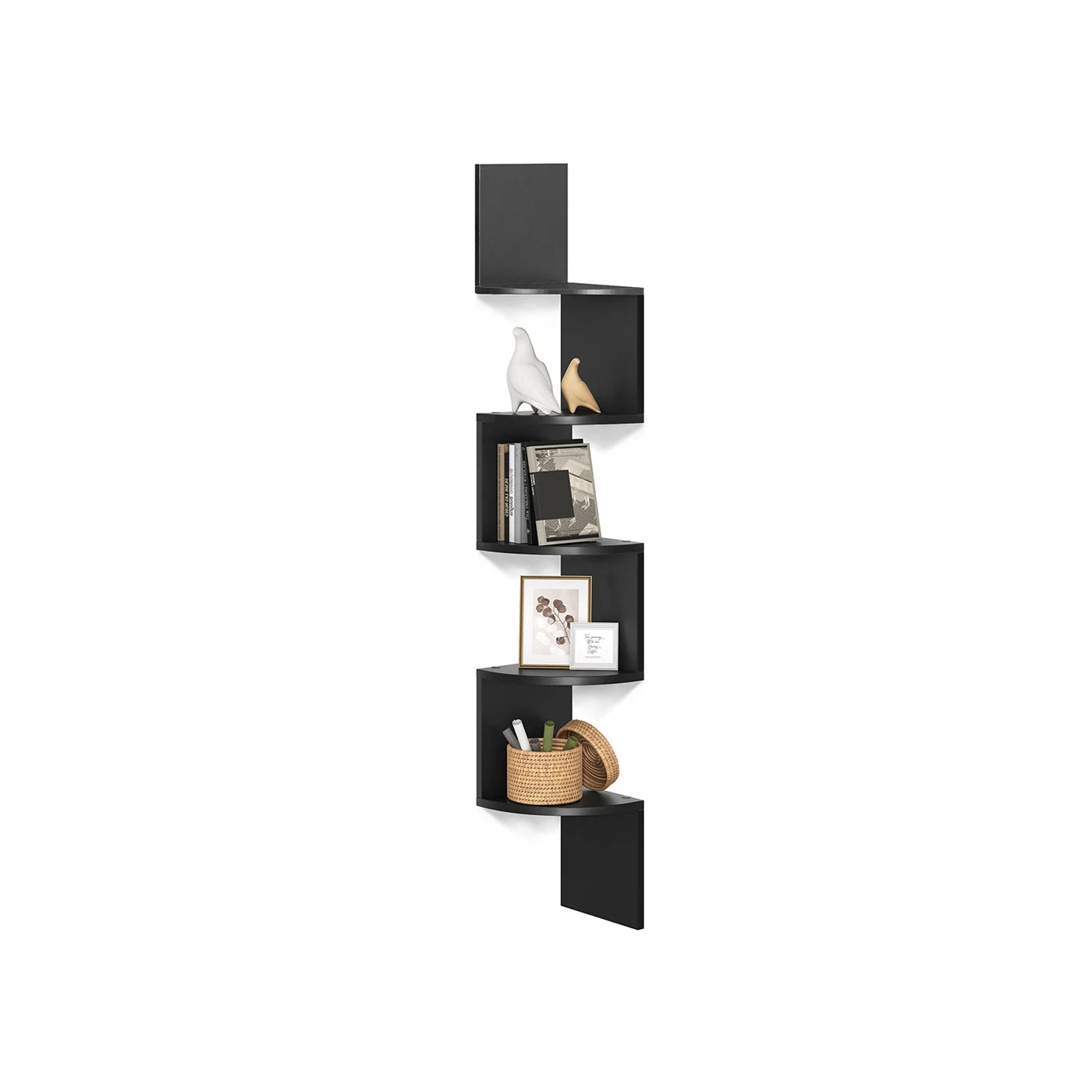
The real manufacturer image of the ink-black VASAGLE ULBC072B01 shows a five-tier corner shelf with alternating curved shelves. It illustrates why looking only for legs on the floor misses part of the occupied space. A rounded shelf front does not by itself establish that a shoulder, bag or carried basket will pass it.
Before choosing a wall unit, obtain the current dimensions and installation instructions for the exact model. Check the wall, permitted fixings, intended load and position. Do not select a mounting height from the product photograph or attach an unverified fixture temporarily at head or shoulder height to test the route.
Consider the household's actual users. Something outside one adult's shoulder line may lie in another person's view or movement path. If a mobility aid or wheeled item uses the hall, assess that actual combination rather than replacing its shape with the circles in the example.
Compare Storage at the Bend with a Setback Position
Mark a candidate footprint on a plan first. Include the loaded projections you measured. A flat, removable floor outline suitable for the floor can help identify position, but it cannot demonstrate the shape at shoulder height. Do not create raised mockups in the route or deliberately brush past a proposed obstruction.
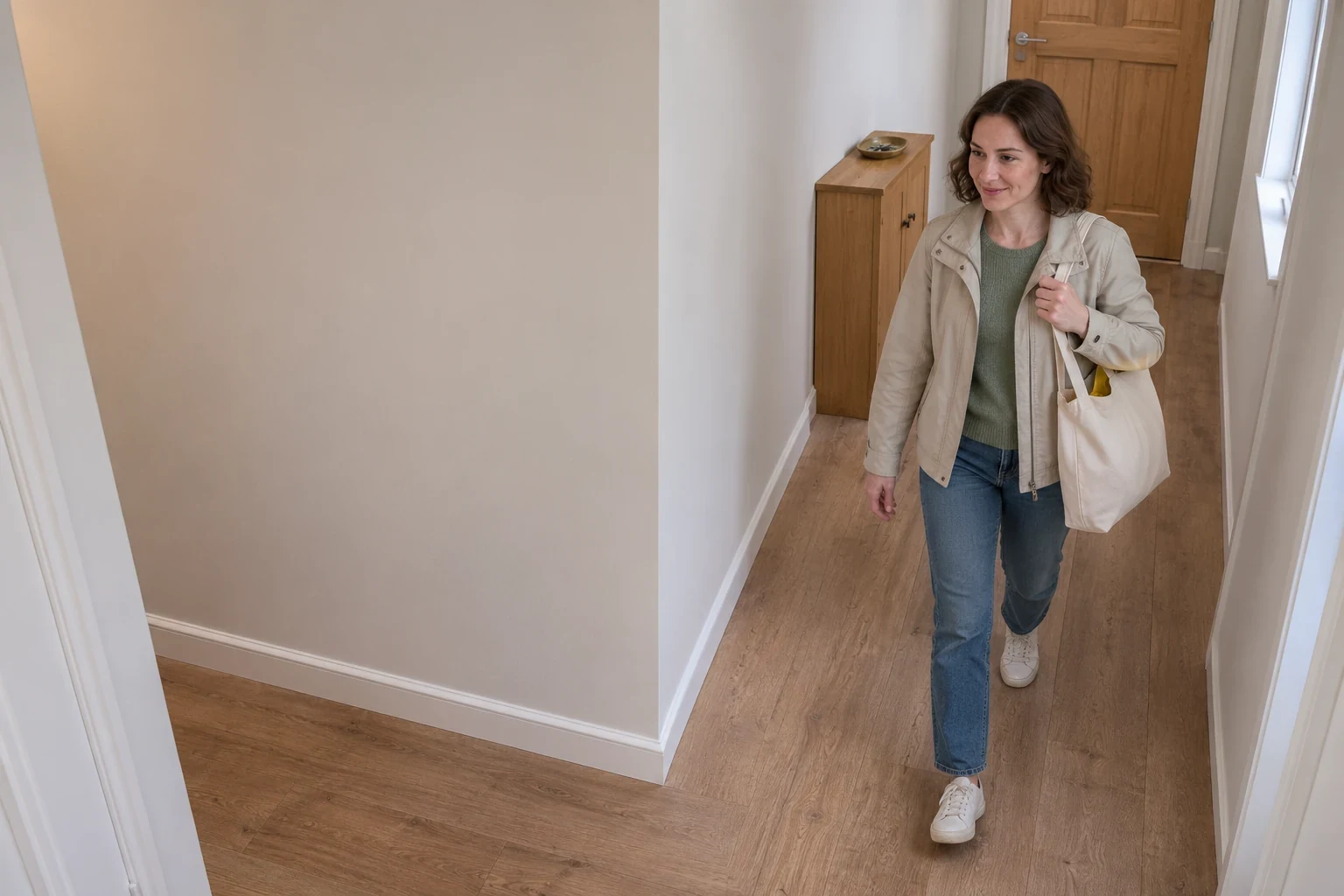
Compare the bend with a suitable position farther along the straight wall. There, you may be able to approach the storage and pause without occupying the turn. The room illustration shows this kind of candidate arrangement: an empty bend with a shallow cabinet set back along a wall. It is not a measured clearance test.
The setback position has its own checks. Open the cabinet and retrieve its intended contents. Include the standing person and any basket pulled out. Check adjacent doors, switches and the approach from both directions. Moving an obstruction away from the corner is helpful only if the new location works too.
If no location preserves the needed movement, reduce the storage job. Keep fewer current items here, return occasional belongings to another room, or leave the bend empty. A corner does not need an object simply because furniture is sold in a corner shape.
Complete the Ordinary Journey in Both Directions
After selecting a workable arrangement, repeat the normal trip with everyday belongings in their homes. Enter the hall, turn, reach the next doorway and return. Stop and reconsider if you need to twist unnaturally, lift a load over the furniture or change your normal carrying position just to avoid it.
Check the storage task separately: approach, put an item away, remove it and close or reset the storage. Another person should not have to negotiate a newly opened obstacle without warning. Keep any required route and door operation available under the requirements that apply to the home.
Finally, recheck after changing the stored load. A fuller tote or a new object on the top shelf can change a previously useful arrangement. Keep the turn clear enough for the routine you actually perform, and let that routine decide how much corner storage belongs there.