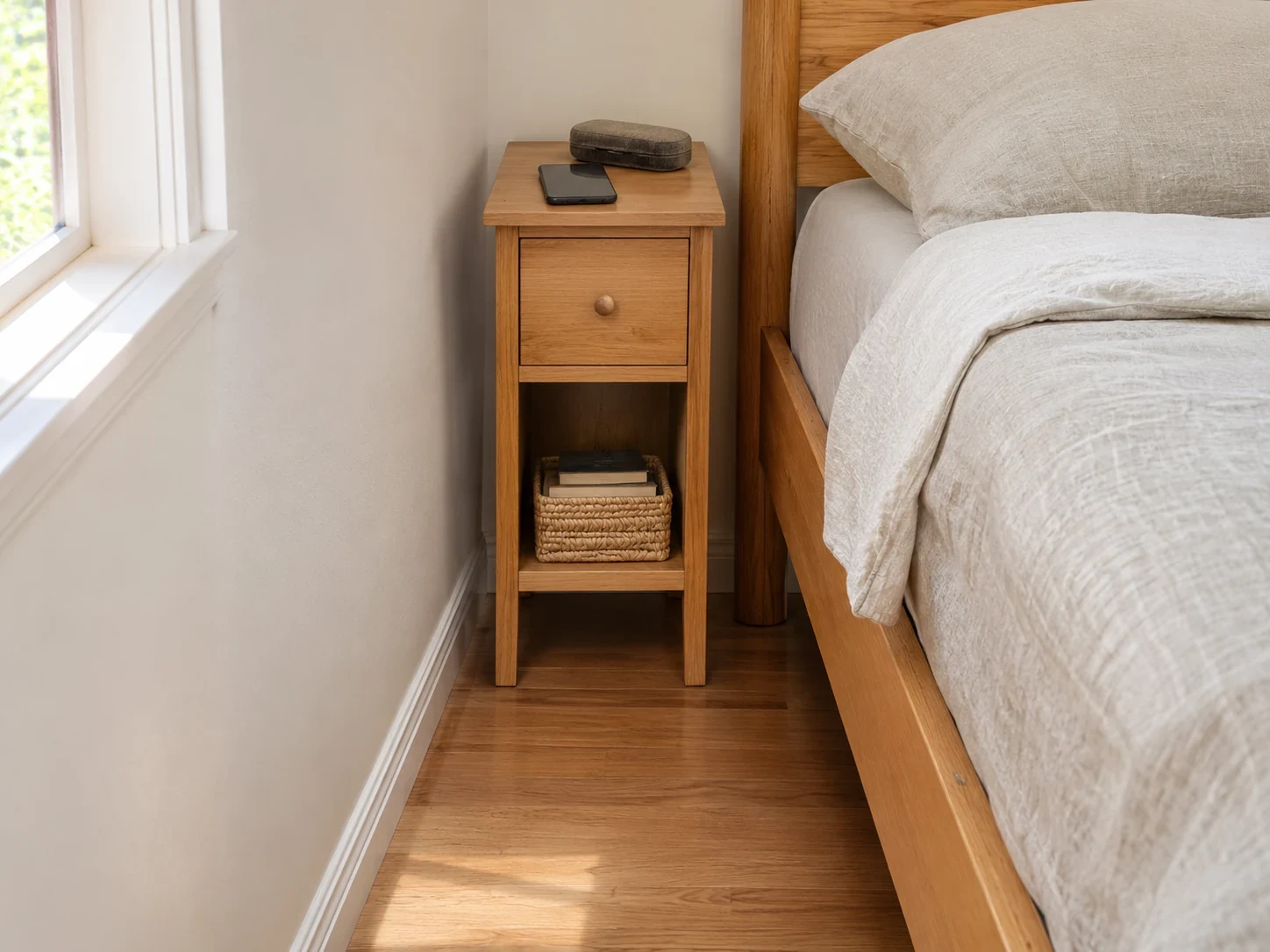
Choose a narrow bedside table from the clear space beside the whole bed frame, the objects it must hold and the room needed to use its storage. A small outside width is only the first check. The top must be reachable, a drawer must open and the furniture must leave the household's normal way into and out of bed usable.
Start with the bed made as you normally use it. Include the duvet, pillows and the position where you get up. A cabinet that fits beside a bare mattress can become awkward once the frame, bedding and ordinary night-time routine are present.
Measure the Usable Gap and Compare the Height
Measure from the bed frame's widest outside point to the nearest obstruction. Check more than one height: skirting, a projecting leg, an outlet plug or a headboard can change the available space. Record the narrowest relevant width rather than borrowing the mattress dimension.
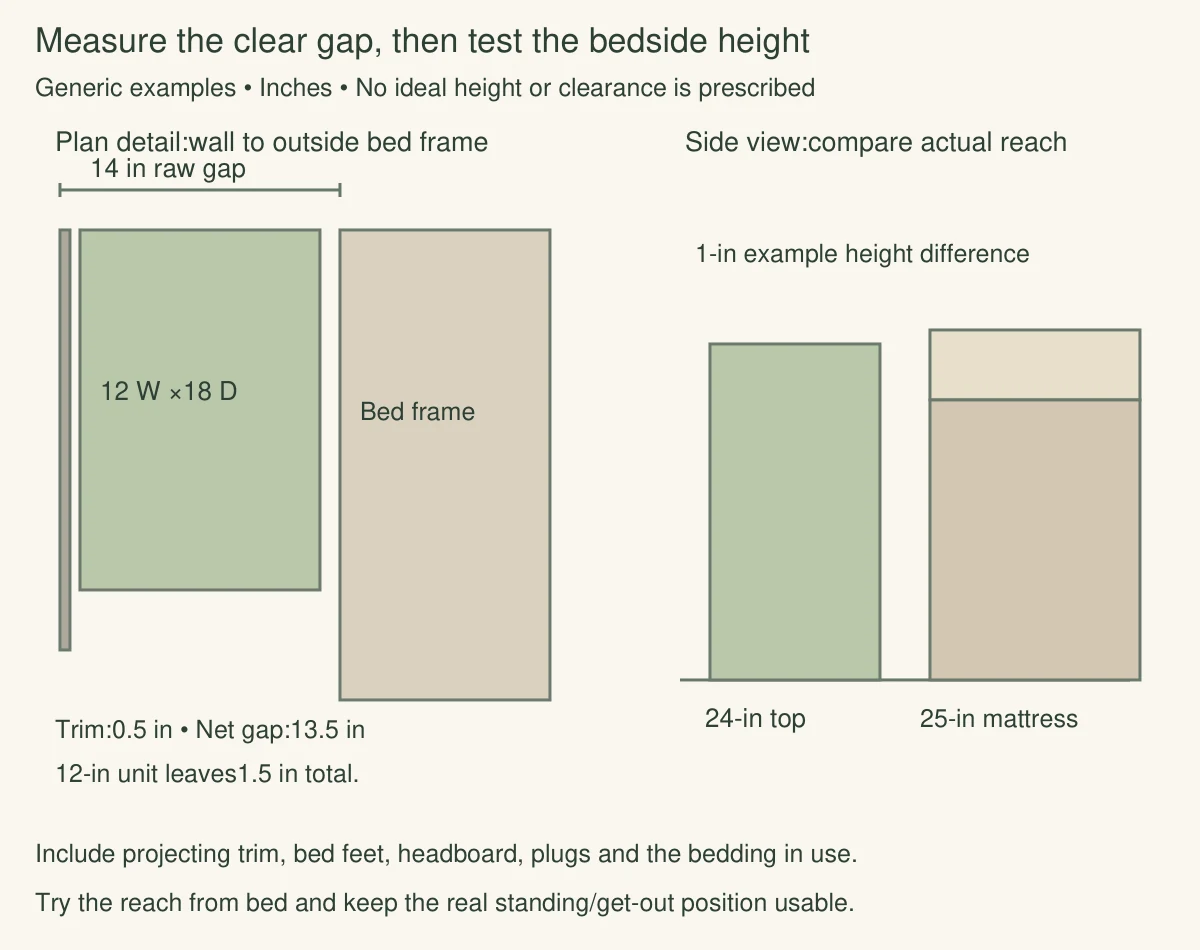
For an example, a 14-inch gap from the wall plane to the frame becomes 13.5 inches where trim projects half an inch. A 12-inch-wide example cabinet leaves 1.5 inches in total to distribute beside it. That remainder is a geometric result, not a recommended installation or cleaning allowance.
Measure the usable depth too. A narrow cabinet may run a long way toward the foot of the bed. Mark where its front would end relative to your normal foot position when standing up, and include handles or feet extending beyond the main body.
Compare its top with the mattress surface, then try the actual reach. The illustration pairs a 24-inch cabinet with a 25-inch mattress top to show the relationship. Those numbers do not establish an ideal bedside height: check from your normal lying and seated positions with the objects you use.
Do not treat bedside furniture as a support for getting up unless it is specifically intended for that purpose. A stable landing surface and a suitable handhold are different jobs.
Decide What Belongs on Top and What Belongs Inside
Set out the necessary objects: perhaps a phone, glasses case and one book. Measure them in the way they will be used, including a charging connection or an open book if either needs to stay on the surface. Remove occasional items from the immediate bedside requirement.
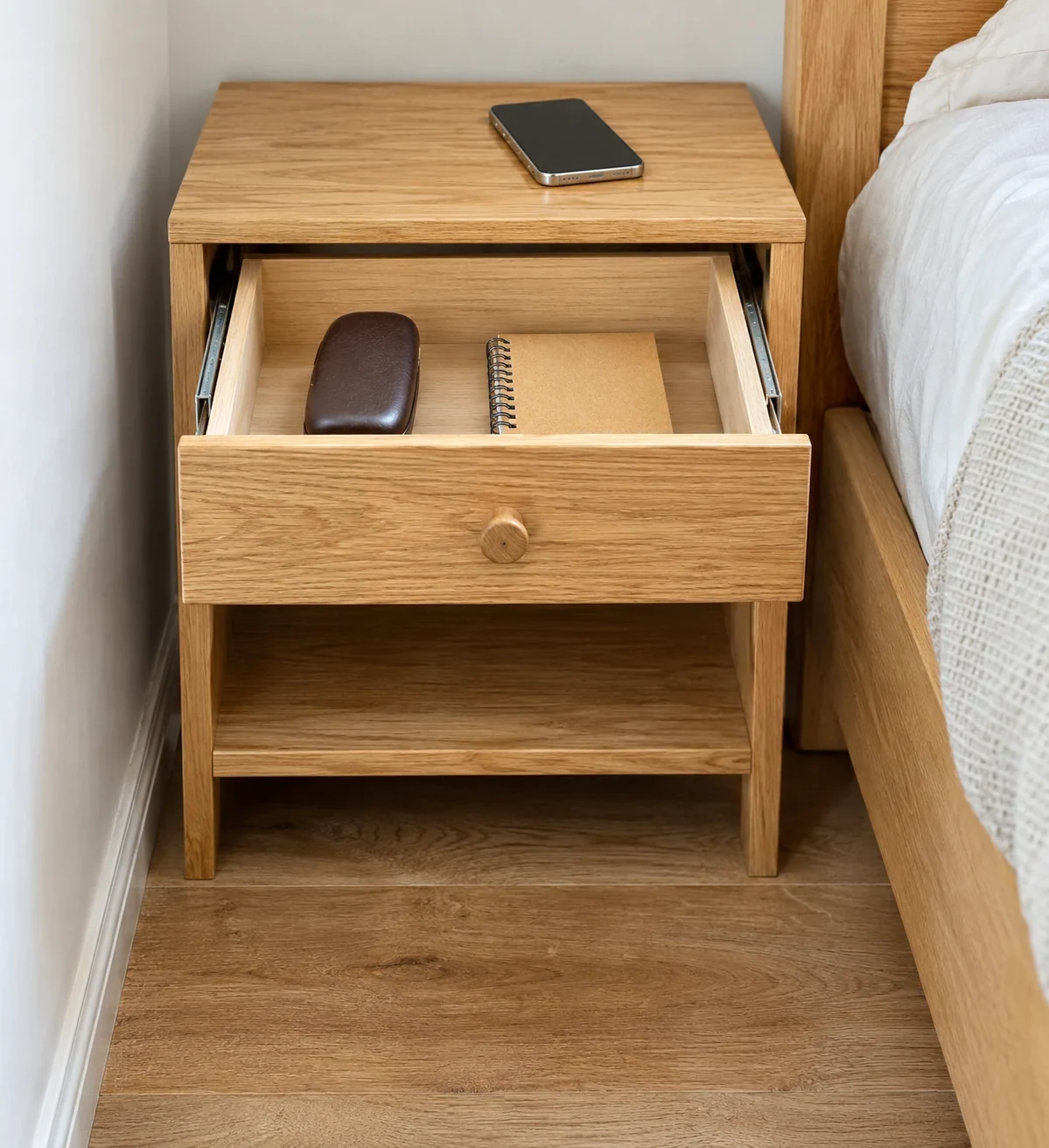
Keep the top useful for placing and retrieving those objects. A lamp base can consume much of a very narrow surface, so include it in the trial rather than adding it after the furniture is chosen. If lighting has another suitable support, that may leave the cabinet doing the storage job more effectively.
IKEA's small-bedroom example divides bedside functions between the table and other storage. Use that principle to decide what your narrow cabinet really needs to do, rather than asking a miniature top to carry every bedroom object.
Choose enclosed storage when it has a clear purpose, such as keeping small personal items together out of view. An open shelf may be simpler for a book you retrieve frequently. Neither adds useful capacity if the object cannot pass through the opening or be reached from the intended position.
Check the Front in Its Working State
A drawer needs its actual extension space in front. A hinged door needs its sweep and the opening angle required for retrieval. An open compartment removes a moving front, but still needs room for the item and the person taking it out.
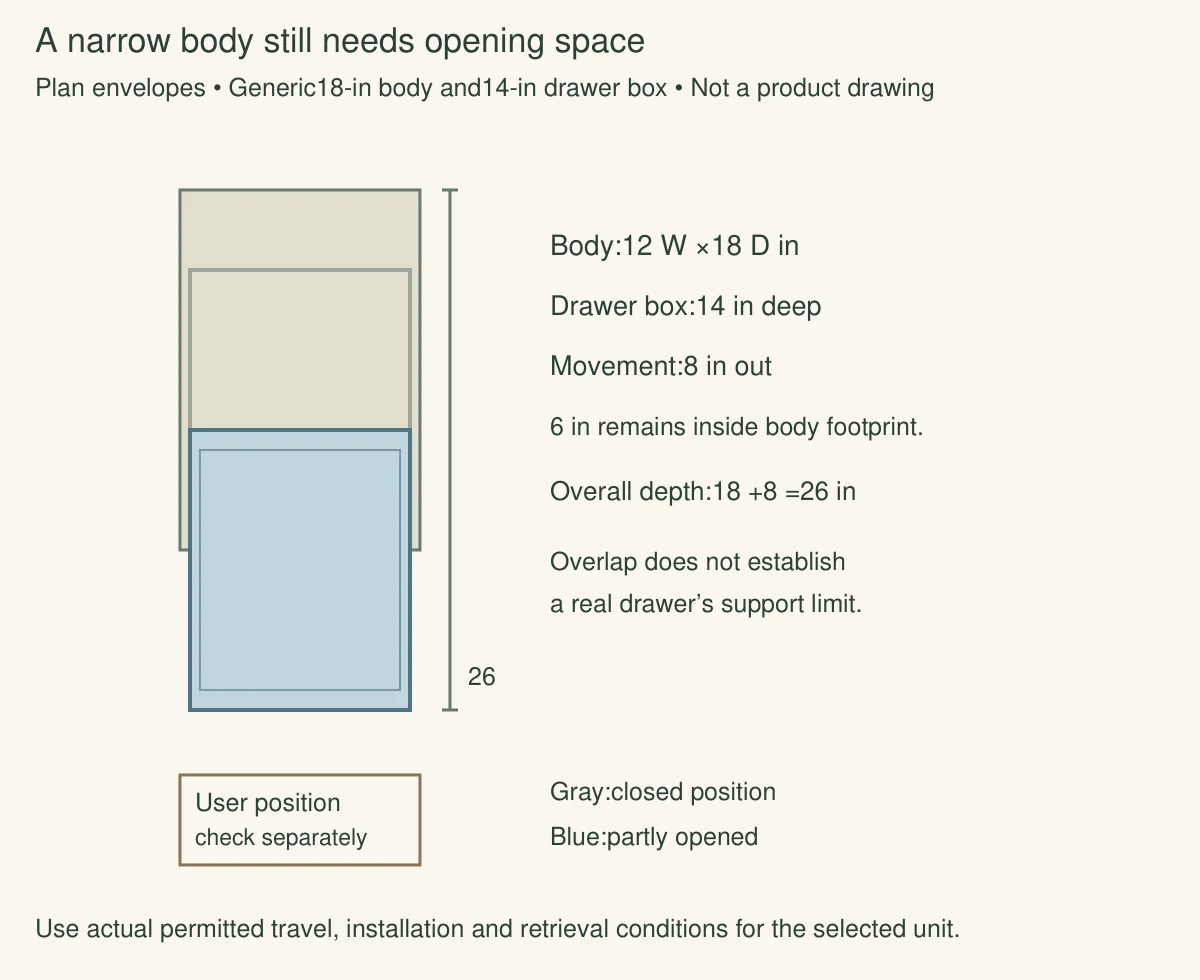
In the generic drawer scene, the drawer moves toward the foot of the bed into clear floor, rather than sideways into the mattress. Its back remains supported in the cabinet. Look for that complete relationship when inspecting a real unit, then follow its actual instructions and permitted travel.
The plan example uses an 18-inch-deep cabinet body and a drawer box 14 inches deep. When closed, the drawer box occupies the front 14 inches of that body. Moving it out by 8 inches leaves 6 inches within the body footprint and extends the total occupied depth to 26 inches from the cabinet back.
That calculation explains the extra floor area; it does not prove an acceptable support length for a real drawer. Obtain the selected unit's actual movement and instructions. Check the user position separately: an open drawer may clear the bed while occupying the exact place where you need to stand.
If a drawer faces the bed because you rotated the cabinet to fit the gap, check that it can still operate. Turning an attractive long table through a right angle does not automatically turn its storage front into a usable bedside drawer.
Size the Contents from the Usable Interior
Ask for the actual inner width, depth and height of each compartment, plus the opening through which objects pass. Outside cabinet measurements include walls, runners, fronts and other structure. They do not establish the drawer's usable capacity.
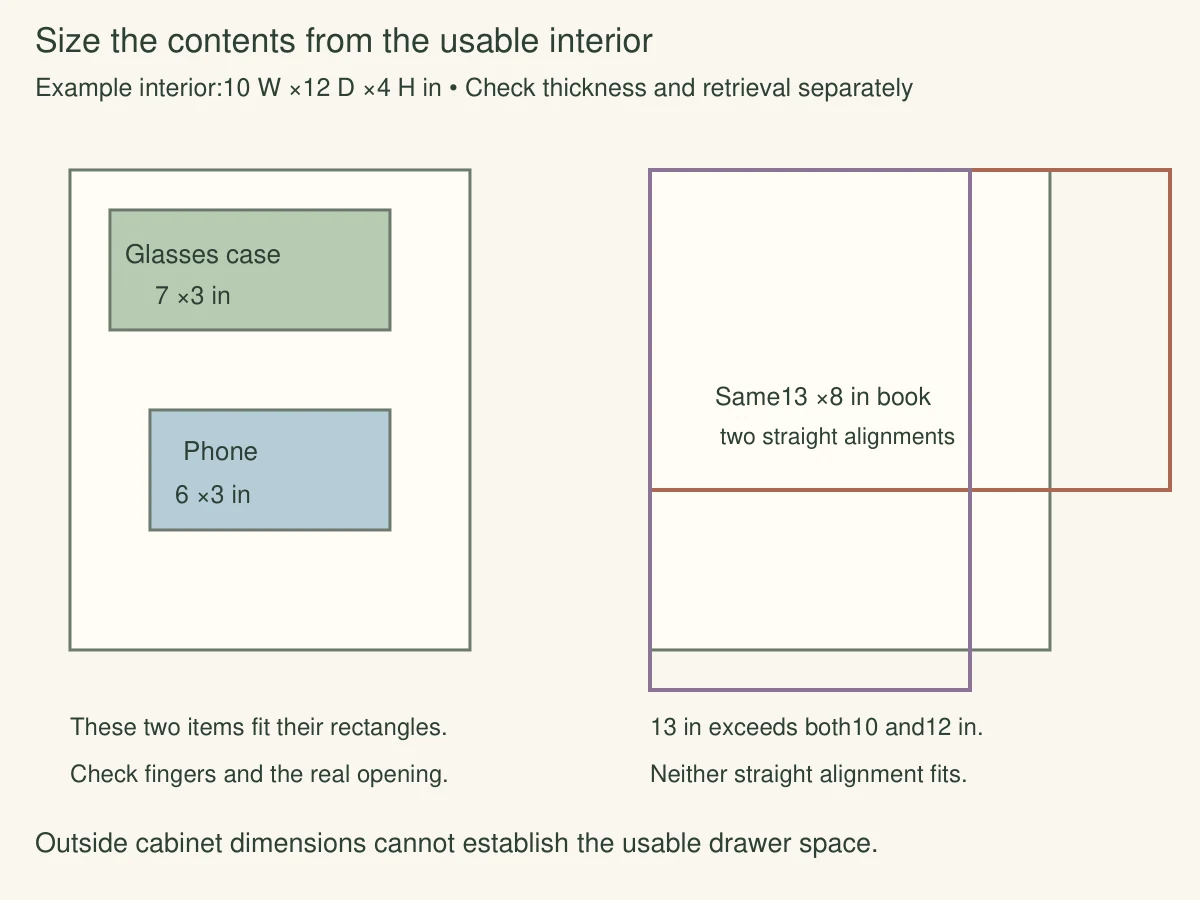
For a second example, suppose a drawer has a clear interior 10 inches wide, 12 inches deep and 4 inches high. A 7-by-3-inch glasses case and a 6-by-3-inch phone can occupy separate measured positions inside that opening. Check their thickness and how your fingers retrieve them, not just whether their rectangles fit.
A book measuring 13 by 8 inches does not fit that example in either straight alignment: its 13-inch side exceeds both the 10-inch width and 12-inch depth. The cabinet's 18-inch outside depth would have hidden that problem if you had used it as the storage measurement.
Dividers and handles can reduce the practical opening further. A drawer with plenty of area may still be a poor home for an object that must be tilted beneath a fixed rail. Try the actual removal action with the intended contents or obtain a sufficiently clear drawing before buying for them.
Keep the examples separate from product specifications. The 12-by-18-inch cabinet and the 10-by-12-inch interior illustrate different checks; they are not the dimensions of every narrow nightstand.
Compare an Exact Narrow Cabinet Format
The rustic-brown and ink-black VASAGLE ULET324K101S, ASIN B0H3PDP327, is one narrow cabinet format to compare. The selected size is 11.8 inches wide, 18.9 inches deep and 24 inches high. Its listing describes two drawers, two open shelves, a rear magazine holder and an integrated charging station. The package is one side table with an accessory kit and instructions, not a pair.
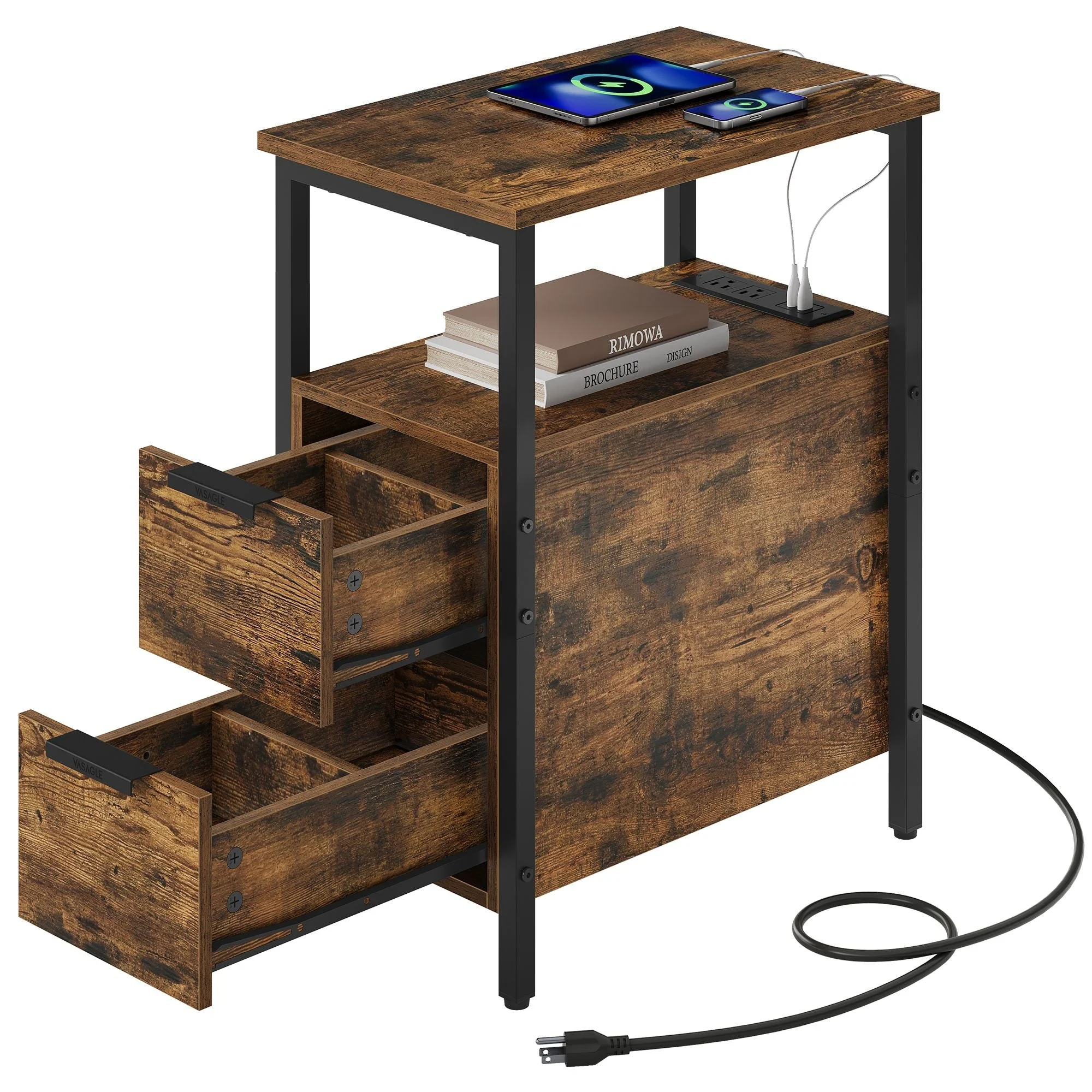
Those outside measurements do not establish its drawer interior or opening travel. Confirm those details for your specific contents and occupied bedside before choosing it. Also check the rear holder and the space needed to reach it; a feature against a wall may be less useful than it appears in a product view.
As an Amazon Associate I earn from qualifying purchases.
Check the VASAGLE slim nightstand on Amazon
The manufacturer photograph identifies the exact format. The room scenes and numerical diagrams use generic furniture. Check the selected 18.9-inch-deep variant rather than substituting a deeper version with a similar name. Follow the actual furniture and charging-station instructions, keeping the connections accessible and cables clear of movement.
The charging feature is part of the product to evaluate, not a reason to choose it over a better-fitting plain unit. Include the real plug and cable positions in your measurements instead of allowing them to reduce the narrow gap after installation.
Try the Night-time Routine Before Committing
Mark the proposed footprint with a suitable removable method and include the front's opening area. Use an appropriate existing surface to test the reach when practical. Do not build an unstable substitute cabinet or force furniture into the gap.
Lie down, place the phone and glasses, retrieve the book and sit up. Then get out of bed at your normal position and walk away. Include the duvet edge and any charging lead. Open the proposed storage from the position in which you would actually use it.
If an object only fits when the drawer is tightly packed, reduce the contents or choose a different storage arrangement. If the cabinet fits but blocks the foot position or required access, the width check has not produced a workable result. Keep those failures specific rather than assuming an even narrower-looking style will solve them.
Write the final brief around clear outside width, depth, reachable height, usable interior and permitted opening movement. The right narrow bedside table completes those jobs together; it does not merely fill the last empty strip beside the mattress.