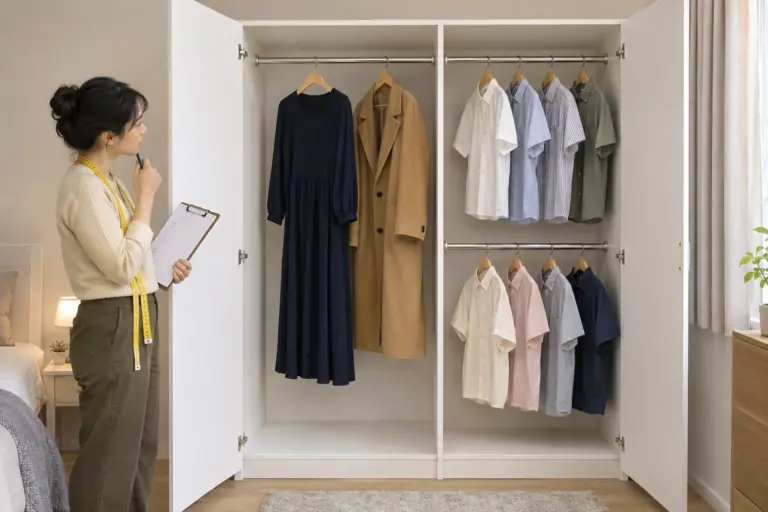
A wardrobe can fit the bedroom wall and still be wrong for the clothes inside it. A large shelf section does little for long dresses that need hanging space, while a full-width rail can leave folded clothes without a convenient home. Before comparing finishes or door styles, make a short record of what the wardrobe must actually hold.
Use the clothes you intend to keep and the storage methods that suit them. The result should be a buying brief you can compare with a current internal drawing, rather than a hope that a headline garment count will cover everything.
Separate the Clothes by How They Will Be Stored
Group hanging clothes into short and long items, keeping the hangers you normally use. Put folded clothes into their intended groups too. Include shoes, bags, or other objects only if this wardrobe genuinely needs to hold them; do not assume every category must share the same unit.
Account for clothes temporarily in the laundry or being worn. Otherwise, a layout that looks sufficient on shopping day may already be full when those items return. Record seasonal items separately if they have another appropriate storage home, and be explicit about which clothes this wardrobe must accommodate throughout the year.
IKEA's clothes-storage planning guide distinguishes the needs of folded clothing from those of long garments. Its planning estimates are starting points. Your actual clothing, hangers, handling space, and chosen arrangement should determine the requirements you take shopping.
Record Occupied Hanging Space, Not Just Piece Count
On a suitable existing rail, arrange a representative group as you would normally use it. Check that you can identify, remove, and replace an item without forcing the neighboring clothes aside. Measure the span occupied by that group in this usable arrangement. Do not divide the rail into a universal number of inches per garment: a thick jacket and a thin shirt do not use it in the same way.
For long garments, also measure down from their supported hanging position to the lowest point. Include the real hanger, and check what would sit below the clothes. Record the needed clear depth with the hanger and garment in place; external cabinet depth is not the same as usable internal depth with the doors closed.
Keep these observations separate. Rail length describes side-to-side demand; hanging drop describes the unobstructed vertical space; depth concerns the garment and hanger between front and back. A generous value in one direction does not rescue a shortage in another.
Turn the Inventory Into a Layout Requirement
Consider an illustrative household with 12 shirts, six jackets, two long dresses, and four folded sweaters. Suppose its short hanging group occupies 30 inches in the chosen usable arrangement, while the two long dresses occupy another 12 inches. These are example records, not measurements taken in your home or standard allowances for those quantities.
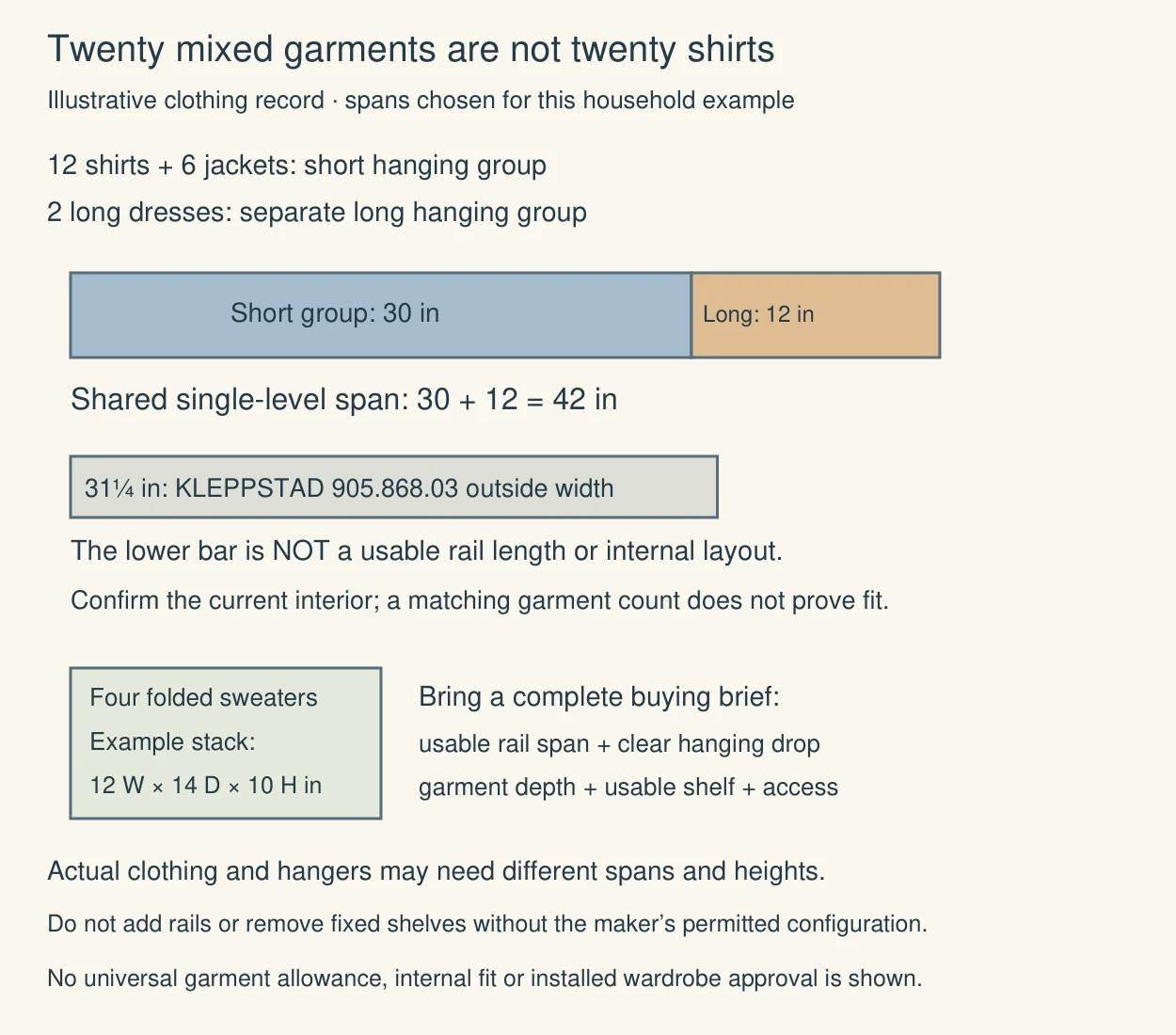
If all those hanging garments share one continuous level, their spans total 42 inches. That does not mean you can order a 42-inch-wide wardrobe: the usable rail, partitions, supports, and garment clearances still need checking. Another properly designed internal arrangement might distribute the groups differently, but it must provide the appropriate hanging drop and access for each group.
The four sweaters form a separate example stack, 12 inches wide, 14 inches deep, and 10 inches high. Compare that with a usable shelf position and its opening, including the ability to lift out a sweater. It is not a standard sweater size or a suggestion to fill the shelf opening tightly to the top.
Compare the Current Interior Before Buying
Ask for the internal layout for the exact model and variant. Identify the included rails and shelves, their usable dimensions, and which positions are permitted to change. A photograph of an open wardrobe is helpful, but it may not show a lower shelf, a fixed divider, or the current version of the unit.
Check the long group first against anything beneath its rail. Then assign the short hanging and folded groups to actual remaining places. If the proposed layout only works by removing a required shelf or adding an unsupported rail, it is not a verified fit. Choose a different permitted configuration or another wardrobe instead of treating a modification as part of the purchase.
For a modular system, check the complete selected combination: frame, doors, hinges, rails, shelves, and any required components. For a self-contained wardrobe, establish what its current retail unit includes. A staging basket, hanger collection, or clothes shown in a photograph is not automatically part of the bundle.
Treat Product Capacity Claims as a Starting Question
The current US white two-door IKEA KLEPPSTAD, article 905.868.03, is listed at 31¼ inches wide, 21⅝ inches deep, and 69¼ inches high. One wardrobe arrives as two shipping packages. Those measurements describe its exterior, not the usable rail or clear hanging drop.
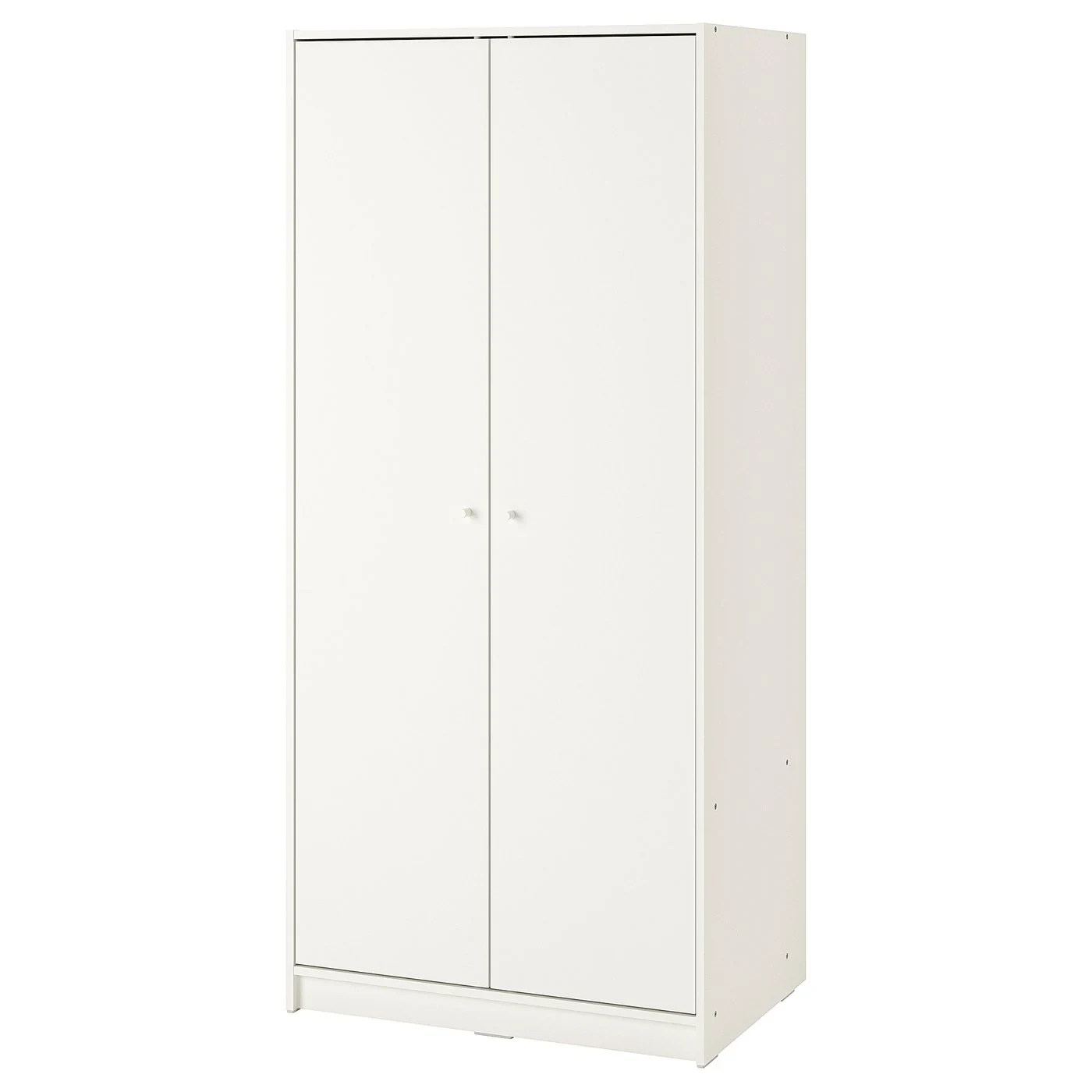
The maker describes capacity in terms of about 20 shirts on hangers. The example household also has 20 hanging garments, but its jackets and long dresses make that numerical match insufficient. Its 42-inch shared-level span cannot be inferred from a cabinet 31¼ inches wide. Verify the current internal arrangement rather than treating “20 shirts” as a promise about 20 mixed items.
The product requires secure anchoring with fixings appropriate to the home. Its exterior photograph does not establish interior suitability. A current internal drawing and your own clothing record are still needed before choosing it.
Check the Room Around the Chosen Unit
Measure the proposed location in width, depth, and height, including skirting, obstructions, and the requirements for assembly and installation. Check delivery access using the actual package dimensions and route. Leave the required room for the complete door operation and for a person using the contents.
Finally, take the brief through an ordinary dressing sequence: choose a shirt, reach the long item, remove a folded sweater, and put each back. Keep a place for the clothes returning from use. Select the unit only when its permitted internal arrangement and its place in the room can accommodate that complete routine.