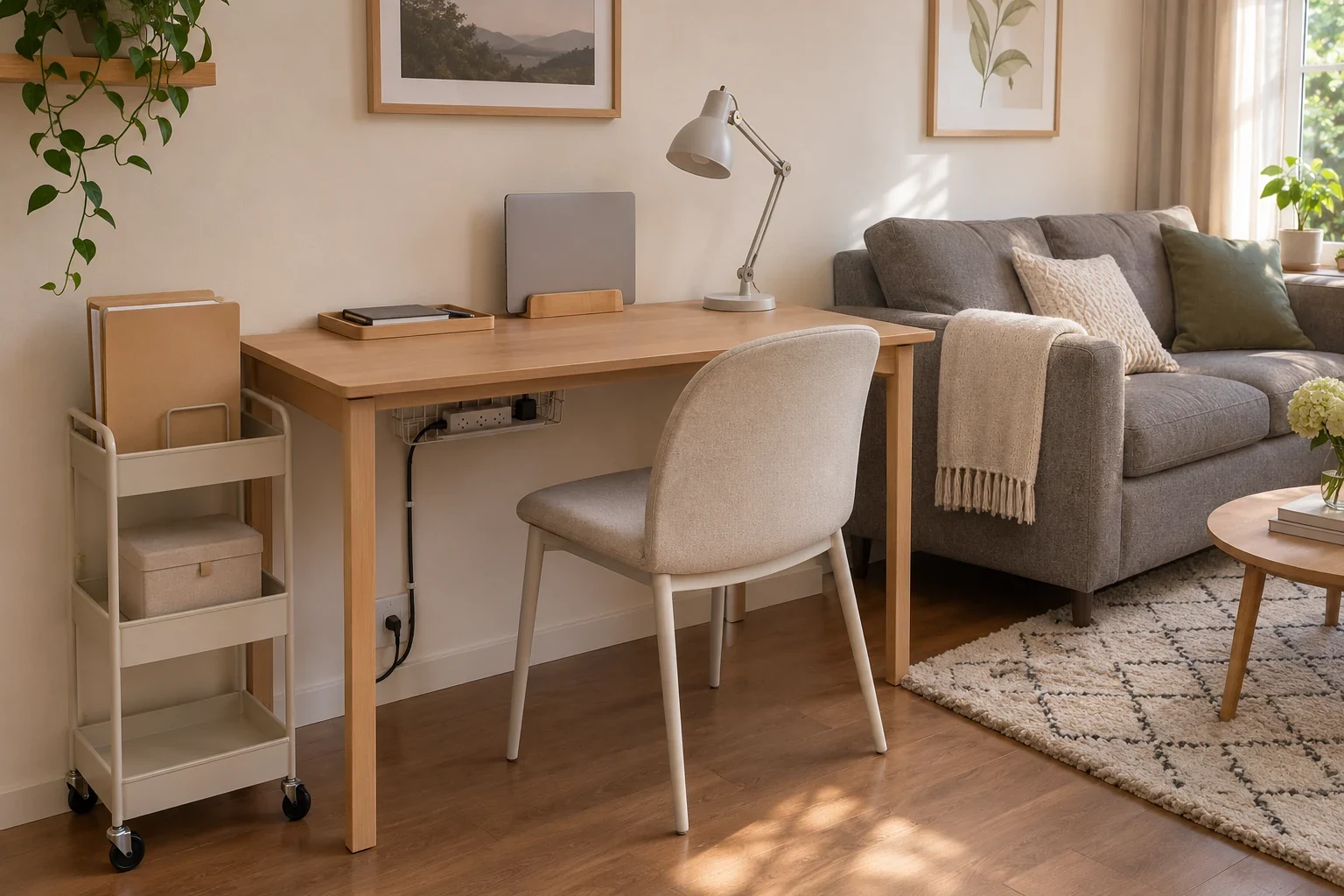
A rolling cart helps when a defined kit needs to travel between a storage position and a work position. It gets in the way when it has no real parking place, carries objects that prevent it moving safely or occupies a route every time another activity starts. Plan the two positions and the journey before choosing the cart.
“Mobile storage” is not automatically more space-efficient than a shelf. Wheels add the possibility of movement; your room determines whether that movement is useful. A cart parked permanently in a doorway is still an obstruction, however compact its baskets look.
Give the Movement a Specific Purpose
Choose one job: bringing a work kit to a shared desk, moving a craft session beside a table or keeping a small reading kit near the seat in use. Identify the objects and their order of use. If the cart combines unrelated possessions from several rooms, moving it for one person can inconvenience everyone else.
A useful kit can stay together while traveling. A notebook, pencil case and lightweight folder can move as a group. A desk lamp plugged into the wall, a monitor cable and an open drink cannot simply travel with it without a reset. Include unplugging or removing those objects in the routine if they are part of the plan.
If the contents never move, a stationary shelf or box may provide the same access without a turning requirement. Use the cart when the movement removes carrying or setup steps you actually perform.
Measure the Parking Place with the Cart Fully Loaded
Use the whole outside footprint, including handles and wheels. Then add any items projecting beyond the baskets. A tall folder leaning outward or a bag hanging from a handle can make the occupied shape wider than the published dimensions.
The parked cart must not prevent a nearby cupboard or room door opening normally. Try retrieving the object behind it. If every cupboard visit requires moving the cart into the walking route, consider whether that is an occasional acceptable trade-off or a daily frustration.
Height matters too. Check the handle and the tallest stored object against the underside of a desk or shelf. Do not plan to push the cart under a table merely because the basket body appears low enough. A little extra clearance in one place does not help if the route into that place is blocked by a brace or chair.
Draw the Route and the Turn
Trace a path from parking to working position. Include the narrowest doorway, furniture corners, rug edges and floor transitions. Consider where you will stand to guide the cart. The cart's own rectangle is not the complete occupied space of the person moving it.
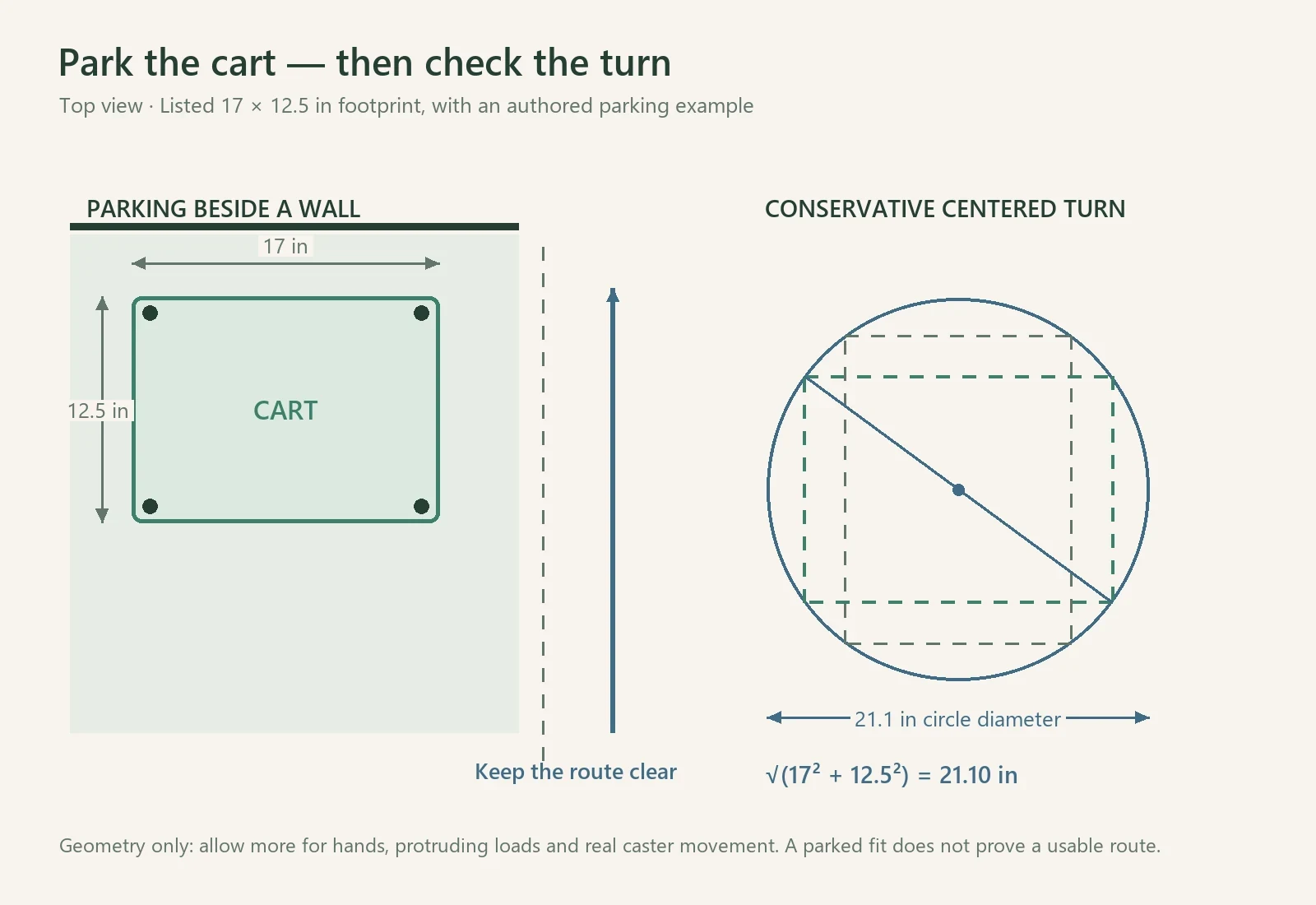
For a geometric planning example, a 17-by-12.5-inch rectangular footprint rotating about its center sweeps a circle about 21.1 inches across: the rectangle's diagonal. That is a conservative all-angle envelope for that idealized rectangle, not a guarantee that a real cart turns comfortably in a 21.1-inch gap. Real handles, projecting loads, caster behavior and your hands can need more space.
The example is useful because it exposes an easy mistake: a 12.5-inch-deep cart can pass straight through a gap where it cannot turn freely. Mark both straight travel and the change in direction. When in doubt, test a full-size lightweight footprint before ordering rather than using the narrowest published dimension for every movement.
Store the Load for Travel
Keep contents within the intended basket boundaries and follow the cart manufacturer's load and placement instructions. Put objects where they can be retrieved without destabilizing the cart. A tall, top-heavy stack defeats the usefulness of a compact mobile frame.
Avoid placing open drinks or unsecured fragile objects on a cart you expect to move. Treat storage baskets as storage, not as a substitute for a stable tabletop for hot objects. Keep cables unplugged and clear before moving any electrical equipment, following its instructions.
If you use removable containers inside the cart, check their outside dimensions against the actual basket opening. A bin may fit once inside but be awkward to lift past a handle or the shelf above. Decide whether you want to carry the whole kit away or pick individual objects while the cart stays still.
Put the Controls Where You Can Use Them
Check how the wheel locks work and whether they remain accessible in the parked position. Engage them as instructed during stationary use. A lock hidden beneath an overhanging cupboard or behind a sofa is harder to use consistently.
Try the handle height and the route with your own body position. Do not pull the cart by an object stored on it. If the floor transition makes it catch, lift or tilt, assess the actual product instructions and load rather than assuming all caster-equipped furniture handles every surface.
A Specific Cart to Compare
The Simple Houseware three-tier utility cart, ASIN B07V49ZP66, is listed as 12.5 inches deep, 17 inches wide and 31.5 inches high. It has three metal baskets and four casters, two described as lockable. Those are useful initial facts for the parking and route exercise.
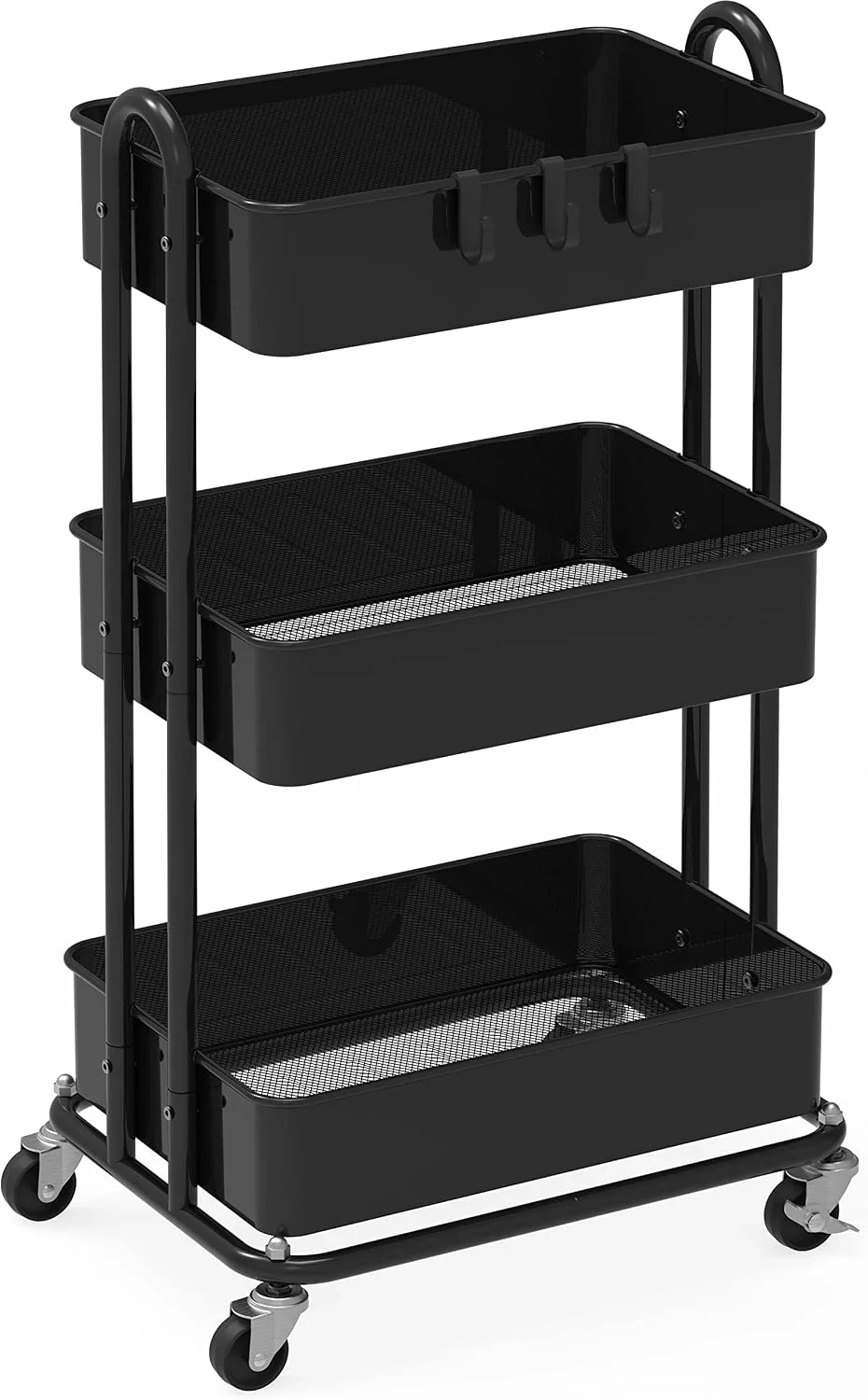
Check the exact basket openings and current assembly information before choosing fitted inserts. The overall dimensions do not establish usable internal shelf space. The illustrated route is a planning example rather than a maneuvering test of this cart.
Complete one full cycle on paper or with a safe mockup: collect the kit, move it, park for use, retrieve the bottom-shelf item and return the cart. If it solves that cycle with fewer interruptions, wheels have earned their place. If the cycle mainly consists of moving the cart away from something else, choose a different home for the contents.