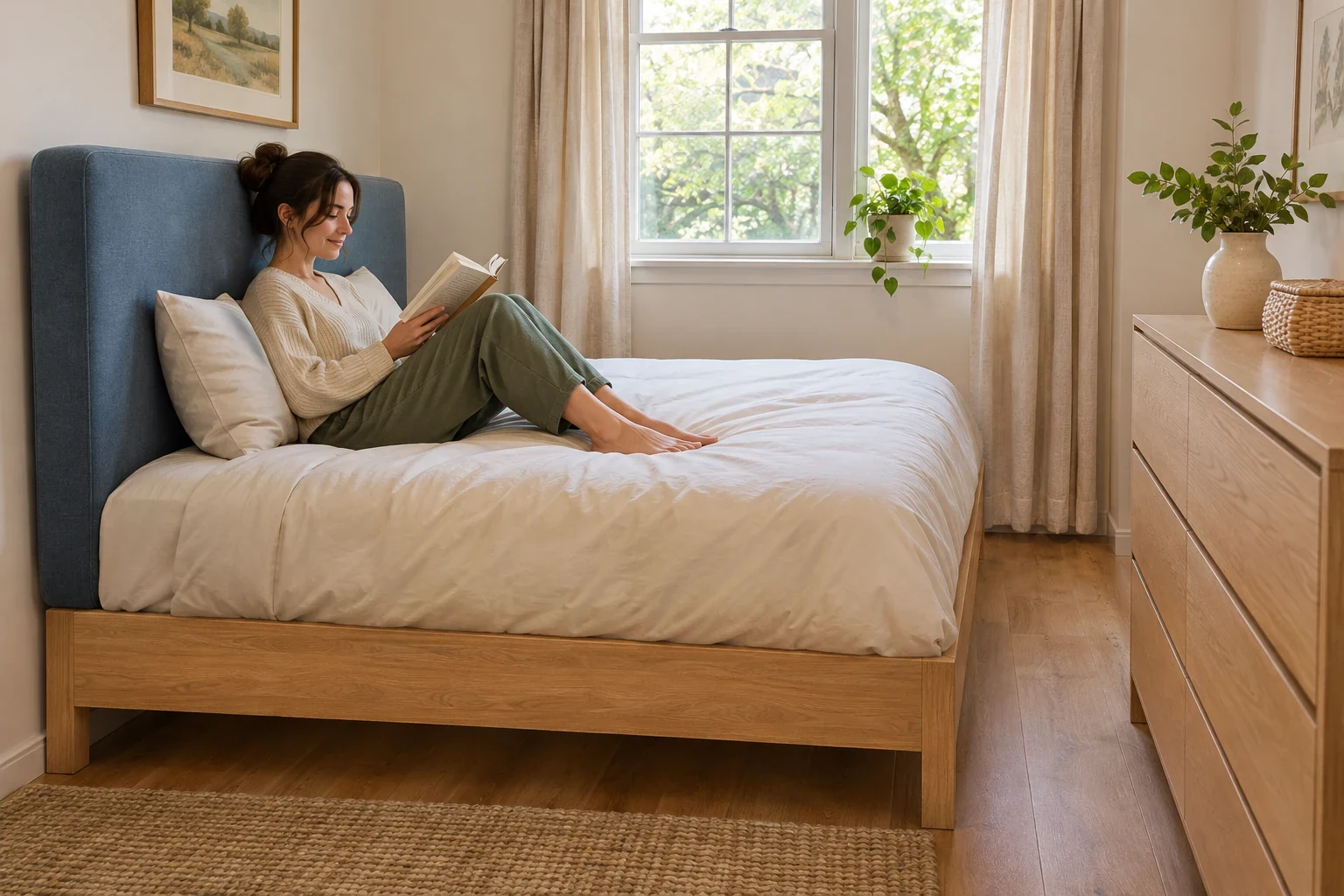
Choose a headboard by comparing the job it performs with the complete bed's position in the room. The space question is not simply how thick the board looks. Its supports, required installation and relationship to the frame can change where the mattress and foot of the bed actually end up.
Begin with a complete, permitted bed configuration. A headboard may be a separate optional item or a required part of the frame. This comparison does not call for removing structural bed ends, supports or fixings. Keep every component required by the actual bed's instructions.
Decide What You Want the Headboard to Do
List the functions that matter to you: a suitable surface behind the pillows, a particular visual finish or storage for specific bedside belongings. Try your ordinary seated position in the complete setup when possible. Appearance alone does not establish that a headboard suits how you use the bed.
If the headboard has shelves, list what actually occupies them. A book, phone and glasses each need an appropriate accessible home if those shelves disappear. Do not count removing a storage headboard as a complete space saving while leaving its former contents in a new pile on the mattress or floor.
IKEA's bedroom-storage material considers clothing, books and bedside essentials within the same room. Use that whole-room view when comparing options. A deeper headboard may replace another appropriate storage item, but only if its actual access and capacity satisfy the household's needs.
Keep a visual preference in the decision too. You may prefer the finished outline of a headboard or the simpler appearance of a complete bed designed without one. Treat that as your preference, alongside the measured consequences, rather than assuming one style makes every small bedroom look larger.
Measure Each Complete Bed Configuration
Record the actual frame's outside width and length, including its end panels, legs and projections. Add the required position relative to the wall using the manufacturer's complete layout or confirmed assembled measurements. Do not substitute mattress dimensions for the outside footprint.
For a separate headboard, check its full depth and how the frame is meant to sit in relation to it. A nominally thin panel may have deeper feet or brackets, while a storage model has a different shape altogether. Use the intended assembled arrangement rather than simply adding a front panel's thickness.
Check the wall and any required attachment before choosing the position. Include baseboards, outlets, windows and other features that affect the actual installation. Keep access required for the bed's setup and maintenance. A plan that assumes the frame can move tight against any wall may promise space you cannot reclaim.
If your current headboard is part of the bed's structure, compare another complete suitable bed configuration when replacement is genuinely under consideration. Do not translate this exercise into an instruction to detach that part. A separate optional accessory and a structural end panel are different objects.
Compare Where the Foot of the Bed Finishes
The illustrative room is 116 inches long and 96 inches wide. A dresser occupies 18 inches from the wall opposite the bed, placing its closed front 98 inches from the bed's wall. The generic complete bed frame is 82 inches long and 62 inches wide.
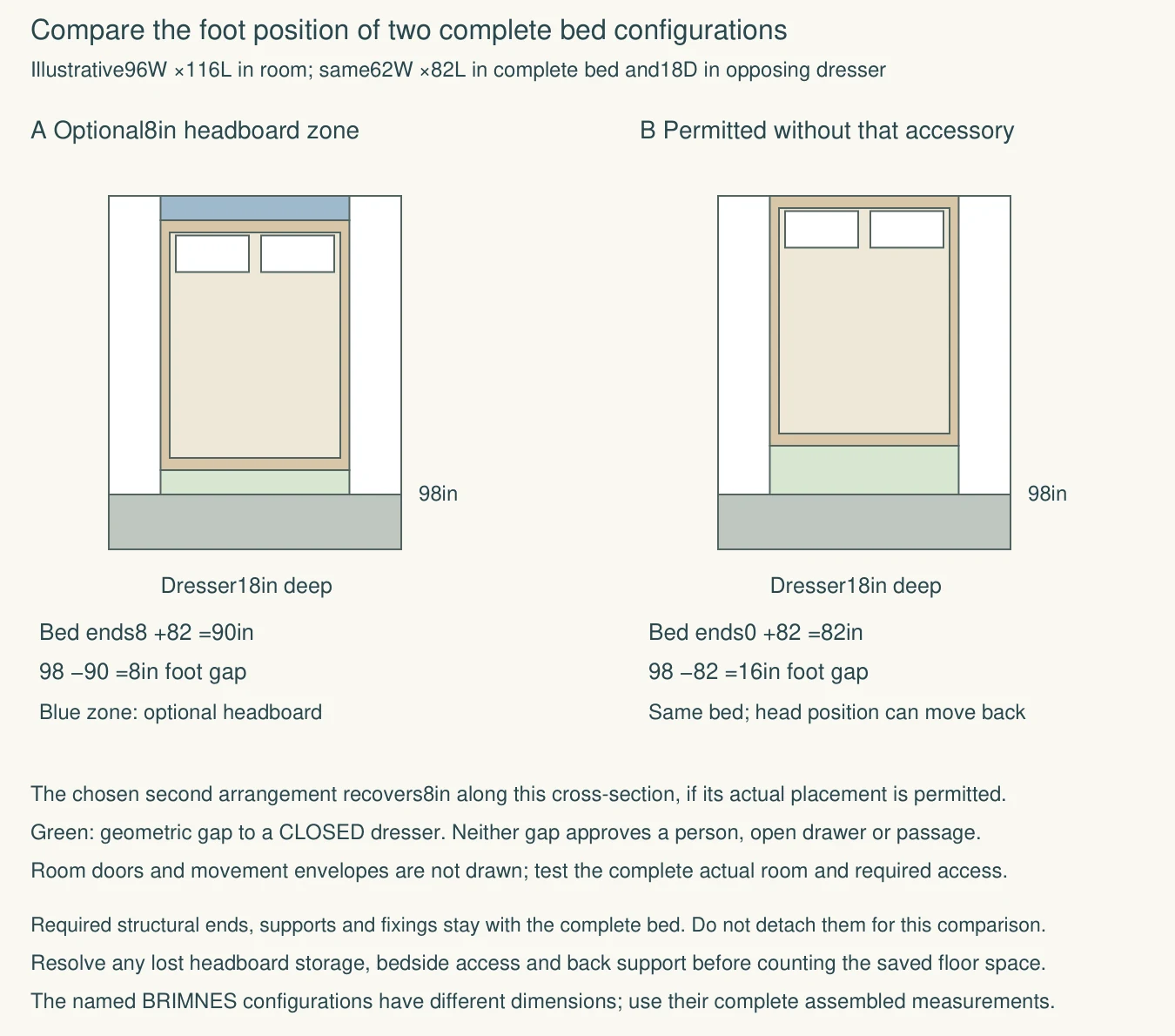
In the first chosen configuration, a separate optional headboard occupies an 8-inch-deep zone behind that frame. The frame begins 8 inches from the wall and ends at 90 inches. Subtracting 90 from the dresser-front position of 98 leaves an 8-inch geometric gap.
The second configuration is a complete bed permitted without that optional headboard. In this selected example it can stand with its head end at the original wall line, so its foot ends at 82 inches. The same dresser front now leaves a 16-inch gap, recovering 8 inches along this particular cross-section.
Those numbers compare the two chosen arrangements; neither 8 nor 16 inches is a recommended passage or working clearance. They do not establish space for a person, an opening drawer or the room's doors. Try the actual activities and movements before accepting either configuration.
Keep the Actual Purchase Objects Distinct
IKEA's current white Queen BRIMNES frame reference 699.029.45 lists an outside length of 81⅞ inches and width of 62¼ inches. It includes frame 302.287.23 and the required SKORVA center support beam 901.245.34 in four packages. Its selected configuration excludes the slatted bed base and mattress, which are sold separately.
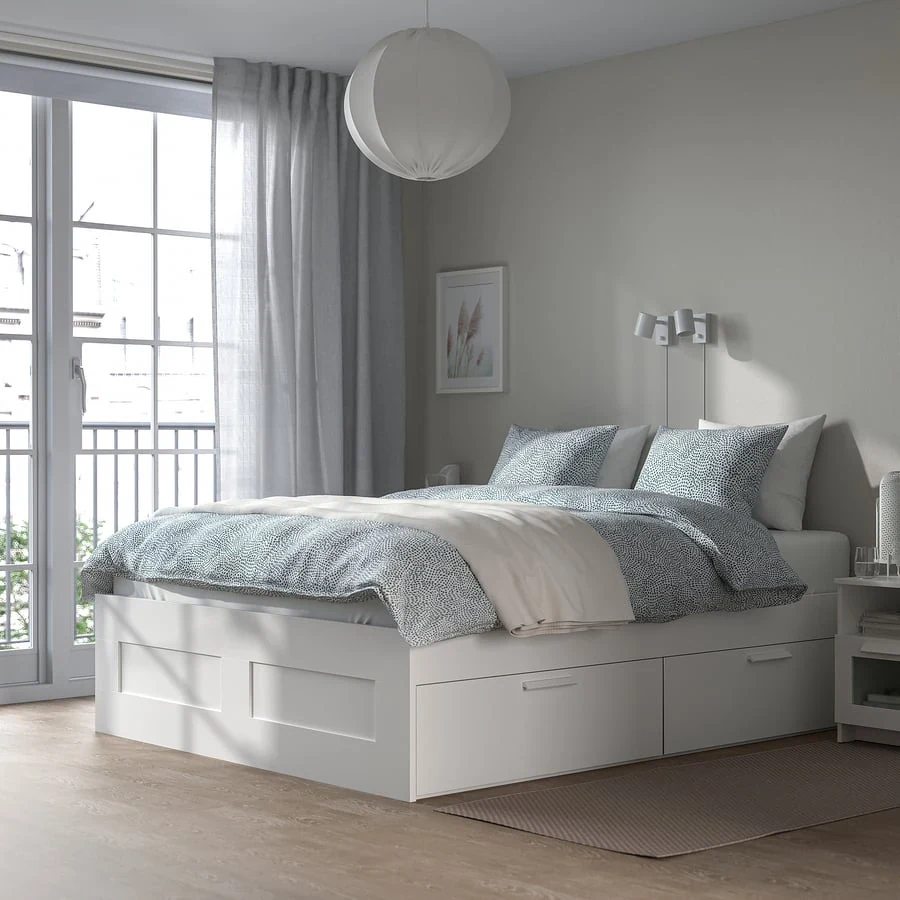
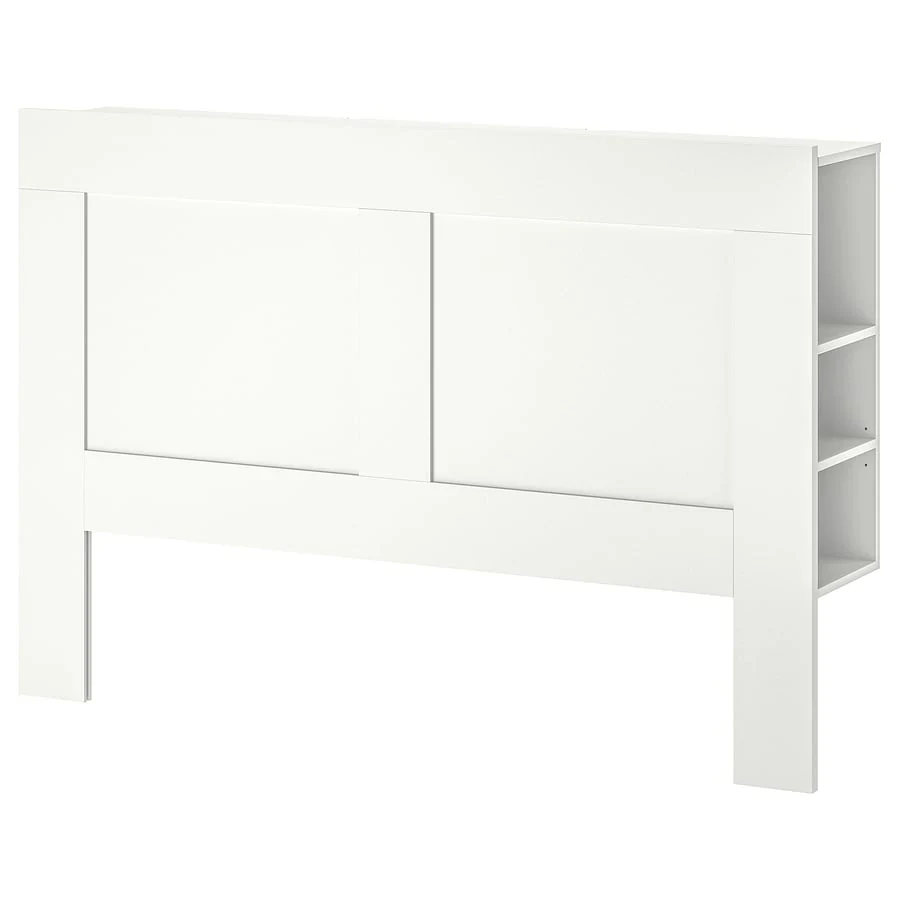
The white Queen combination 490.992.50 adds headboard 702.287.16 and lists an overall length of 95¼ inches, the same width and five packages. The selected combination also excludes the slatted bed base and mattress. Its headboard must be secured to the wall as instructed.
The listed length difference is 95¼ minus 81⅞, or 13⅜ inches. The separately sold headboard's own depth is 11 inches. Use each complete configuration's confirmed assembled dimensions; adding that 11-inch accessory depth to the frame length does not reproduce the combination's listed length.
The real photographs distinguish the frame from the headboard-only object. One headboard package is not a complete bed, and four or five packages are not that many beds. Check the actual selected components, suitable mattress support and installation instructions before ordering. These references also differ from the generic 82-inch frame and 8-inch headboard used in the room exercise.
Make the Floor-space Gain Useful
Try the resulting room with the complete bed in its intended position. Get into and out of it, reach the bedside belongings and carry out the ordinary bed-making routine. Open the dresser and other storage only as the actual furniture permits, including any interlocks.
Check what changes elsewhere if you choose the simpler configuration. Assign former headboard contents to real homes that suit when they are used. If a replacement side table is necessary, include its complete footprint and access in the comparison before counting the saved space.
Keep the headboard when its actual functions justify its installed footprint and the room remains usable. Choose a suitable complete configuration without an optional headboard when the recovered space improves the activities you need, with the lost functions resolved. The useful result is a bedroom that works through normal use, rather than a shorter measurement on its own.