Give an ordinary arriving package a temporary place with a clear owner and a clear next step. In a small entryway, the useful result is an empty landing surface after the parcel has been opened and its contents put away. A growing stack beside the front door has simply moved the unpacking problem into the entrance.
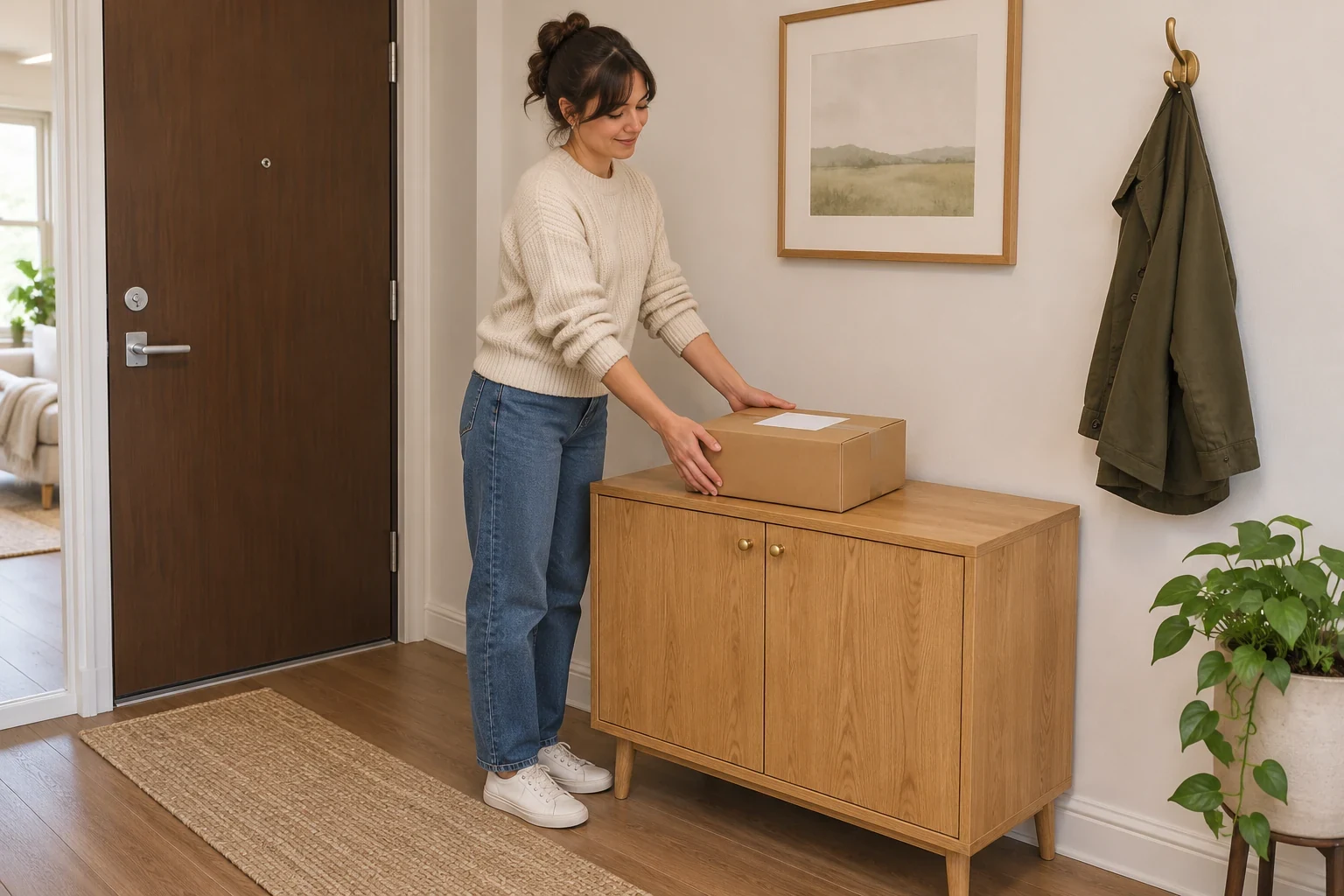
Start with an appropriate surface you already own. The example here uses one existing cabinet for one ordinary parcel, then follows a blue hardback book and a folded green throw to their permanent homes. It does not require a new parcel cabinet or a larger entryway organizer.
Choose a Place That Leaves the Entrance Working
Look at the entry with the door moving through its full opening and someone arriving with their normal belongings. Keep the parcel out of that movement and the route through the room. Include cabinet doors, drawers and other household access rather than judging the spot from a closed-door photograph.
IKEA's small-hallway ideas assign arrival functions to places within the available room. Apply that principle to a parcel briefly waiting for its owner. Keep the key dish or other everyday landing function available instead of covering it with a box that nobody has agreed to move.
The surface must be suitable for the actual parcel's complete footprint and weight. Check the furniture's actual instructions and condition. A narrow console being convenient for mail does not establish that a deeper box can sit fully supported on it. Do not balance an overhanging carton on the edge or create a stack to gain capacity.
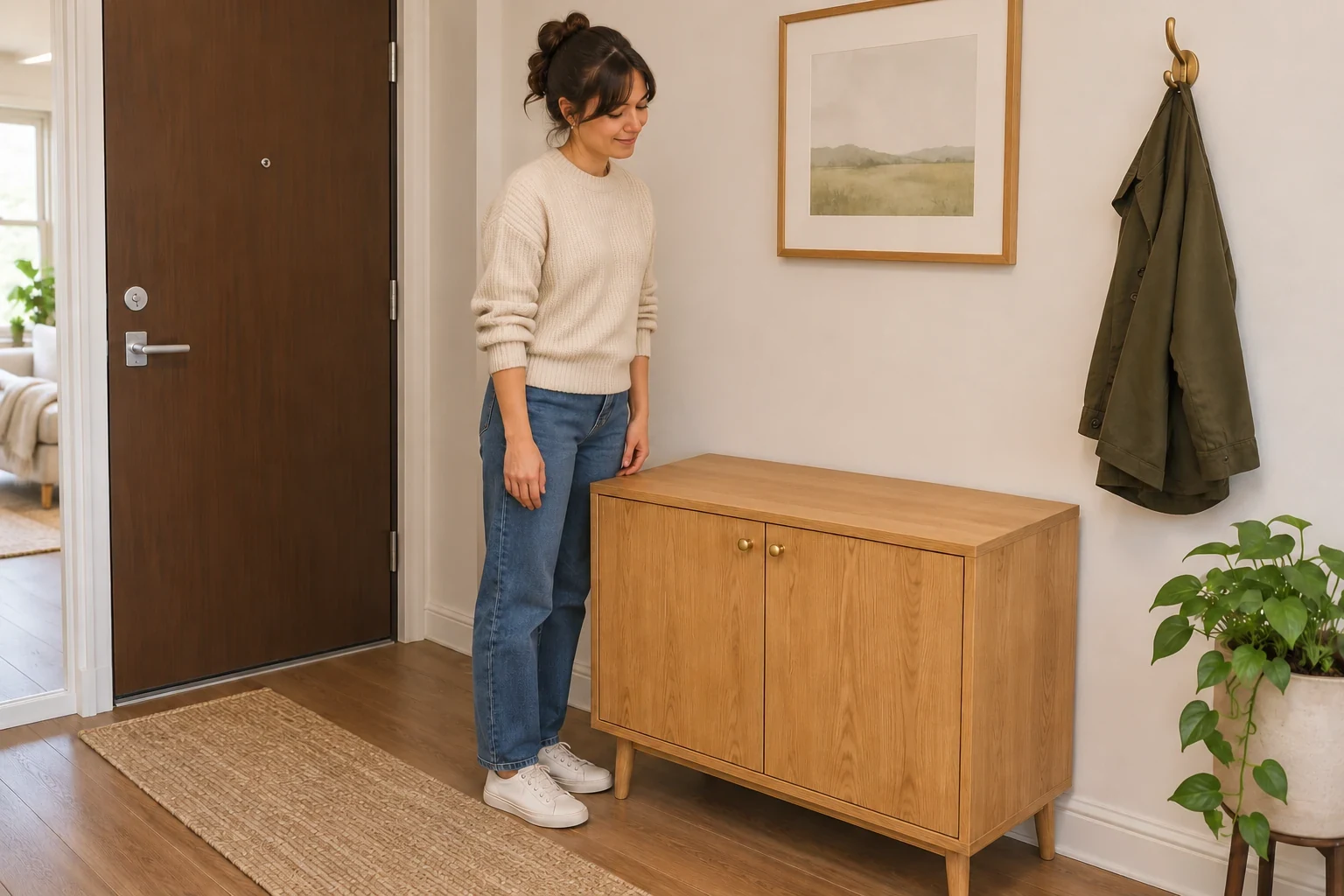
For this example, the single box fits fully on an appropriate existing cabinet with room around its edges. That is the cabinet's chosen temporary capacity. If an arriving parcel does not fit, arrange a different appropriate place and owner handoff rather than extending the landing zone onto the entry floor.
Give the Waiting Parcel an Owner and a Next Action
Agree who will collect and open the parcel. In a shared household, tell that person where their ordinary delivery is waiting. Do not turn a convenient surface into permission to open someone else's package or to sort their purchases without an agreement.
Choose a practical household handoff, such as the owner dealing with it when they return and have a suitable opening space available. There is no universal number of hours that makes a parcel landing place work. The useful test is whether the agreed action happens before the temporary spot becomes the next delivery's obstacle.
Keep unresolved ownership separate from ordinary unpacking. If nobody recognizes the parcel, identify who will investigate the delivery through the appropriate channel. Likewise, an item awaiting a return needs an owner, a required action and a suitable holding place. Leaving either indefinitely on the arrival cabinet does not resolve it.
Open It Where the Contents Can Be Handled
Before starting, clear an appropriate working surface and decide where the ordinary contents will go. The entry cabinet can remain a brief holding point; it need not also be the opening table. Choose a place where the parcel and its contents are supported and you have room to handle them.
Use the actual packaging's appropriate opening method and the equipment needed for it. Keep the work at that surface rather than opening the box on the entry floor. Move and handle the parcel in a way that suits its actual size and weight, arranging help when the task requires it.
In the example, the owner moves the ordinary box to a cleared table, opens it and removes a blue hardback book and a folded green throw. The table gives both objects a temporary supported place while the box is checked. The entrance is already free of the parcel, but the household task is not complete yet.
Check whether any packaging or enclosed information is needed for the owner's actual next step before disposing of it. Set aside what is genuinely required in its appropriate place. This is a decision about that purchase, rather than a reason to keep every empty carton beside the door.
Send the Contents to Their Real Homes
University of Illinois Extension's decluttering guidance emphasizes assigning retained items a home and returning them to the appropriate place. For a delivery, make that the next action after opening, rather than replacing the unopened box with a pile of new belongings.
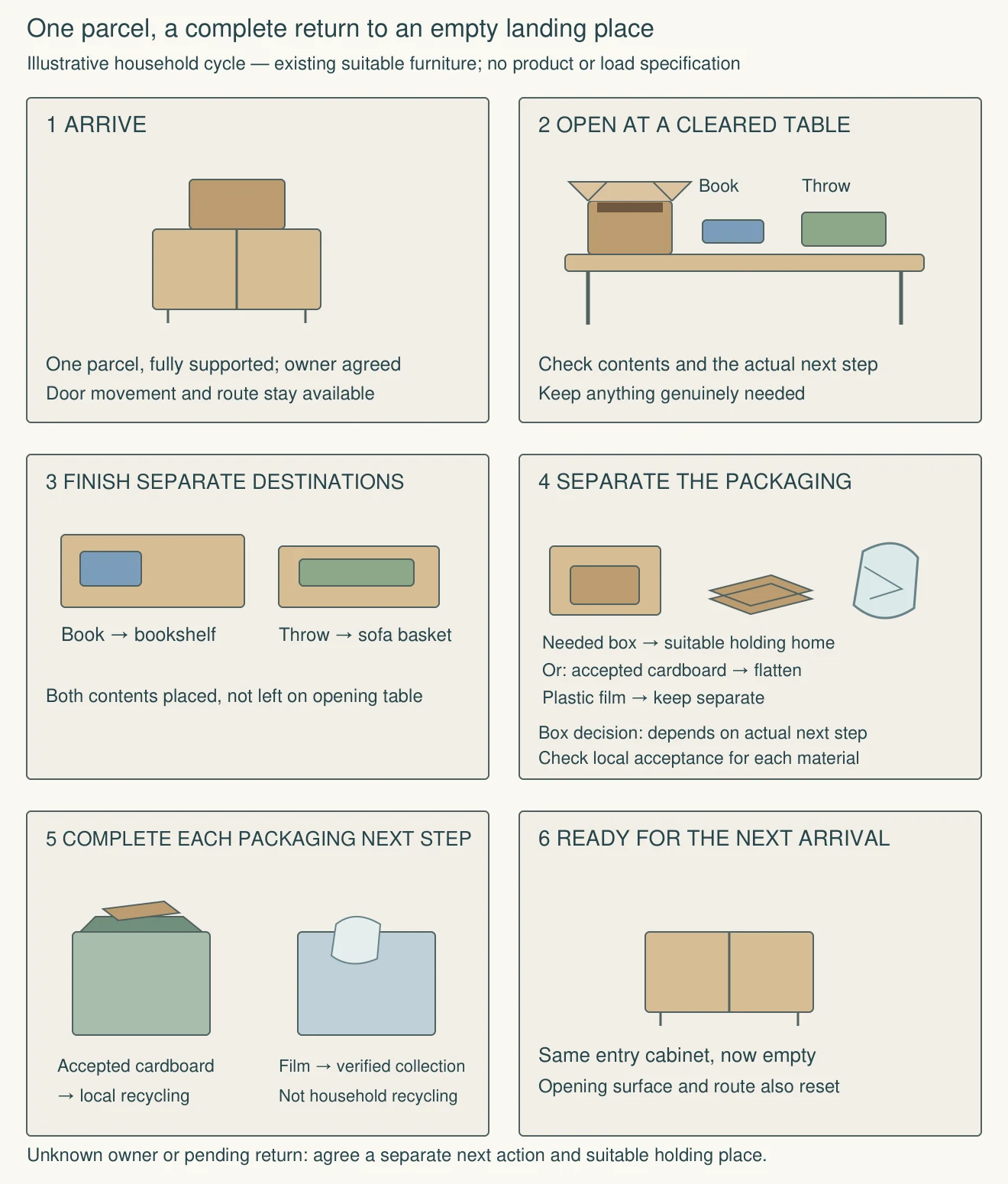
The blue hardback goes to the living-room bookshelf. The folded green throw goes into the existing basket beside the sofa. Those are two separate destinations, so the owner completes both placements. Neither item stays on the entry cabinet or the unpacking table waiting for another person to finish the job.
If a new object has no suitable home, resolve that storage decision before treating the delivery as put away. Identify the room and usable space it needs, then make an appropriate place. Moving it from the carton into an unassigned basket merely changes the container around the same unfinished task.
Separate Packaging Before Resetting the Space
Make an explicit decision about the empty box. Retain it somewhere suitable if it is needed for an actual next step. Otherwise, check the local program's acceptance rules and prepare accepted cardboard as required. EPA's recycling guidance says to flatten cardboard boxes before placing them in the recycling bin.
Keep any clear plastic wrapping separate from the cardboard decision. EPA says plastic bags, wraps and films do not belong in the household recycling bin; check for an appropriate collection location and its accepted materials. Do not assume that a cardboard box's acceptance also covers everything that arrived inside it.
Use the correct next destination for each packaging material rather than leaving a mixed pile on the opening table. Handle discarded paperwork containing personal information appropriately; Illinois Extension advises destroying that information-bearing paper before disposal. Retain purchase information that the owner still needs.
Finish by clearing the working surface and checking the cabinet at the entrance. In this example, the book is on its shelf, the throw is in its basket, and the packaging has its separate next destinations. The original landing surface is empty again, with the door and route available for the next arrival.