Count the storage you can open, reach into and close in the proposed layout. A bed with four drawers does not provide four usable drawers when two face a wall. Check every opening before moving clothes into it, and keep the blocked spaces out of your working storage plan.
Begin with the bed you actually have and its current instructions. Wall-side placement must suit the frame, mattress and any specified clearances. Saving floor space is useful only when sleeping access, the room route and the storage actions still work together.
Map the Frame and Every Storage Opening
Measure the complete bed frame, including any projecting headboard, footboard, handles or other parts that affect placement. Mattress dimensions alone do not describe the outside footprint. Mark the fixed room features and the space used by nearby furniture in their open or occupied states.
Give each storage opening an identity. For a bed with two drawers on each long side, label them left-head, left-foot, right-head and right-foot. Draw an arrow for each opening direction. This makes it harder to overlook a drawer simply because it disappears on the far side of a tidy room sketch.
Record how the storage actually works. A drawer on runners, a separate wheeled box and a lift-up platform need different access. Use the actual instructions and movement dimensions; do not assume that a box can be pulled from the foot or that a drawer can be reversed because that would suit the wall better.
IKEA's small-bedroom examples show why under-bed storage can be useful and emphasize finding the right piece for the task. The layout here applies that idea by checking whether the storage can still be used after the bed moves. It does not provide dimensions for any particular IKEA bed.
Remove Wall-Facing Drawers from the Usable Count
The illustrative plan uses a hypothetical 60-inch-wide, 80-inch-long frame with two drawers opening from each long side. The left side is against a wall. The two left drawers would need to travel into that wall, so they are unavailable in this layout.
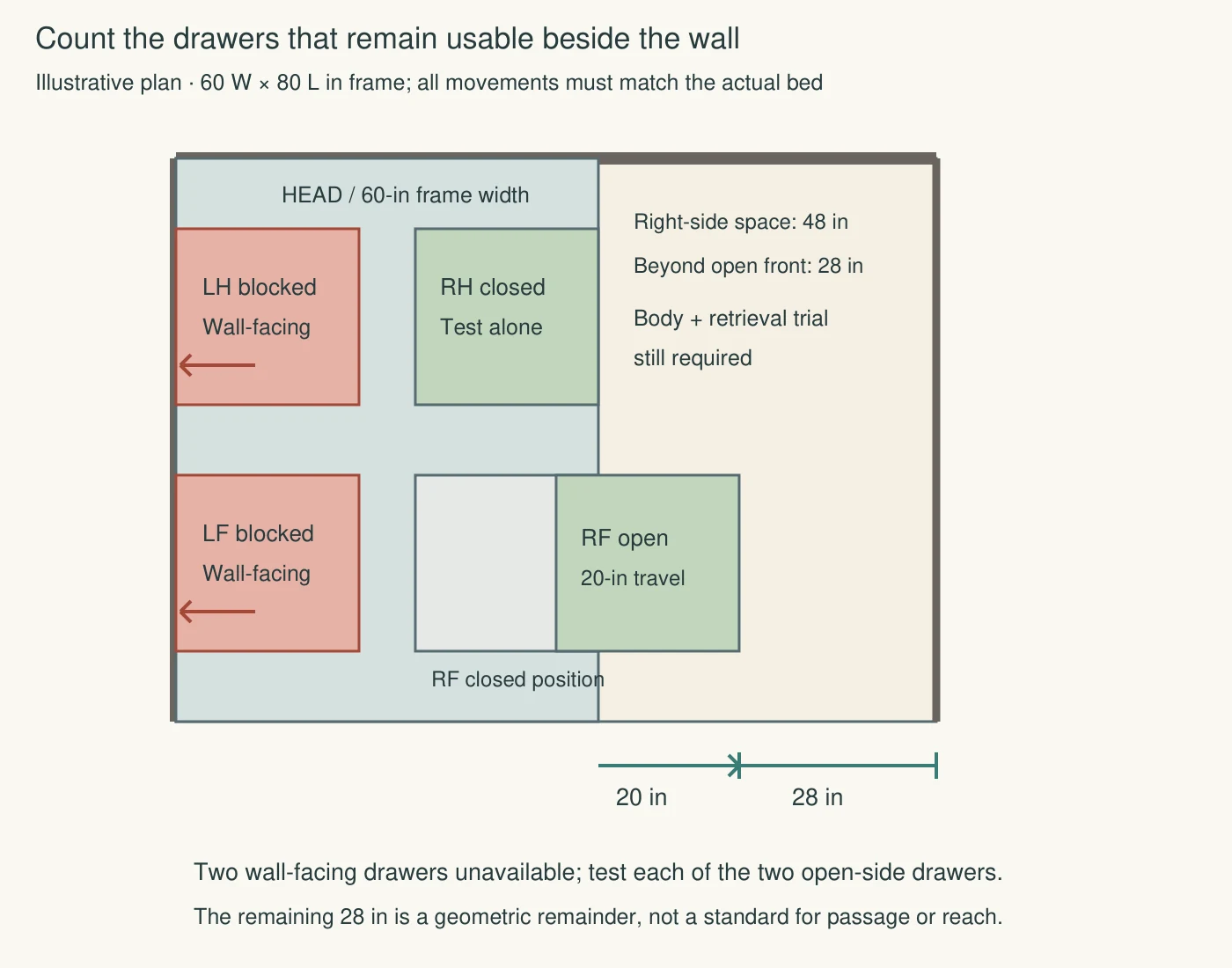
Label them unavailable on the plan rather than calling them occasional storage. Reaching their contents by moving the bed is a different task from opening a drawer. Do not build the everyday storage plan around moving a loaded bed or reaching through another compartment in a way its design does not permit.
Empty any drawer that will become blocked before placing the bed, using the actual moving and assembly instructions and appropriate help. Give those contents real accessible homes. The physical presence of an unused compartment is not evidence that the room has retained its former working capacity.
Keep structural parts and unused drawers in the configuration required by the manufacturer. This is not a suggestion to remove a side rail, alter runners, turn a drawer around or change the frame. If wall placement conflicts with the bed's instructions, choose a different arrangement.
Check the Full Travel on the Open Side
Find the actual permitted drawer travel, not just the depth of the closed box. Include handles and any part projecting beyond the drawer front. Mark the open position on the room plan, then test it with the nearby furniture in its real use state.
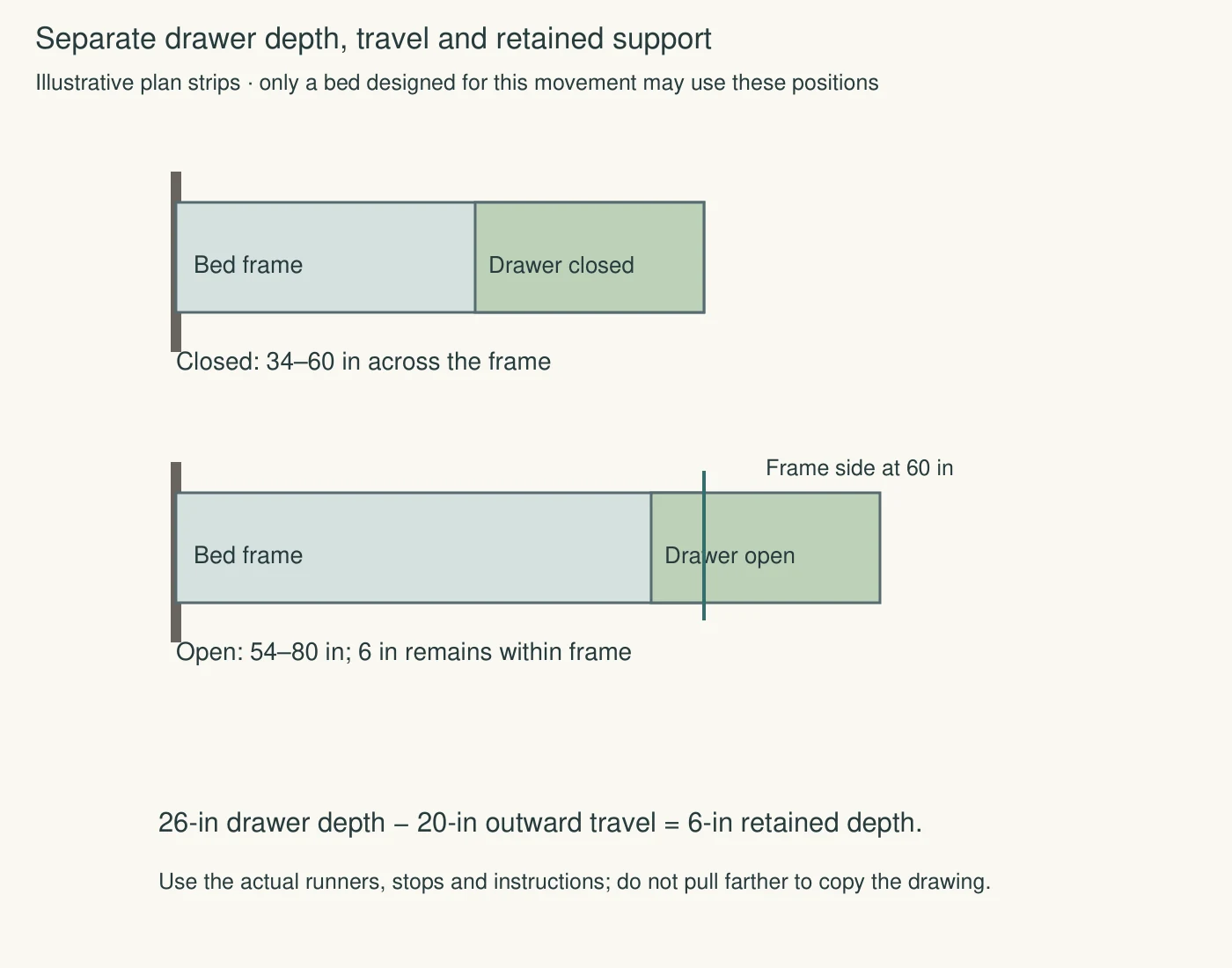
In the example, each right drawer is 26 inches deep and travels 20 inches outward. Across the bed's width, it starts between positions 34 and 60 inches. Open, it occupies positions 54 to 80 inches. That leaves 6 inches of its depth within the frame and puts its front 20 inches beyond the bed's side.
The right room boundary is at position 108 inches, leaving 48 inches between the bed side and that boundary. Subtracting the 20-inch drawer extension leaves 28 inches beyond the open front. That is a geometric remainder, not a universal clearance recommendation or proof a person can retrieve every item.
The example assumes this drawer's design permits that travel and retained support. Your actual runners, stops and opening may differ. Do not pull a drawer farther than instructed to reach something at the back or use the illustration as an installation drawing.
Test Retrieval with the Person and the Contents
Open the actual permitted drawer and retrieve the items you intend to keep there. Include bending or kneeling, the drawer-front position and the room needed to handle a folded item or organizer. Check that you can return the contents and close it without trapping bedding or fabric.
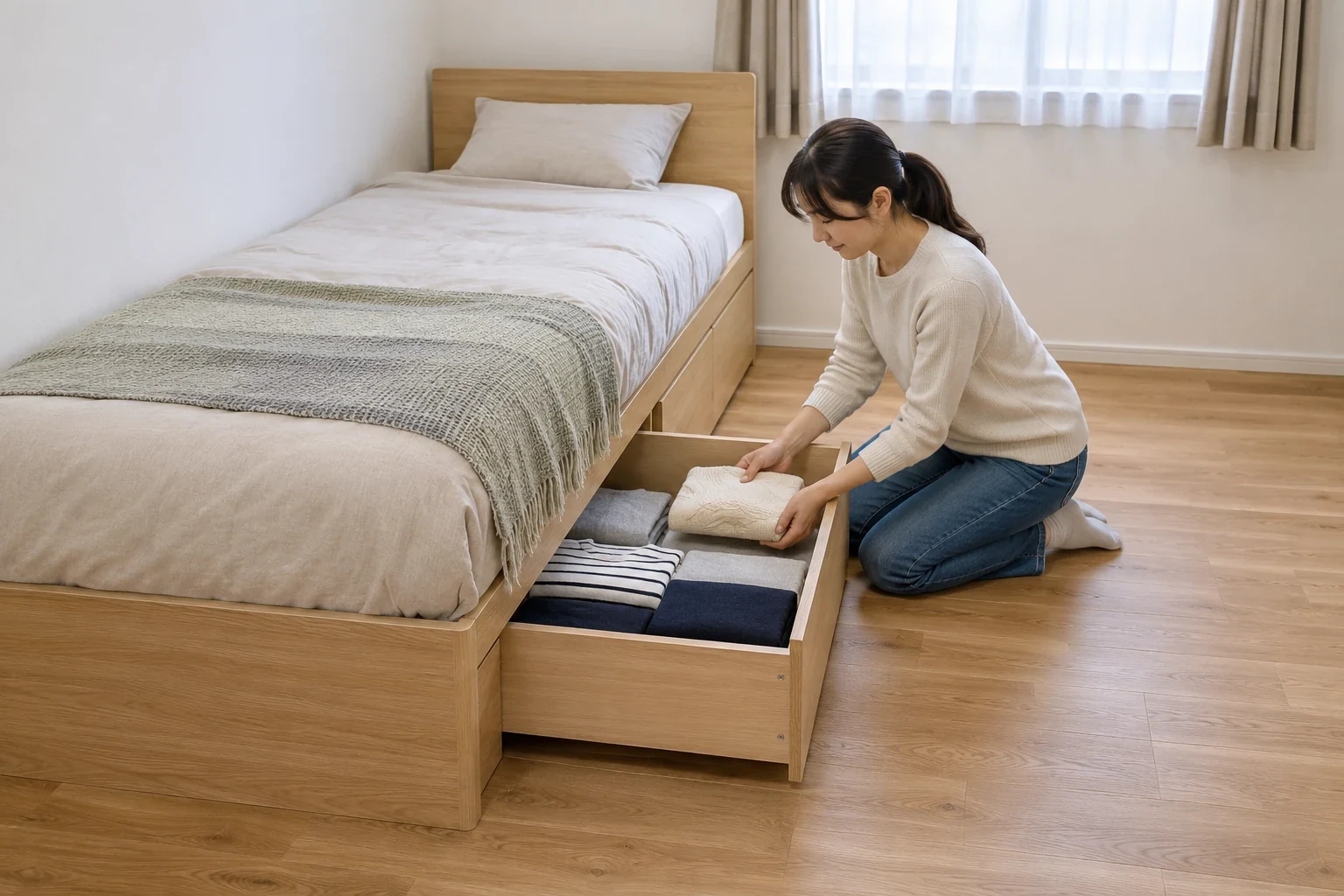
The opening scene shows a person using the footward drawer from the clear side of a generic bed while the headward drawer stays closed. It illustrates the storage action and approach, rather than the exact frame or dimensions in the plan.
Test the headward drawer separately. A bedside cabinet may leave the footward one available while preventing the other from opening or making its contents awkward to reach. Include the cabinet's top, legs, projecting handles and its own drawers, not merely its floor rectangle.
Repeat the actions with whoever normally uses the storage. A gap that works for one person's approach may not work for another's. Do not count a drawer as convenient just because someone can stand beside it while it remains closed.
Keep the normal getting-in-and-out route usable and check bed-making access as separate tasks. Drawer access does not establish that a wall-side sleeping position is suitable for the people using the bed. If either task fails, reconsider the layout.
Assign Contents Only After Each Opening Passes
Make a small storage record beside the drawing. For each drawer, note whether it clears its full intended movement, whether the user can retrieve and return its contents, and whether it closes correctly. A drawer passes only when all of those actions work in the actual arrangement.
For this example, the two left drawers remain marked unavailable and empty. The right-head drawer can receive a defined clothing group only after its own opening and retrieval trial. The right-foot drawer can receive another group after the same checks. Two accessible drawers are the starting usable count, and either can still fail its individual trial.
Size organizers from the drawer's actual usable interior and the opening through which they must pass. A divider that fits the closed box but cannot be handled in the open position may add another obstacle. Try the clothing group first rather than buying a set to recover capacity that the room no longer offers.
If the accessible drawers do not hold the intended daily group, relocate part of it to an appropriate existing wardrobe or shelf. Keep seasonal extras separate from frequently used things where that suits the household. Do not hide the excess in a blocked drawer merely to make the room look finished.
Recheck the Whole Room Before Keeping the Layout
Close the drawers and use the bedroom normally. Then repeat the storage actions with the relevant door, wardrobe or chair in the state it usually occupies. Check whether one useful action prevents another that the household needs at the same time.
If a drawer fails, identify the specific cause. A bedside cabinet may need a different suitable position; the bed may need to move; or that storage group may need another accessible home. Moving a handle, removing a structural part or forcing the drawer beyond its stops is not a layout solution.
Keep the final map and contents record together. If furniture changes later, repeat the opening and retrieval checks before relying on the previous usable count. A bed against a wall can be a useful arrangement, but its storage value comes from the compartments you can actually use there.