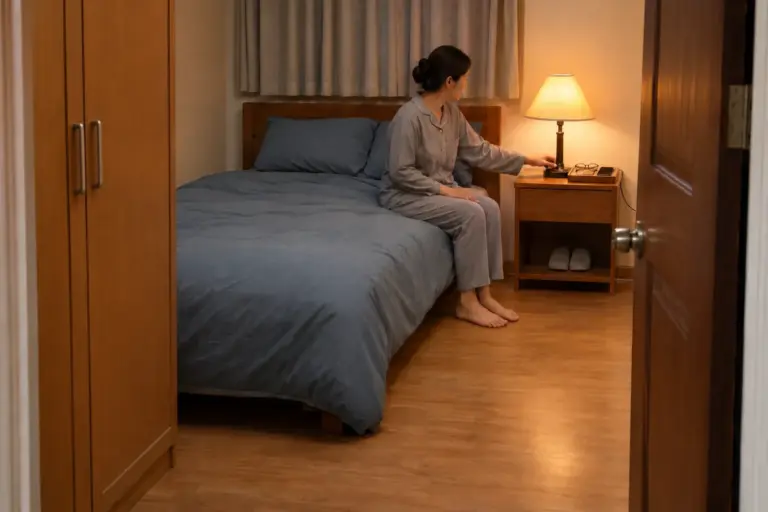
One bedside table can serve as shared storage for two people, but a table on one side of a double bed is not automatically within both people's night-time reach. Divide the storage jobs first, then check the essentials from each person's own sleeping position.
The workable arrangement may be one table plus an existing suitable bedside recess or other small personal landing point on the far side. If that second point is needed but cannot be provided safely, reorganizing the table's drawers will not solve the reach problem. Change the arrangement rather than making one person reach across the other.
Make Two Lists, Then Split Them by Timing
Each person should identify what they use before bed, what they may need during the night and what is only occasionally kept in the bedroom. Glasses, a phone used as an alarm, a book and water do not necessarily need the same location throughout the evening.
Treat the timing honestly. A book returned before sleeping can use the shared table even when it is not reachable from the far pillow. Glasses needed to get up at night need a safe, predictable place that their wearer can reach independently. Do not assign an essential object to a drawer simply because both people technically own part of it.
IKEA's small-bedroom examples separate occasional storage behind the bed from everyday bedside essentials. Another example takes some jobs off a bedside table with small wall storage. Use that distinction to reduce the table's workload, without assuming that any shelf or hook is appropriate at your bed.
Keep objects with special safety, care or privacy requirements in storage suited to those needs. This is a plan for ordinary bedside belongings, not a reason to decant medication or move necessary equipment into an unsuitable decorative container.
Give the Shared Table Named Storage, Not Two Competing Piles
Assign one removable kit or clearly identified section to each person. It might be a small existing tray, a suitable drawer divider or two ordinary pouches for the before-bed items. Use a name or another recognizable label rather than expecting everyone to remember which identical pile belongs to whom.
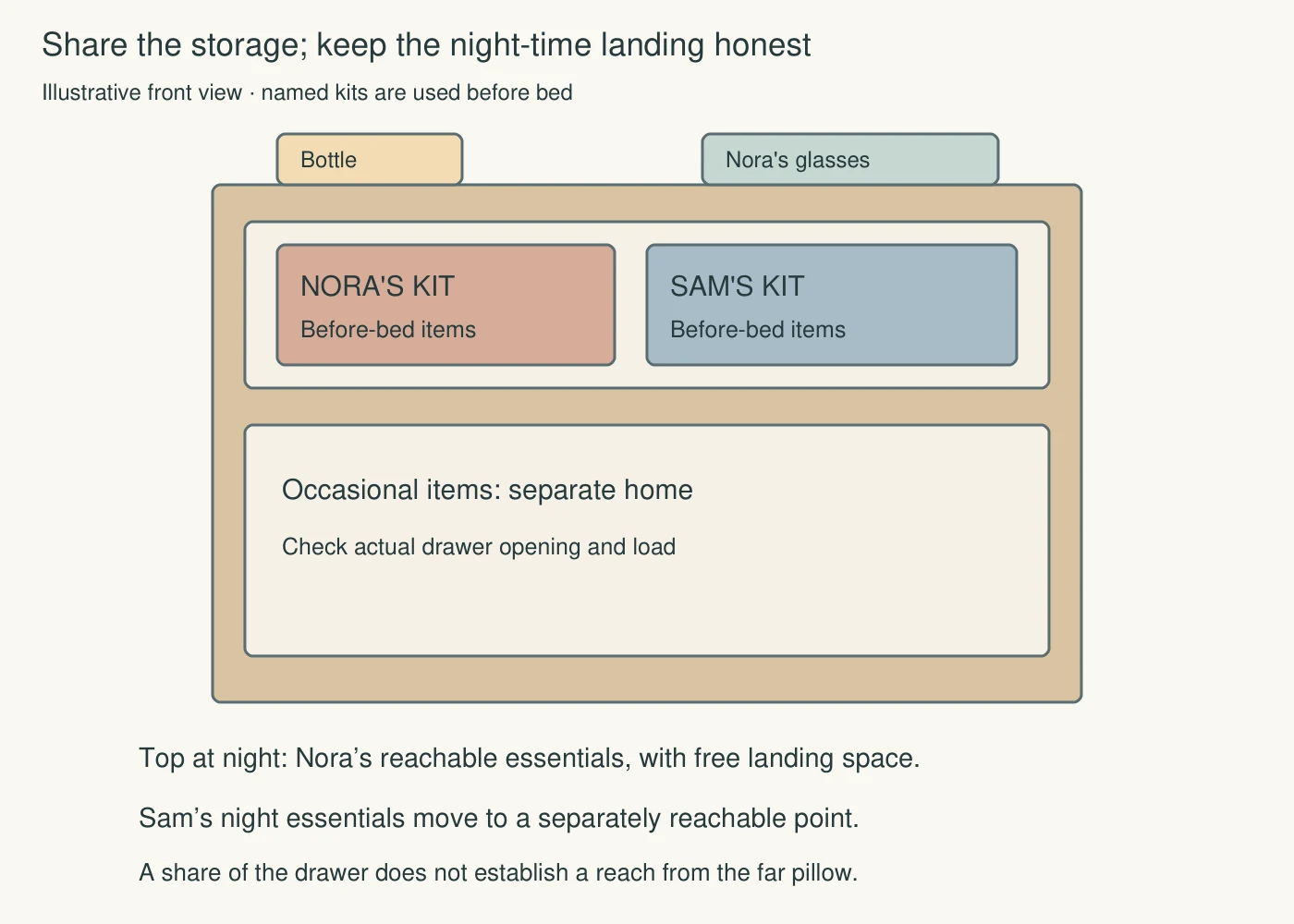
Keep the things used together in the same kit. A notebook and its pen can return together after an evening session. A few occasional charging accessories can have their own home instead of filling the top with loose leads. Measure the actual kit and drawer opening before choosing a container; a wide tabletop does not establish the drawer's usable capacity.
Decide who retrieves the kits and when. Both people should be able to use their assigned storage while standing at the table before bed. Open the drawer fully through its permitted travel and include space for the user, bedding and the other person passing nearby.
A shared drawer is not necessarily a shared-borrowing agreement. Keep personal objects recognizable, and agree before moving or using someone else's belongings. A quick evening return to named homes is easier to maintain than searching through a mixed drawer after the light is out.
Reserve the Top for the Person Who Can Reach It
A one-sided table's most valuable night-time surface is normally on the nearer person's side. Do not divide the top into equal halves and then pretend the far half belongs within the distant sleeper's reach. Assign the surface from the actual action of putting something down and picking it up.
In the illustrated room, Nora uses the left table's top for her closed water bottle and glasses case. Sam uses the table's assigned storage before bed, then takes the phone and glasses needed overnight to a suitable existing recess beside the right pillow. The table remains shared storage, while the immediate landing points are personal and independent.
Keep enough free surface for the real objects and the hand placing them. A case should rest fully on the top rather than bridging an edge or sitting beneath a bottle. Keep water away from electrical equipment and connections. If a lamp consumes the usable surface, revise the lighting or the item list instead of squeezing everything into a fragile arrangement.
Choose from the actual table height and mattress position. Test the reach with pillows and bedding as you use them. A photograph of a tidy table cannot establish that either person can retrieve an item without rolling into the other person's space.
Give the Far Sleeper an Independently Usable Night Point
Start with anything suitable that already exists beside the far sleeping position. In this example it is a recessed wall niche outside the mattress boundary, with a stable bottom that supports the small dry items. It is beside the pillow rather than overhead. The example is not a suggestion to cut a recess into a rental wall.
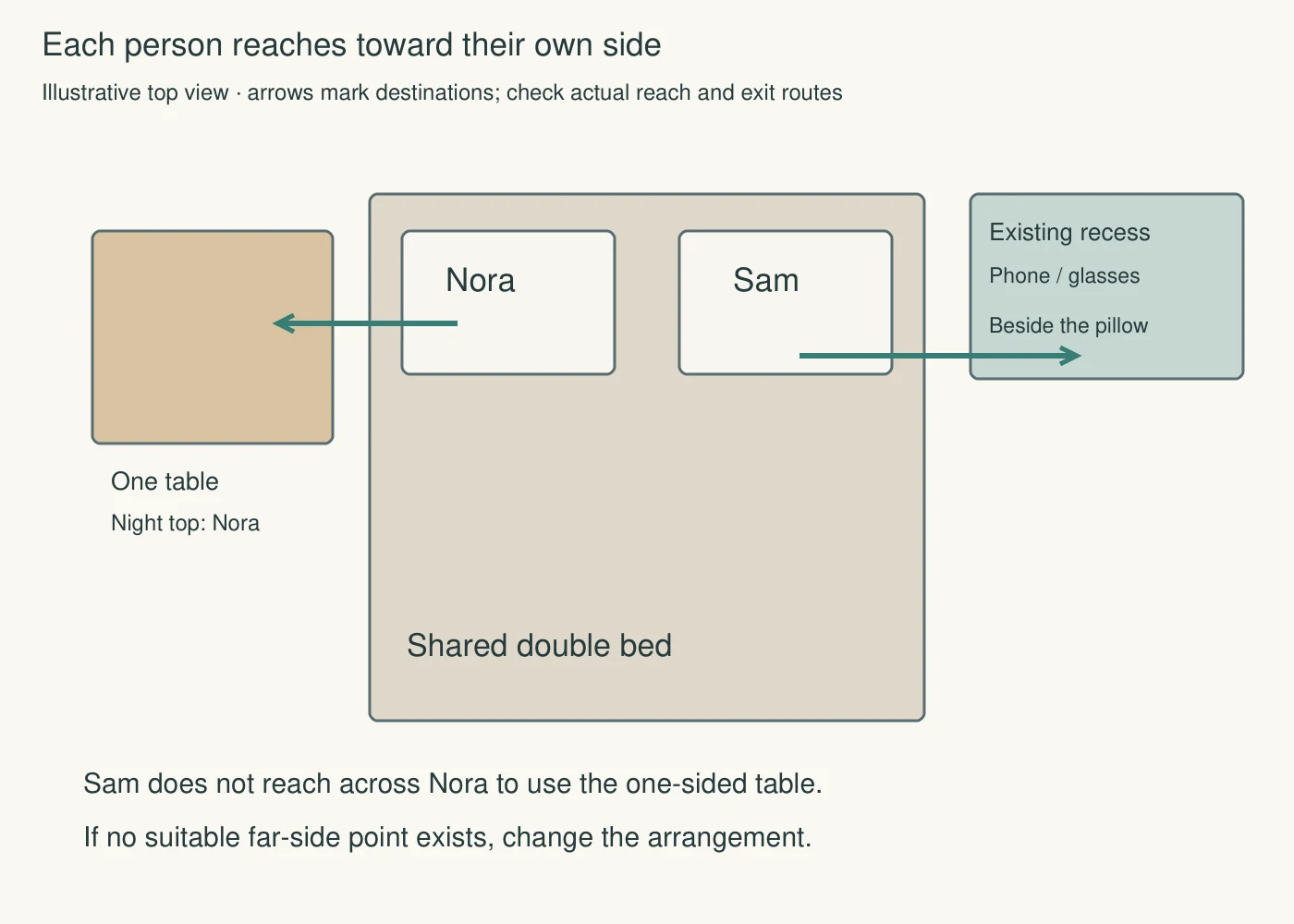
Check the actual opening, usable depth and reach before assigning objects to it. Put the phone and glasses case in place with the bed made, then have Sam sit and lie in the normal positions and try the retrieval. The items must remain supported, visible enough for the routine and clear of bedding that could sweep them away.
A properly installed small shelf or a bed-mounted support may be another option where its instructions, mounting interface and position genuinely fit. Check the wall or bed structure, attachment, permitted load and projections. A clamp designed for one rail shape is not a universal fit, and a shelf without legs can still project into the path used to get out of bed.
If there is no appropriate reachable location, consider another bed position or a different bedside arrangement. Do not solve the problem with objects on the pillow, a drink perched on a narrow frame or a container hanging from an unverified fixing above a sleeper. One table is a useful limit only while both people's essential routines still work.
Check Lights, Alarms and Cables for Both People
Each person should try the light control they will actually use at night. A switch on Nora's side is not automatically a usable control for Sam. Discuss whether they need independent reading lights, access to the room light or a different control arrangement, then check the actual equipment rather than assuming the other person will always operate it.
Check the alarm from its assigned location too. A phone left in a shared drawer may not be the place its owner can reach when waking. Choose the location from the person's actual requirements and the device's instructions, including whether it needs power there.
Keep charging equipment in a suitable location and follow its instructions. Do not run a charging lead across the mattress or route it where the bed, drawer or someone's feet will pinch or pull it. The phone in the pictured recess is not shown charging. If charging there is necessary, the setup needs a suitable power and cable arrangement before you adopt it.
Rehearse Bedtime and Getting up Separately
Run the sequence while the room is safely lit: both people use their table storage, put away the before-bed objects and move only the night essentials to their own reachable points. Then close the drawers and check that both can get into bed normally.
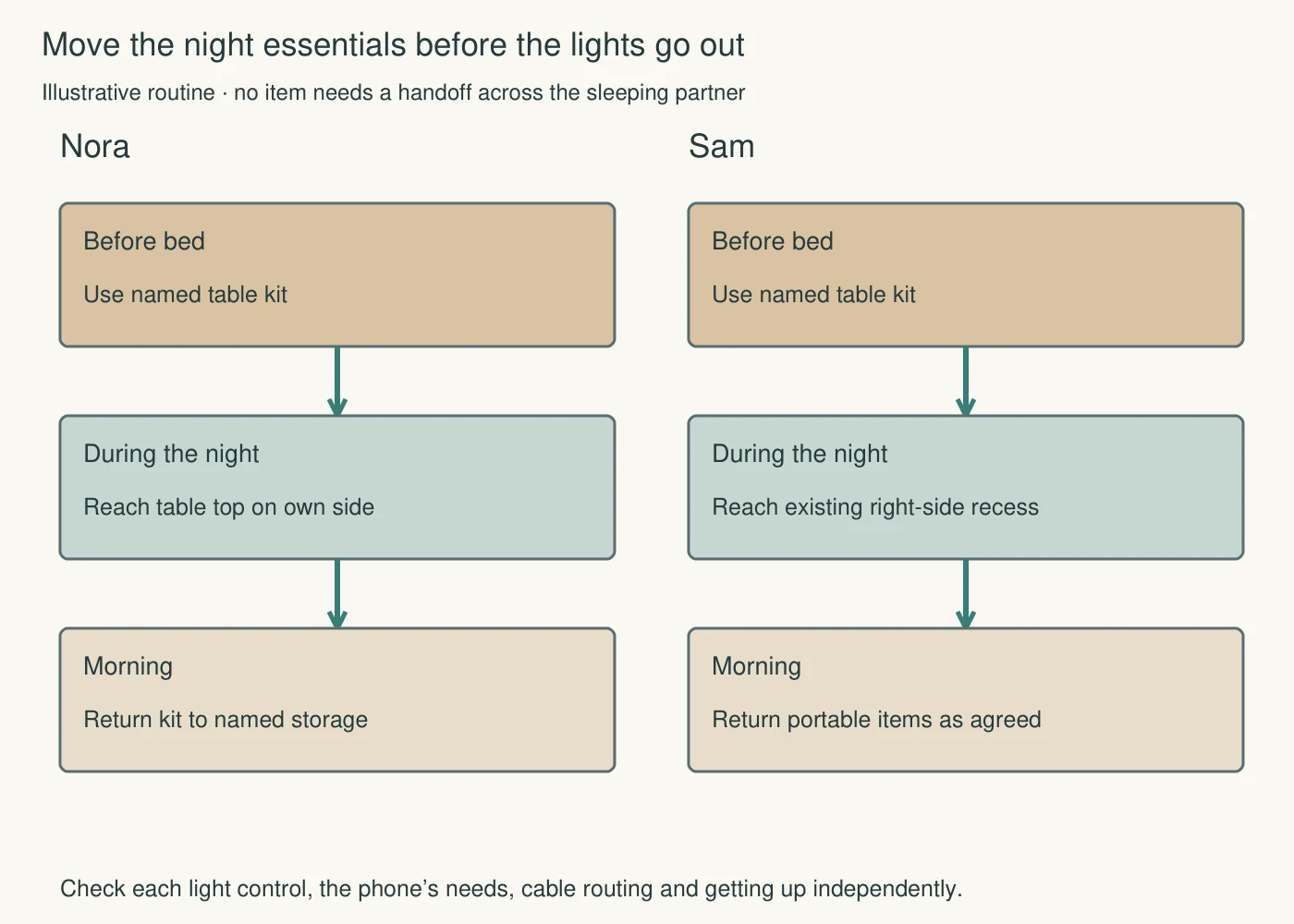
Try each person's reach without help from the other. Afterward, rehearse getting up while the other person remains in their usual position. Include where the feet land, the route beside the bed and the way around its end. Keep required exit and accessibility needs available; the empty floor under a shelf is not proof that the whole route works.
In the morning, return the portable items or kits to their assigned homes when appropriate. After a few ordinary nights, adjust any location that leads to lost glasses, a pulled cable or belongings left on the bedding. Keep the shared table's storage and each person's night-time reach as two connected parts of the arrangement, with neither expected to substitute for the other.