Choose a throw's storage place by the action of returning it after use. An open basket beside the sofa, an accessible shelf and a storage ottoman can all work, but they ask for different movements, folding and surface clearing. Try the complete return with your actual throws before buying another container.
Keep the blankets you use most near their normal seats, outside the walking route. Store occasional extras elsewhere if they make that daily group difficult to handle. A generous container is not useful when returning one blanket means moving several unrelated things.
Measure the Bundle You Will Actually Put Away
Gather the throws normally used in this room. Separate a daily pair from guest or seasonal extras, and decide whether everyone needs an individual blanket available at the same time. Do not size the storage around a single throw if two people regularly use two.
Fold or roll each one in the way you are willing to repeat. A loose fold after watching television may occupy more space than a tightly styled roll. Measure that realistic bundle's width, depth and height without forcing it down to make the proposed container seem adequate.
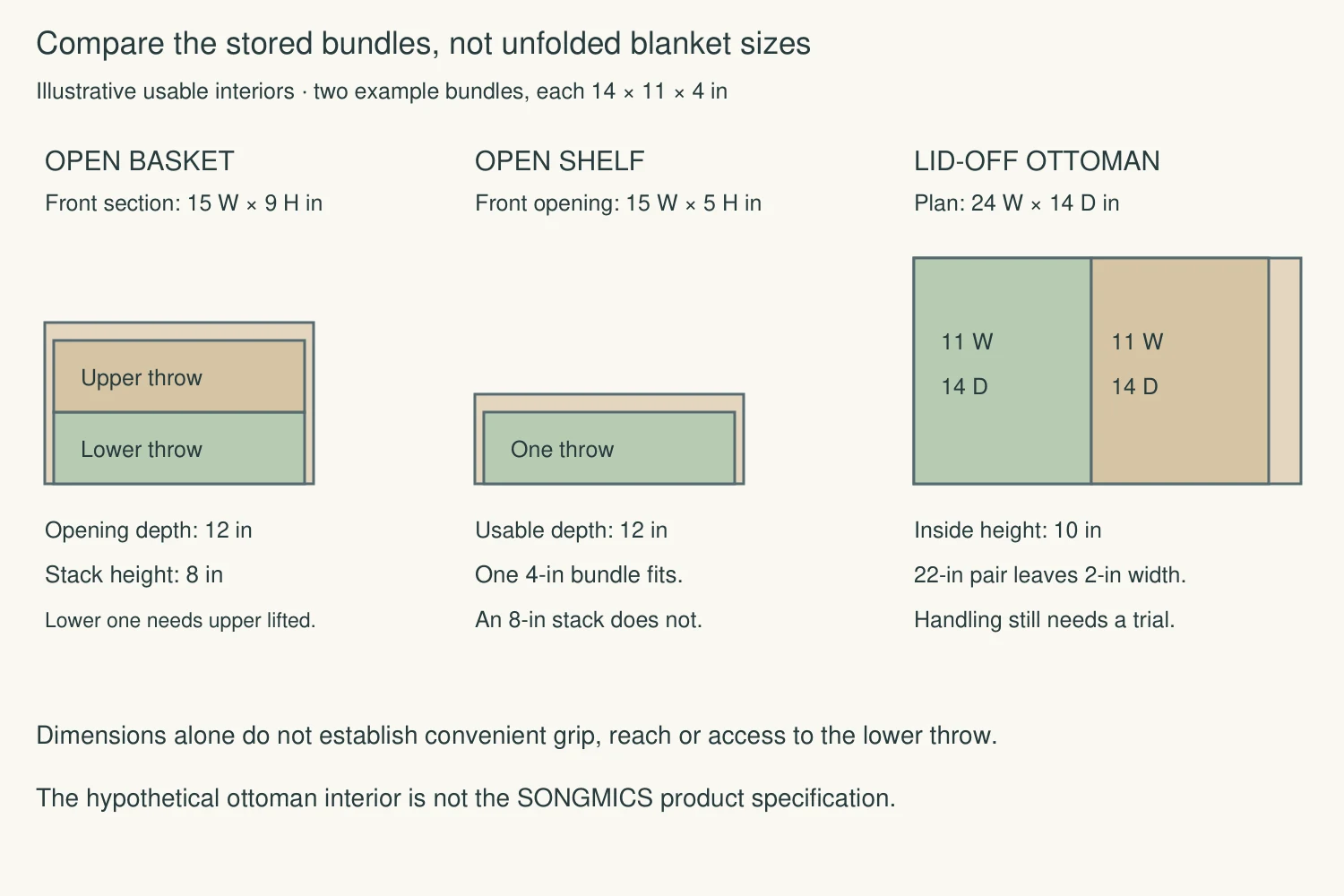
The comparison below uses two hypothetical folded bundles, each 14 by 11 by 4 inches. Your fabric and folding method may produce a different shape. Those dimensions describe the stored bundle, not the blanket's unfolded size or a recommended folding pattern.
Check the storage's narrowest opening and usable interior. Rims, tapering sides, liners, shelf fronts and dividers can reduce the space. Leave enough room for the actual grip and removal; a mathematical rectangle fit is only the first check.
Use an Open Basket for a Direct Return Beside the Seat
A low open basket suits a throw that you want to fold loosely and return without managing a lid. Place it where someone can approach it normally, rather than wedging it into a gap that can only be reached by leaning over the sofa arm.
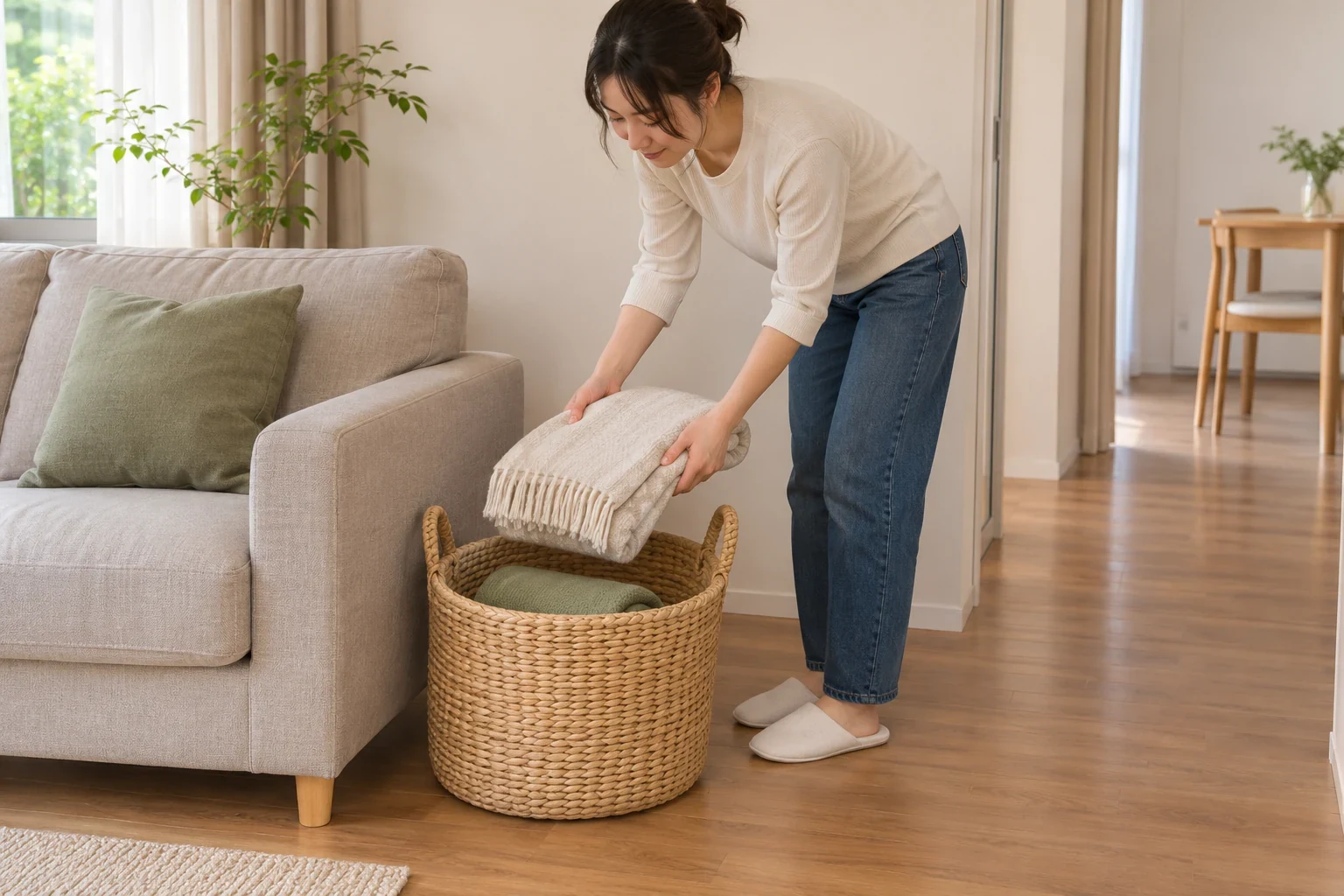
In the opening scene, the person returns a folded throw to a basket at the sofa's outer end. The front approach remains available. That is one illustrated arrangement to test, not a guarantee that any basket will fit beside your own sofa.
For the example bundles, a basket with a usable 15-by-12-inch opening and 9-inch internal height can accommodate a stack 14 by 11 by 8 inches. The 1-inch difference in height does not establish convenient hand space. Try lifting and returning the actual fabric through the real rim.
Stacking also changes access. Taking the lower throw means moving the upper one. If two people repeatedly want different blankets, test that sequence or choose a larger suitable opening that lets each bundle have its own accessible position. Do not assume that making a taller stack improves the routine.
Check the basket's inside surface against the textile and follow the blanket's care instructions. Keep handles and loose fabric from projecting into the route. The basket should hold the daily group rather than become a destination for every cushion and discarded item nearby.
Choose an Open Shelf When a Simple Fold Already Works
An existing suitable shelf can keep throws visible without adding a floor footprint. The return asks you to make a bundle that passes through the opening, place it fully on the shelf and leave it supported. Use the shelf's usable dimensions and stated load limits.
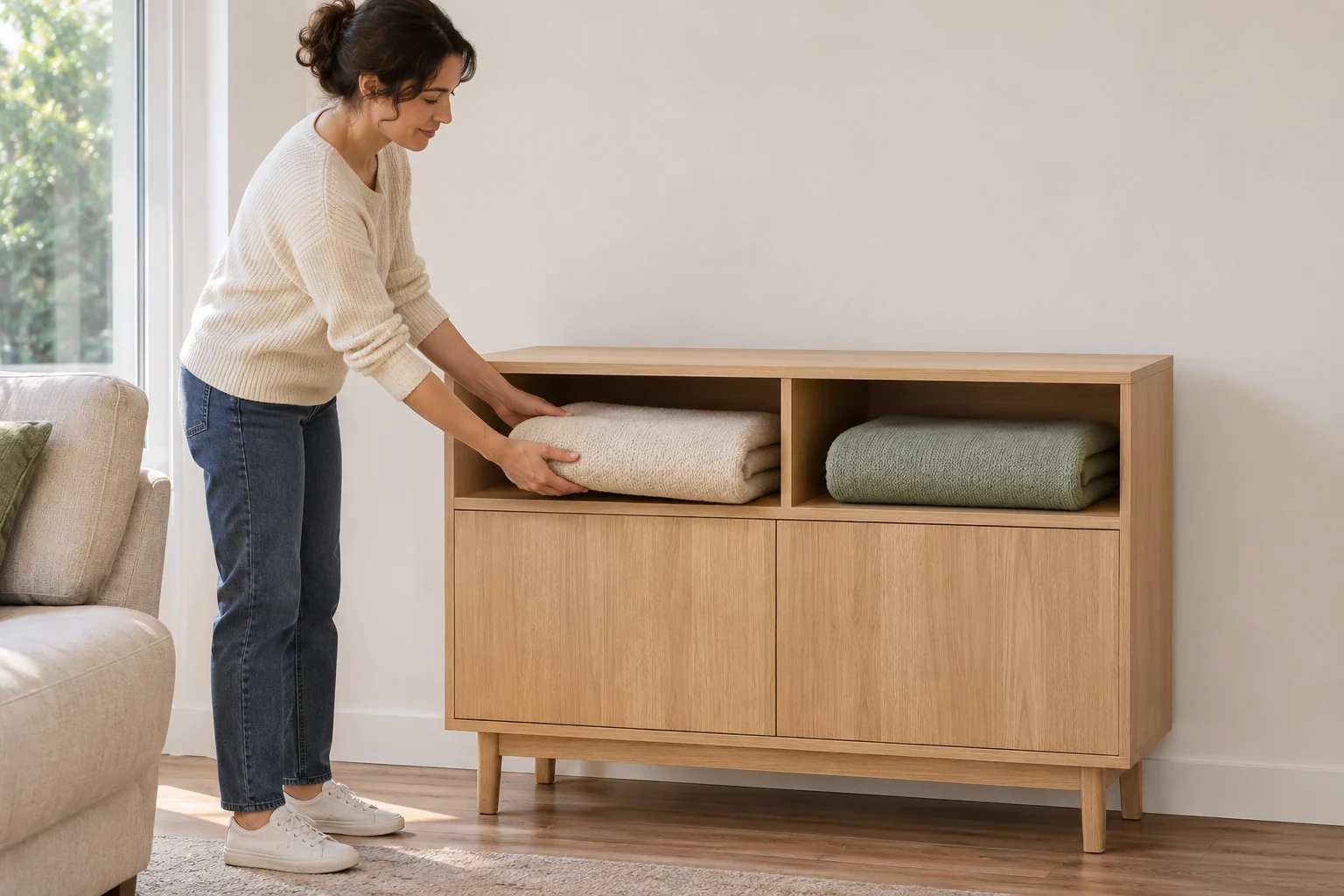
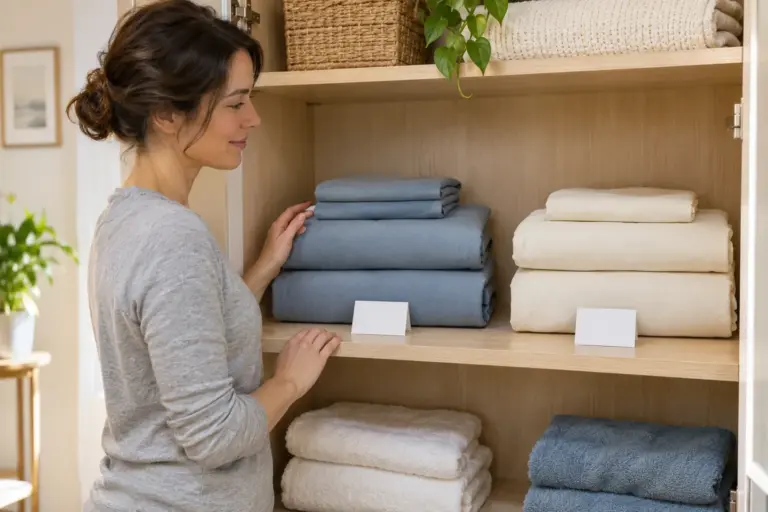
An example opening 15 inches wide, 12 inches deep and 5 inches high fits one 14-by-11-by-4-inch bundle geometrically. Two stacked bundles are 8 inches high, so they do not fit that opening. A second opening or a different location is needed for the second throw; squeezing them together changes the measured task. The shelf-return scene uses two separate openings: the green throw is already in one, while the oatmeal throw returns to the other. This is an illustrative arrangement to test, not a product dimension drawing.
Try removing the throw without dragging books or another household member's things out with it. A shelf behind the sofa, or a deep cubby filled with several rows, may be less convenient than its empty photograph suggests. Check that you can approach the opening and retrieve the blanket normally.
Keep the return standard modest. If a tidy-looking shelf requires several careful folds you never repeat at night, it may suit spare blankets better than the daily pair. The right comparison is the fold you actually make, not the fold used to style a shop display.
Use an Ottoman Only When Its Whole Opening Sequence Works
IKEA's small-living-room guidance includes furniture that combines uses, such as a pouffe with storage. Its open-and-closed storage guidance also relates storage choices to the different activities happening in a living room. Those ideas support considering existing furniture storage, while the access still needs an actual trial.
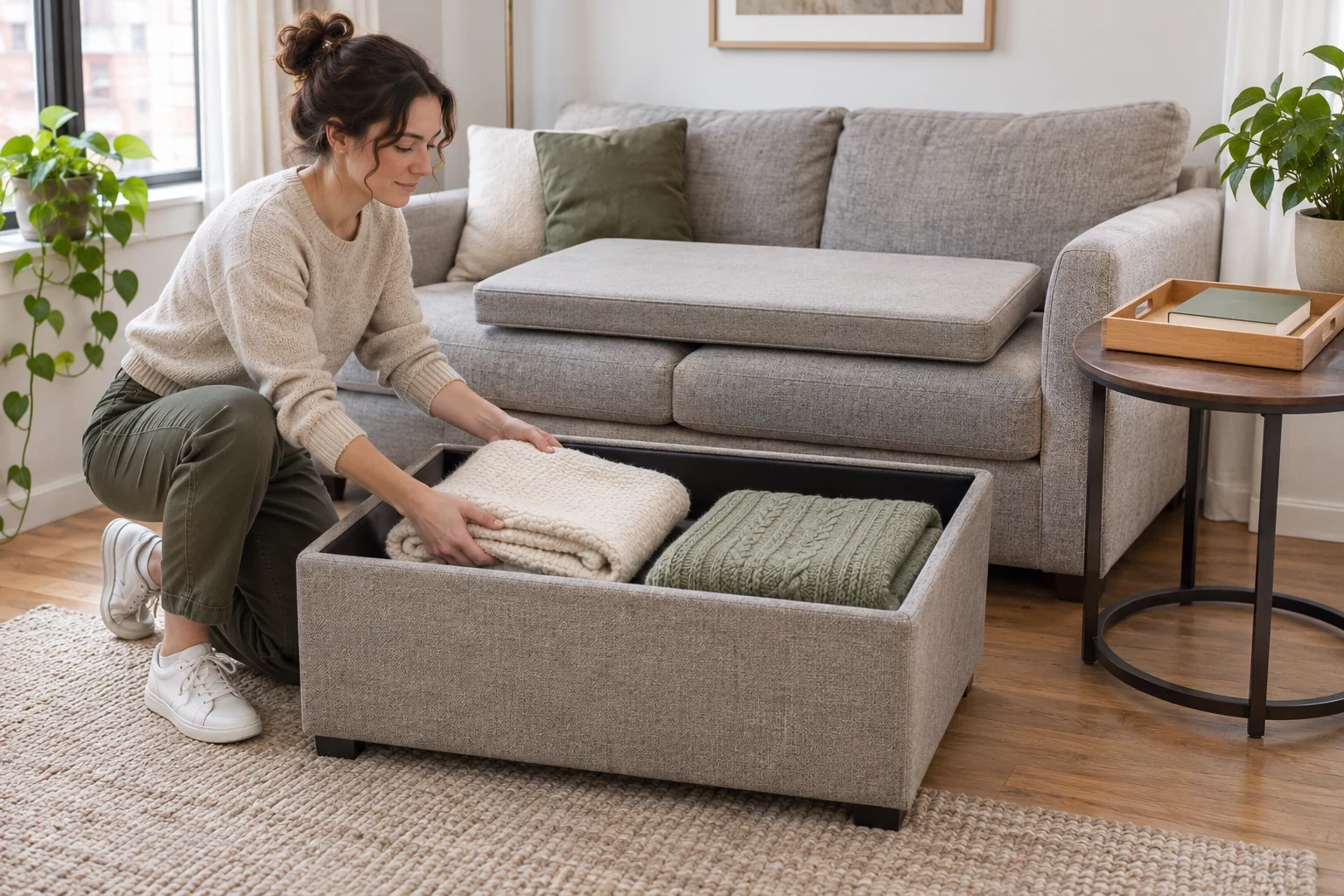
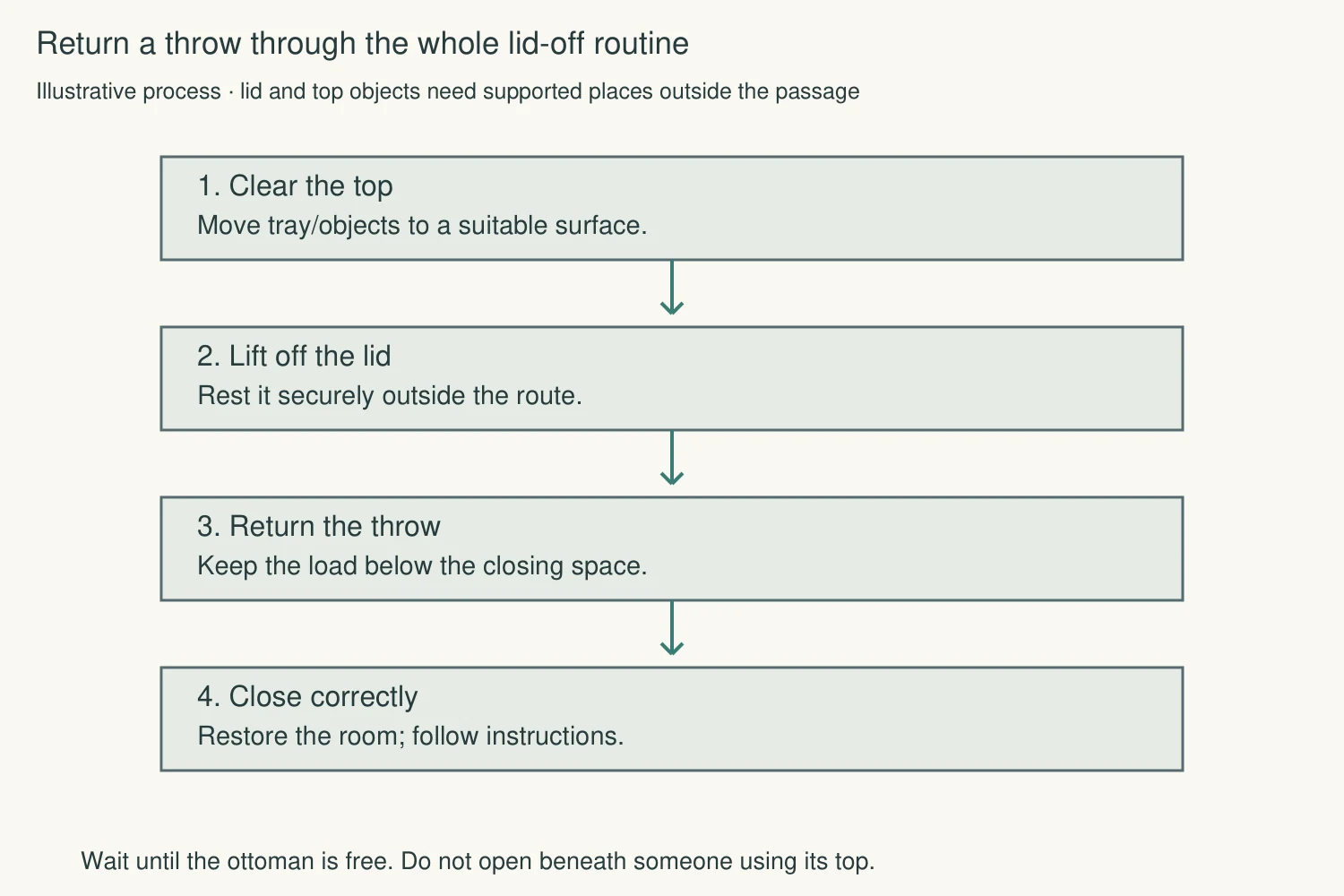
A lift-off-lid ottoman needs more than room for the closed box. Remove everything resting on top, place those objects on a suitable surface, lift the lid and put it somewhere supported outside the passage. Return the throw, replace the lid correctly and restore the normal room arrangement.
If someone is using the ottoman, wait until it is free before opening it. A drinks tray or a person's feet are part of the real access problem. Do not treat the top as available simply because it was empty when you measured the furniture.
The example interior is 24 inches wide, 14 inches deep and 10 inches high. Rotating each example bundle gives it an 11-inch width and 14-inch depth. Two side by side use 22 inches of width and remain 4 inches high. They fit those hypothetical interior bounds, although exact depth fit still calls for a real handling trial.
Those are generic inside dimensions, not the inside measurements of the product below. A seller's outside size or volume figure cannot establish how your folded throws pass through its opening, work around a divider or sit below the lid.
Compare a Covered Purchasing Option with Your Actual Trial
The SONGMICS ULSF16GYZ, ASIN B07Z4STNMT, is the 30-inch-wide, 15-inch-deep Dark Gray storage ottoman option. The selected package is one ottoman with its accessory kit or bag and instructions. The manufacturer identifies the matching finish as Slate Gray. Its lift-off top makes the lid-resting step especially relevant.
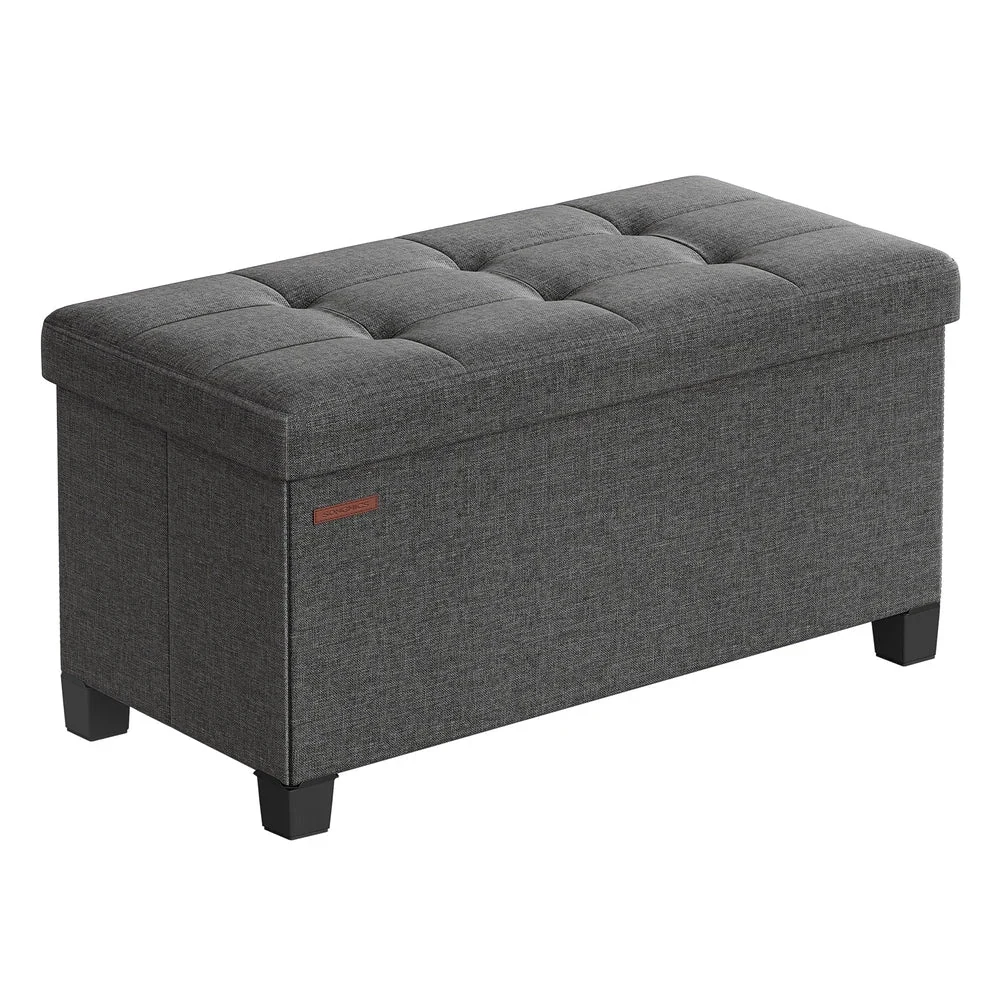
Confirm current assembled height before purchase. The selected retailer variant and overall dimensions show 15.7 inches, while other fields on the same page show 15.2 inches. The current manufacturer product data confirms the model and photograph but does not settle that difference. Confirm usable interior and opening dimensions too; no blanket count is established here.
The listing instructs users to cover the ottoman fully with its lid before sitting and not to put oversized items inside. Follow the actual assembly and use instructions and stated limits. Do not force an overfilled top closed or use a storage footrest as a step.
Disclosure: As an Amazon Associate, Livable Corners earns from qualifying purchases.
Check the SONGMICS ULSF16GYZ 30-inch storage ottoman on Amazon
Test the Return on Ordinary Evenings
Use the chosen location through several normal evenings. Check whether the person using each throw returns it, whether another object must move first and whether the room stays usable while that happens. Ask the people who actually use the blankets to try it; one person's convenient reach may not suit another.
Keep clean, dry throws ready for use according to their care labels. A damp or cleaning-needed blanket needs its appropriate care step before returning to storage. Neither a decorative basket nor a covered ottoman establishes special textile protection.
When the daily location overflows, check whether spare blankets, cushions or unrelated belongings have joined the group. Move extras to their appropriate existing homes and repeat the return trial. Choose the smallest practical arrangement that keeps the normal blankets available and easy to put back.