A tidy pile of sheets can still fail at bedtime. The fitted sheet belongs to the guest bed, the flat sheet fits your own bed, and the matching pillowcase is somewhere else. Store spare bedding as complete, identifiable kits for the beds you actually make. Give each kit a piece list and a home, then check it again after laundering.
You can start with suitable shelf space you already have. A new bag does not tell you which bed a sheet fits or replace a missing pillowcase. The useful result is being able to take one group from storage and make its intended bed without searching through the other groups.
Start with the Bed, Then Count Its Pieces
Choose one bed and write down what you normally put on it. Read the textile labels where available and check uncertain pieces against the actual mattress or pillows. Similar colors are a helpful clue, but they do not prove that two sheets have the same dimensions or that a pillowcase fits your pillow.
For an illustrative household, the main queen bed uses a blue fitted sheet, a blue flat sheet and two blue pillowcases. Its spare kit therefore contains four pieces. The twin guest bed uses a cream fitted sheet, a cream flat sheet and one cream pillowcase: three pieces. These are chosen household inventories, not standard contents promised by every bedding retailer. Your own kit may omit a flat sheet or include different pillow sizes.
Keep blankets, duvet covers and other pieces on the list if they belong to the change you want to retrieve. If a bulky item has a separate storage home, name that home on the kit card. Do not label a small stack “complete bed” when the essential cover is still unidentified elsewhere.
Make Each Spare Kit Identifiable
Gather the required clean, dry pieces on a suitable clean surface and compare them with the list. Fold them into one manageable group. If the existing shelf supports separate stacks without pieces sliding between them, you can use those stacks directly. A suitable container you already own is another option, provided the complete group fits and remains easy to remove.
IKEA's linen-storage guide recommends sorting by categories and forming sets according to factors such as size and use, then giving items defined places. Apply that idea to the actual bed rather than relying on an attractive arrangement of matching colors.
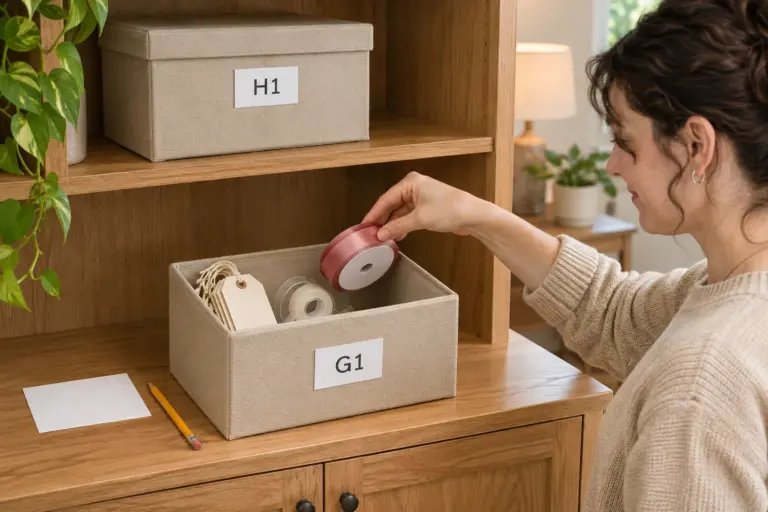
In the example, the blue stack has a card reading “Main queen — fitted, flat, 2 cases.” The cream stack reads “Guest twin — fitted, flat, 1 case.” Put the identifying information where the person opening the cupboard can see it. If another person changes the beds, check that the names make sense to them too.
Avoid borrowing the queen kit's second pillowcase to make the twin stack look fuller. If you deliberately reassign a piece, change both lists and confirm that each bed can still be made as intended. A group is useful because its contents are dependable, not because every stack looks the same height.
Give the Whole Group an Accessible Home
Choose a suitable existing storage place where the textiles can remain clean and dry under their care instructions. Test the complete folded group in that location. It needs to come out without dragging the neighboring kit onto the floor, and return without forcing a door shut against the fabric.
Keep the frequently used spare kit within the access that works for the people using it. Less frequent use may justify another suitable location, but it still needs a practical retrieval plan. Do not make reaching a high shelf while carrying a bulky stack the only way to change the guest bed.
In our example, the queen and twin kits sit side by side in separate existing shelf positions. Their cards stay at those positions. When the blue kit is in use, the empty queen position explains the gap; the cream kit does not move over to fill it. This preserves the distinction between an available spare and a kit currently on the bed.
Take Out One Kit and Check It at the Bed
Retrieve the whole chosen group. Before you start stripping the bed, confirm its identity and count against the card. For the queen example, that means one fitted sheet, one flat sheet and two pillowcases. A four-piece count alone is insufficient: four pillowcases would not make this bed.
Lay out the correct pieces on a suitable surface and make the bed in your usual way. Keep the other spare kit in its own storage position. If something does not fit, stop treating the group as ready and correct its identity or contents. Do not solve the immediate problem by quietly taking pieces from several other kits and leaving all their labels unchanged.
After the change, the queen shelf position remains empty while the blue kit is on the bed. If this household wants another ready queen spare during that period, it must identify another complete suitable group. The empty shelf does not create that reserve, and the twin kit is not a substitute just because it is available.
Reunite the Pieces After Washing
Follow each item's care instructions and return textiles to storage only when they are clean, dry and suitable to store. This sorting method does not prescribe washing temperatures, drying times or a single care process for different fabrics.
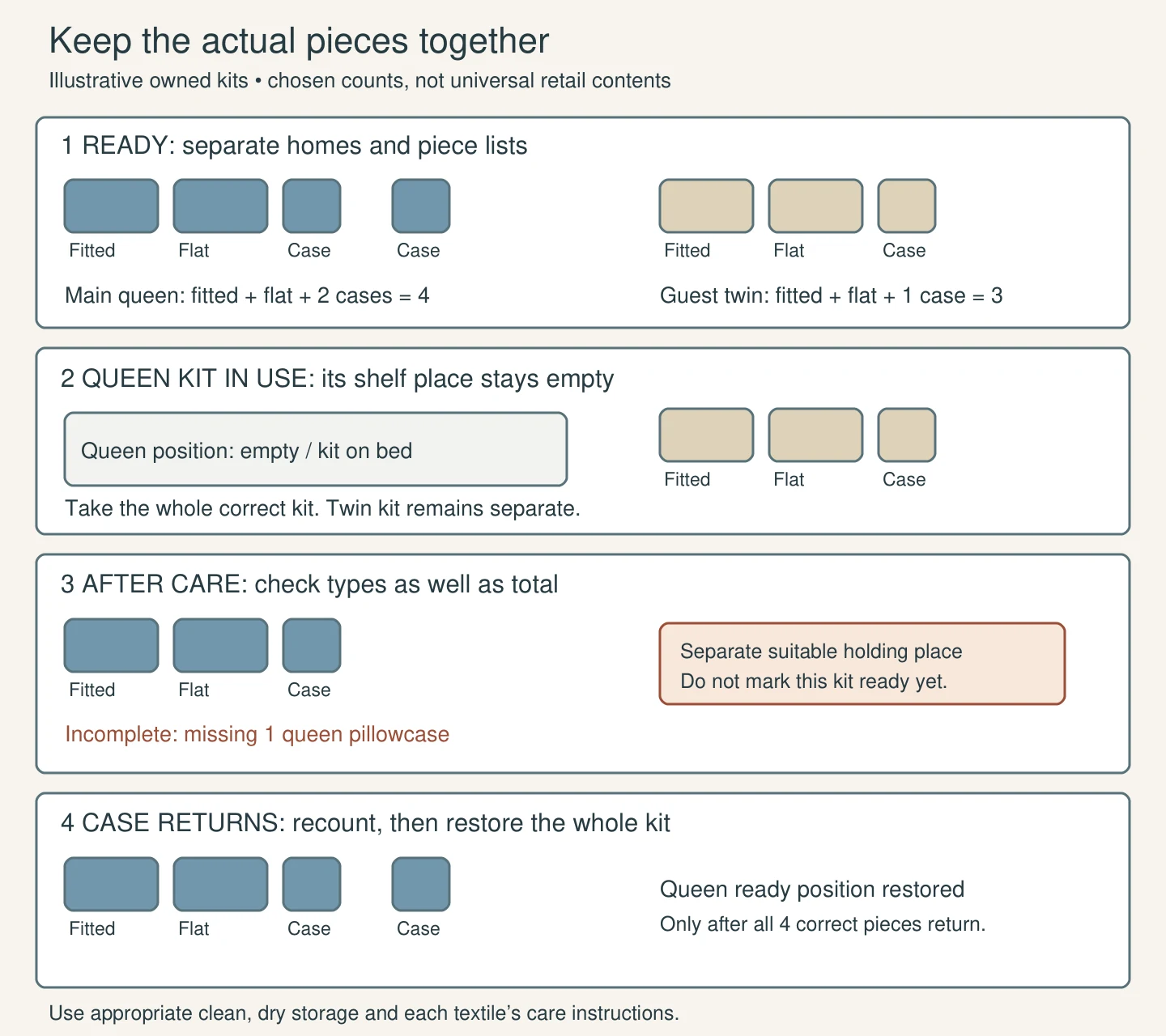
At the folding stage, reunite the blue fitted sheet, blue flat sheet and both blue pillowcases. Check the types as well as the total, fold the group and return it to the queen position. The same three-piece check applies to the cream guest kit after its own use.
If only three of the four queen pieces have returned, keep that group clearly identified as incomplete in a suitable temporary place. A simple note such as “Queen blue — missing 1 pillowcase” gives you a specific thing to find. It should not occupy the ready position under an unchanged complete-kit card. When the missing case returns, recount the group and restore it to its home.
Keep this check small enough to repeat after an ordinary laundry load. The method is working when the next person can identify a bed's complete spare, retrieve it without disturbing another kit, and return all its required pieces to the same place after use.