Give each item one short storage key, then use that key to connect its manual, identifying details and spare parts. The documents and hardware can live in different containers as long as the index tells you exactly where both are. This is more useful than keeping every booklet in one pile and every unfamiliar screw in another.
Begin with a few possessions you are likely to adjust, move or reassemble. A lamp, flat-pack cabinet and desk are a manageable starting set. You do not need to catalog the whole home before the first useful record works.
Separate the Household Key from the Manufacturer’s Identity
Choose a simple sequence such as H01, H02 and H03. Put the key on the document sleeve and the associated parts bag. It is your retrieval shortcut, not the model number and not evidence that a fitting belongs to that product.
Record the maker, exact model or article number, and any relevant size or version alongside it. A family name such as “oak bookcase” may describe several different products. If there are two similar cabinets, distinguish the actual items by a useful location or purchase reference, rather than assuming their instructions and hardware are interchangeable.
Use the item's accessible label, retained paperwork or confirmed manufacturer record to identify it. Photograph the label if that helps you read or preserve the details. Do not dismantle a product simply to find a number. If identity is uncertain, record that uncertainty and retain the evidence you have instead of filling the space with a likely model.
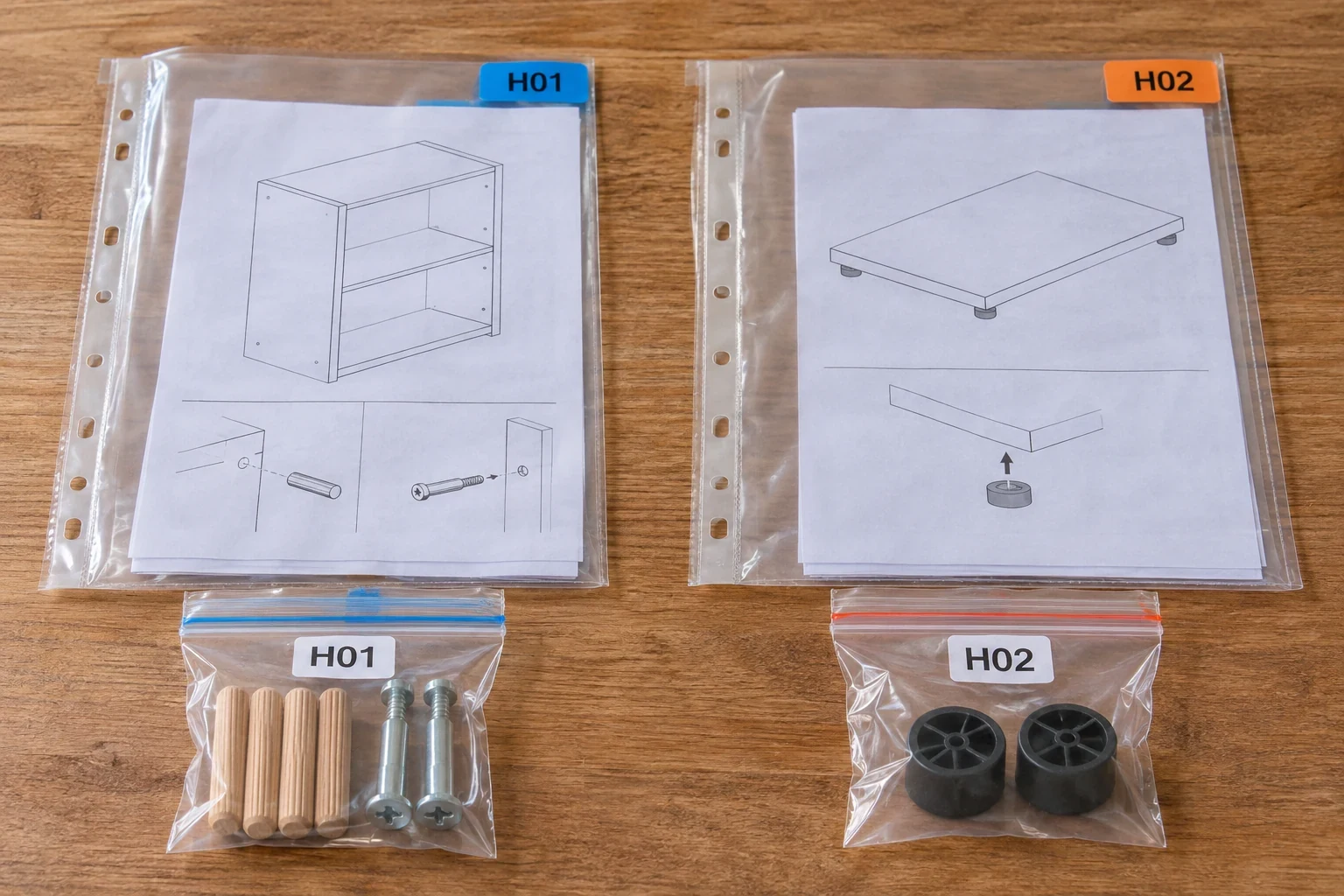
In the pictured sorting example, H01 connects one document sleeve with one closed bag, while H02 connects a separate sleeve and bag. Those labels demonstrate the filing relationship; the illustrated contents are not a parts list for a named product.
Find and Keep the Correct Document
Look first for the booklet that arrived with the item. Check its title, product reference and any version information against the actual object. Keep separate installation, operating and care documents together when they serve different purposes; the assembly sheet may not answer an electrical lamp's bulb requirements.
If a booklet is missing, search the maker's own support or product pages using the exact identity. IKEA's US help page, for example, describes searching by product name or article number, opening Product details and the assembly documents area, then opening or downloading the PDF. That is a useful route for IKEA products, rather than a naming convention every manufacturer follows.
Open the file before saving it. Check that the cover and relevant illustrations match your item and variant. A search result with a familiar product name is not enough when several sizes or revisions exist. Save the file with a recognizable name, such as H01-maker-model-assembly.pdf, and record the original manufacturer page as well as the local file location.
For an older or uncertain item, keep the unmatched document marked “candidate” until the identity can be checked. You can still record where that candidate file is, but do not relabel it as the verified manual or use its hardware diagram to identify loose fittings by guesswork.
Contain Parts by Item Before Sorting by Shape
Keep confirmed spare hardware for one item in its own suitable closed bag or small compartment. Add the household key, the item name and any confirmed manufacturer part code. Keep a set's pieces together when they are intended to be used as a set; a pile sorted only into “silver screws” and “black screws” loses that relationship.
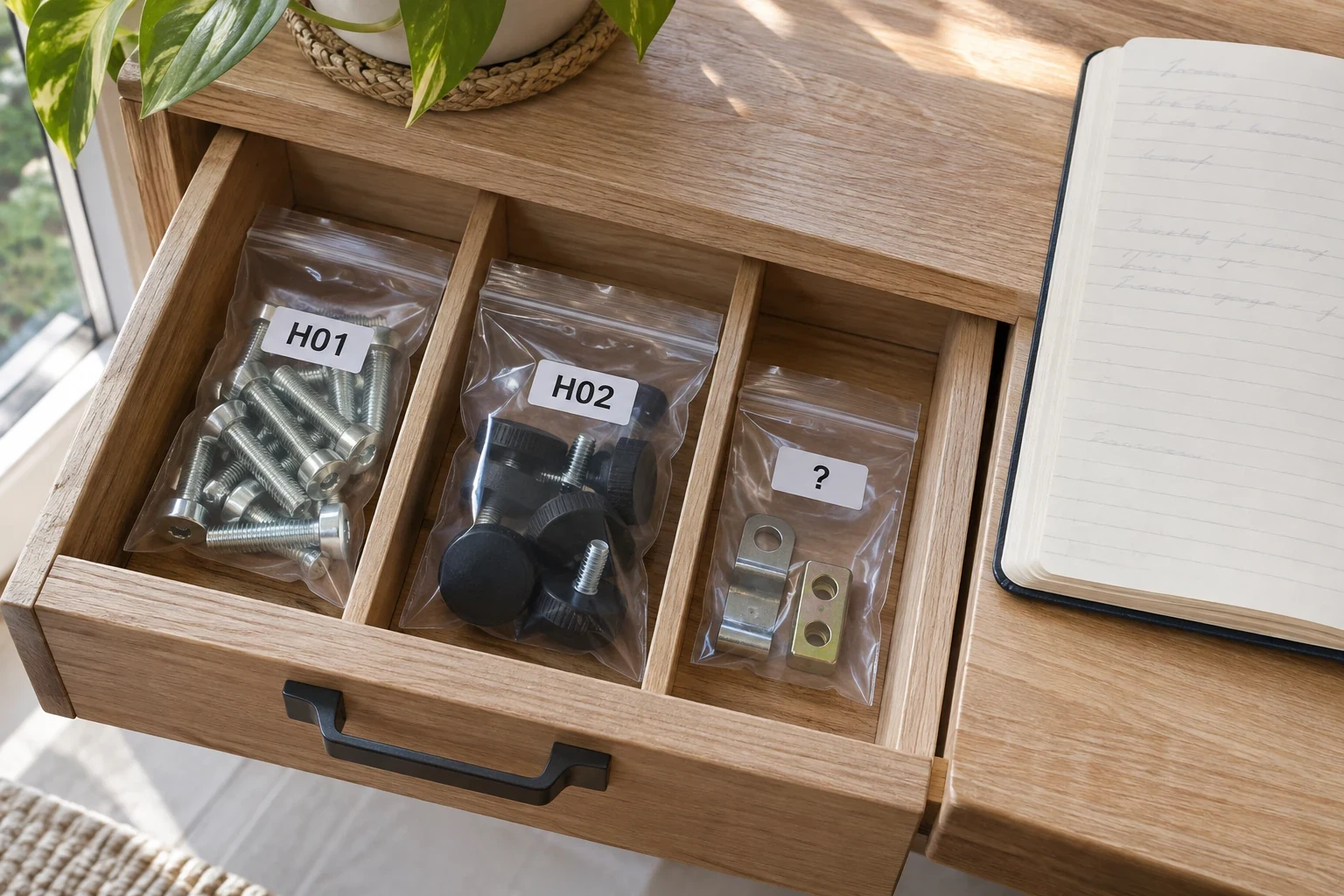
Retain the original labeled packet where it remains useful. If transferring loose pieces, copy the identifying details before discarding packaging. Note a quantity only after checking it. “Two spare shelf supports” is a useful description when those supports are identified; “all parts present” makes a much broader claim that a glance into a bag cannot establish.
Do not remove fitted hardware or safety fittings merely to make a complete-looking spare-parts collection. The record concerns pieces already supplied as spares or otherwise confirmed for storage. Keep small parts contained and stored appropriately for the household, away from children and pets.
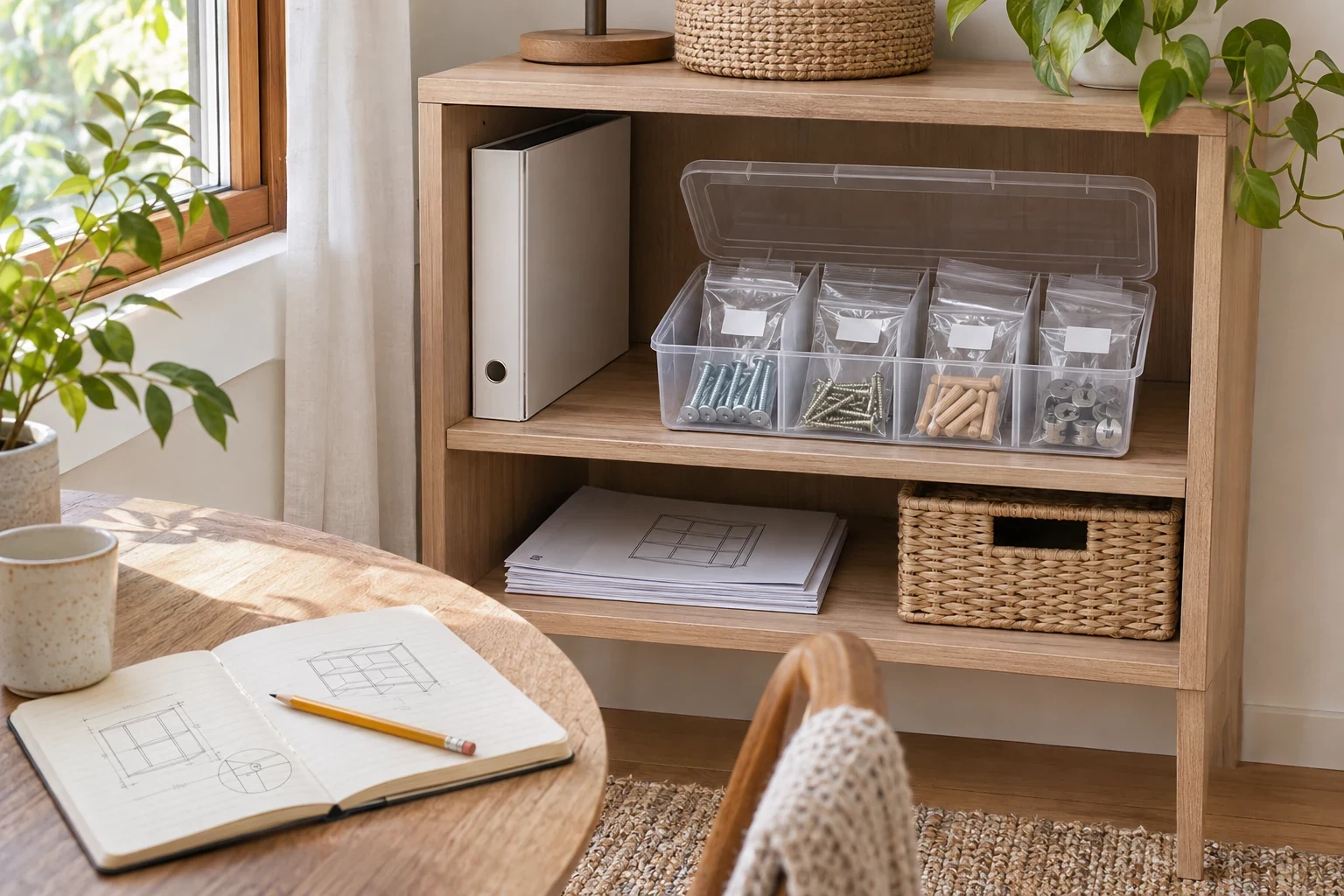
If the parts include an unknown fitting, give it a separate temporary bag. The drawer scene keeps the question-mark bag apart from H01 and H02. That prevents an uncertain piece acquiring a false identity just because it happens to fit into an existing compartment.
Build an Index That Answers Where and Which
Use paper, a spreadsheet or a plain local document—whichever you can open when you need it. Start with these fields rather than a complicated database:
| Household key | Item identity | Manual location | Parts location | Open question |
|---|---|---|---|---|
| H01 | Actual maker and model of bookcase | Binder sleeve H01; local H01 PDF | Utility drawer, closed bag H01 | Confirm the identity of an unlabeled spare |
| H02 | Actual maker and model of low table | Binder sleeve H02 | Small-parts box, compartment H02 | None recorded |
| ?01 | Owner not identified | No verified manual | Separate question-mark bag | Match to retained packaging or manufacturer help |
These are example entries to replace with your own details. The household keys are deliberately short enough to repeat on a sleeve, bag and list. Keep the exact manufacturer's identifiers in their own field so the convenient key does not replace the information needed to find support.
Name the location down to the useful container. “In storage” still requires a search; “utility drawer, rear-left compartment, H01” directs your hand to a particular place. A parts box can move to another room without changing every key if you update its named location in the index.
For digital documents, test the saved location rather than leaving only a vague note that the manual is online. If you use a cloud folder, check that the intended household user can actually access it. Keep sensitive receipts or account information out of a general shared index when a simple private reference will do.
Keep Part Codes Distinct from Product Numbers
When replacing a missing fitting, use the manufacturer's identification process for that exact item. IKEA's US guidance distinguishes products with a six- or eight-digit part code in the assembly guide from cases where a code cannot be found; the latter need help identifying the part. It also makes availability conditional. Do not assume every fitting has a code or that a similar-looking screw is an acceptable substitute.
Store the confirmed fitting code beside its description, not in place of the product identity. One number may identify the whole cabinet, another the booklet and another the small part. Writing each with its role prevents a future search from treating all three as interchangeable.
If you cannot identify a part, keep the original item, photographs and paperwork available for the manufacturer. The index can say “unidentified; do not assign yet.” That is an actionable state, whereas filing the piece under the nearest-looking product creates a misleading record.
Test a Retrieval Before Adding More Items
Pick one item from the room and start with only its ordinary name. Find its key, open the correct document and retrieve the associated parts bag. Check the identity on each. Then return both without changing their locations silently.
Try the reverse lookup too: take a labeled bag and use the key to find the item and manual. If the label leads only to another unlabeled pile, improve the location description or the physical separation. The goal is a complete round trip in either direction, not an impressive list of filenames.
Keep paper and parts where their materials suit the conditions. Do not force a heavy hardware bag into a delicate document sleeve just to keep everything physically touching. A slim binder and a separate contained parts box can form one system when the labels and index connect them clearly.
Update the Record When the Home Changes
When an item moves, update its room location and the parts container's location if that changes too. During a house move, put the key on the packing list and keep the manual and confirmed hardware identifiable. Record any newly removed assembly parts separately from the original spares so their purpose remains clear.
When selling or passing on an item, include its appropriate instructions and confirmed associated parts. Remove or archive the active index entry once it leaves. Check private information before passing on receipts or annotated papers.
You can build this small system with suitable containers and paper you already own. Buy another organizer only when the actual collection needs a capability the existing one lacks. Consistent identity, separate uncertain pieces and precise locations do the important work.