Store each board game as a complete, identifiable set before deciding how it looks on the shelf. Check its contents, enclose the small groups that could escape their compartments and choose a box orientation that keeps those groups together. Then make the end-of-play return as deliberate as the setup.
Start with the original boxes and packaging you already have. A new cabinet will not solve a missing bag of pieces, and putting every game into matching containers can remove the labels and instructions that make the collection easy to use.
Check One Actual Game at a Time
Open one game on a clear surface and find the component list for the edition you own. Match the pieces to that list before changing the packaging. Keep any expansion identifiable, especially when its pieces resemble those from the base game.
Edition matters. CATAN's publisher documents changes to box sizes, component design and some contents across its English editions, and notes that accessories may not all be compatible. That is a reason to use your own game's instructions rather than applying a generic online count to every box.
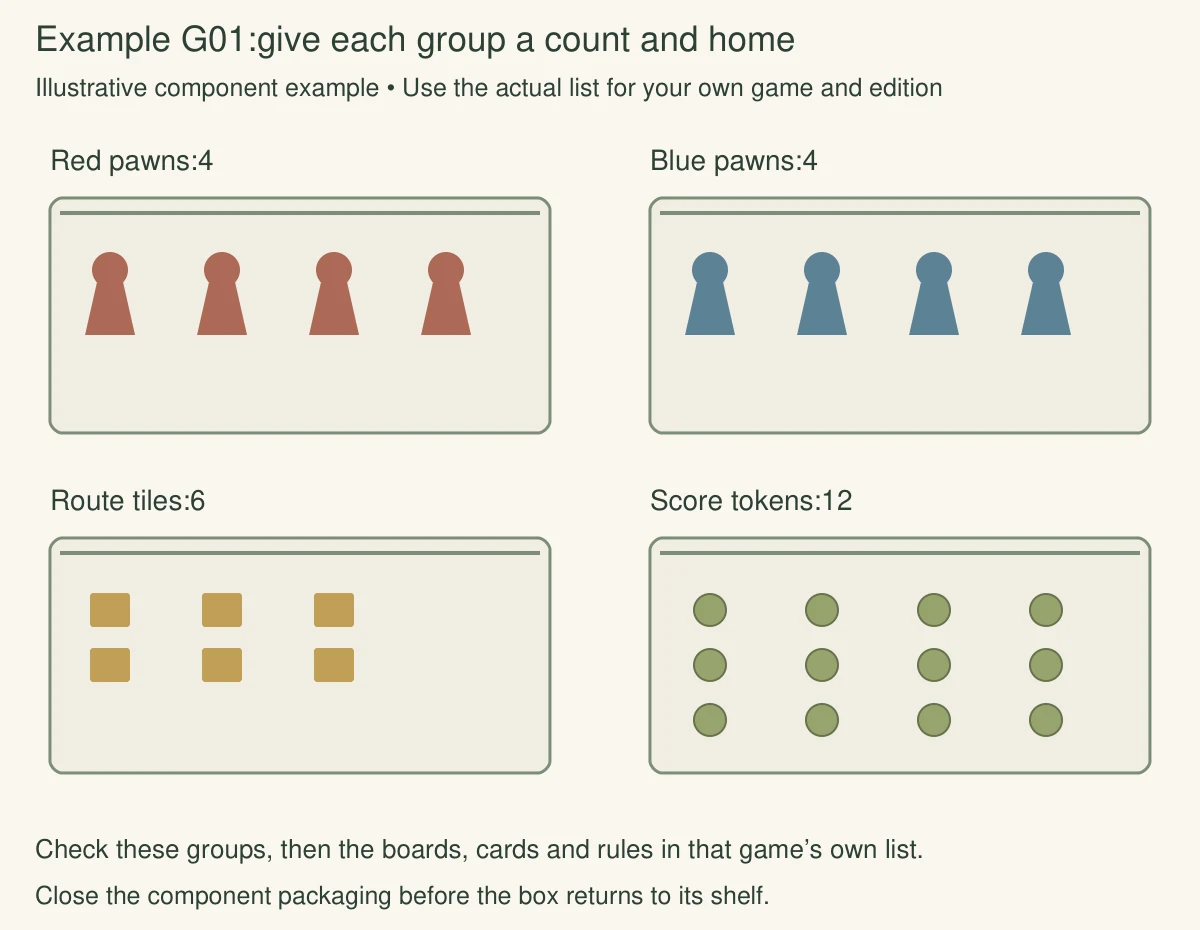
For a simple organizing example, suppose a game labeled G01 contains four red pawns, four blue pawns, six route tiles and twelve score tokens. The illustrated checklist makes those four groups visible. These are example contents, not the inventory of a named commercial game.
| G01 example group | Expected count | Return position |
|---|---|---|
| Red pawns | 4 | Red-group bag |
| Blue pawns | 4 | Blue-group bag |
| Route tiles | 6 | Tile compartment or closed bag |
| Score tokens | 12 | Token compartment or closed bag |
Use the same idea for your real game, including cards, boards and instructions where its list requires them. If something is missing, record the specific part and edition before packing away. Do not complete the count by borrowing a similar-looking piece from another game without preserving that distinction.
Enclose the Groups Before Closing the Box
Keep a working original insert when it supports the contents properly. Use the supplied bags, card sleeves or other retained packaging where they belong. Close each resealable bag completely; a bag folded loosely over its contents is still an opening through which small pieces can leave.
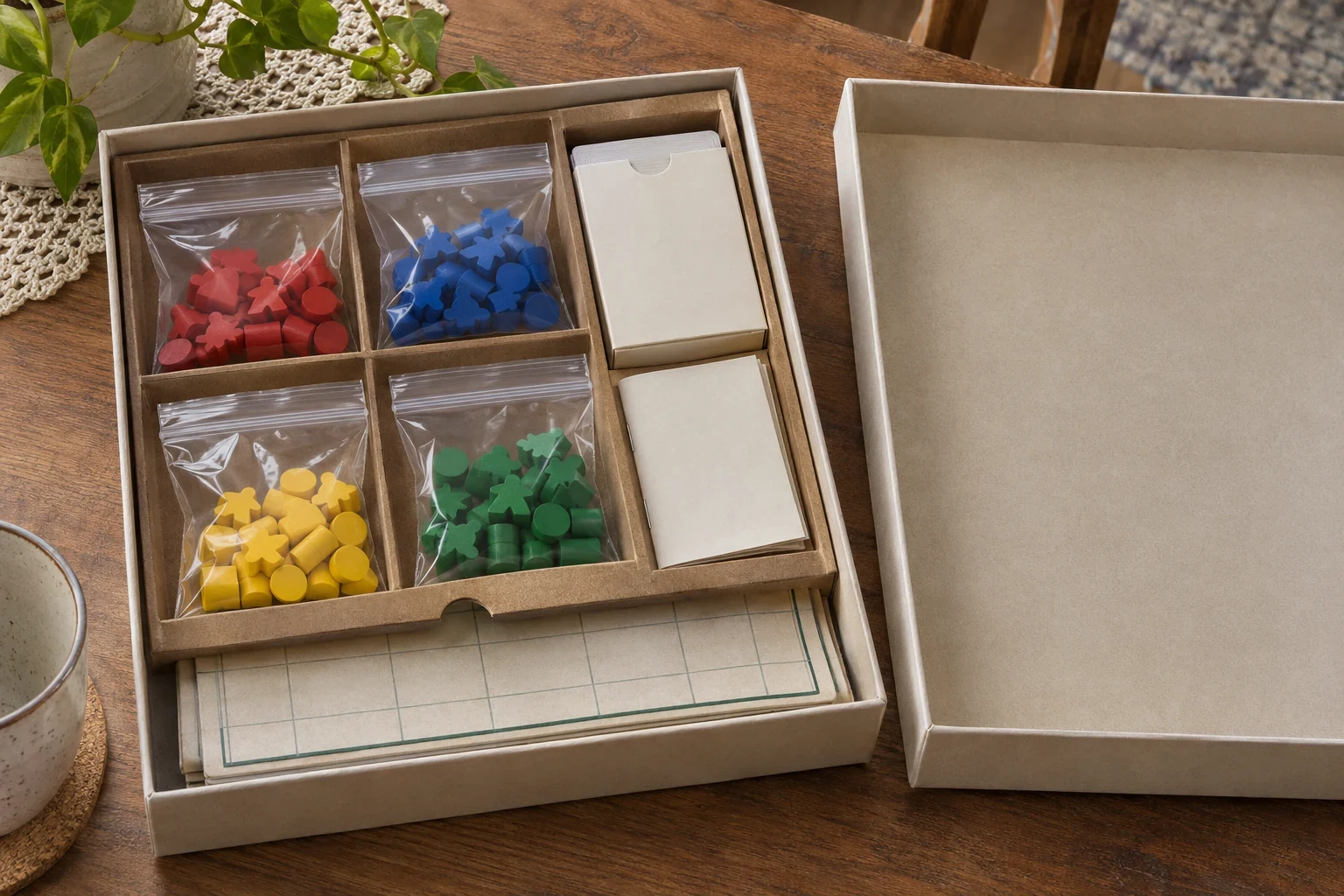
Separate groups in a way that helps the next setup. Player-color sets, shared tokens and cards may need different homes. Avoid combining everything into one large bag if each session then begins with sorting a heap of unrelated pieces.
The packing scene shows a generic box with small groups inside closed bags and cards in their own sleeve. The board and rules remain with the set. Its purpose is to show physical containment, rather than prescribe that every game needs the same number of bags or the same insert.
Keep the lid seating normally. If the new arrangement raises it, check what changed: an overfilled bag, cards returned at an angle or an extra expansion may be taking space the original layout did not allow. Do not compress the contents by forcing the lid down.
Keep any labels readable without hiding the pieces you need to check. For an expansion, a small ordinary label identifying the game and expansion can prevent a bag from becoming an anonymous collection. Choose a label method appropriate to the packaging and preserve information on the original box.
Choose Flat or Upright Storage from the Packed Box
Flat storage can suit an insert that relies on gravity to keep pieces in its wells. Keep stacks small enough that the intended user can take the chosen game without an awkward lift. Putting the current favorite at the bottom of a tall stack creates work every time someone wants to play.
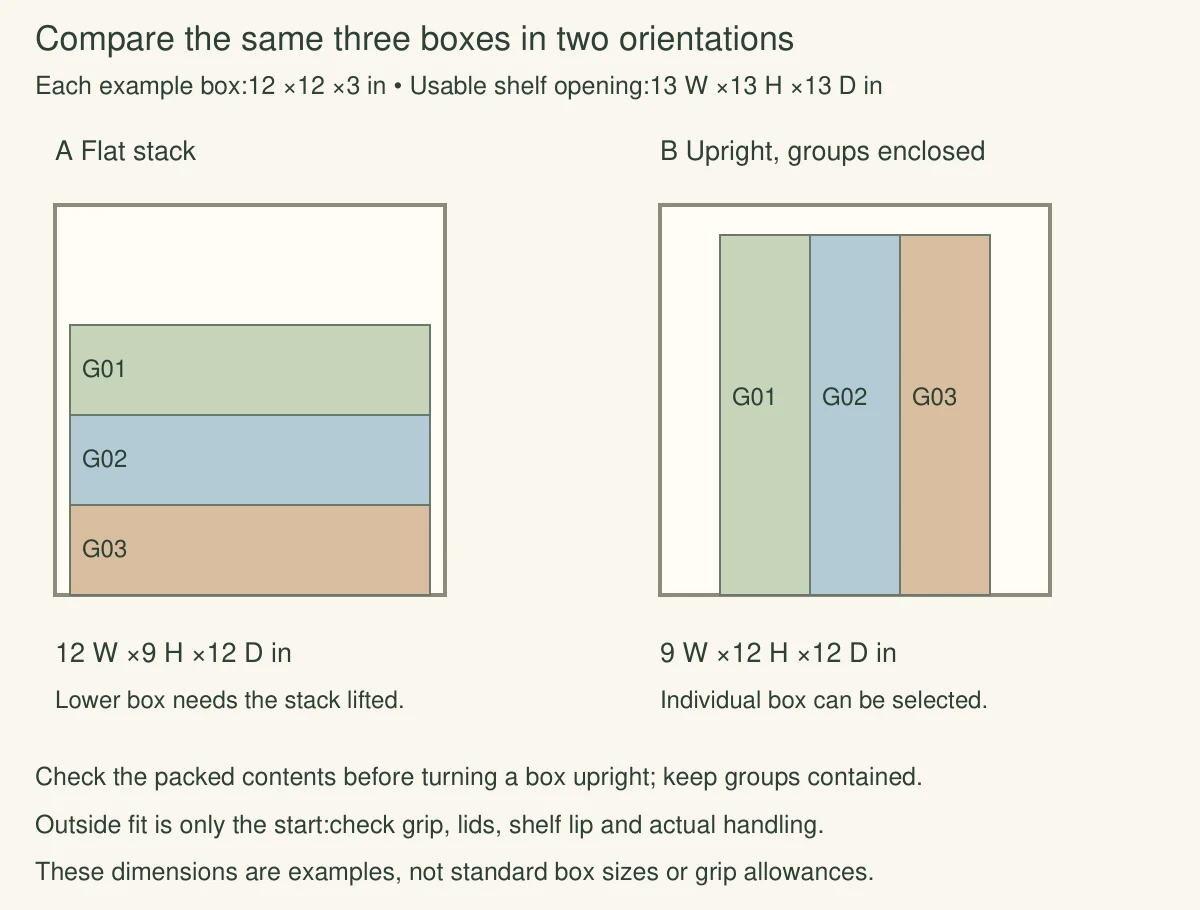
Upright storage can make individual boxes easier to select, but first check the packed contents. An insert that works flat may let loose parts leave their compartments when turned. Enclose those groups appropriately or retain a flat position; an attractive line of box spines does not establish that the pieces stay organized.
With the box supported on a clear surface and the lid held appropriately in place, gently check the intended orientation. Follow the game's packaging instructions where supplied. Do not shake the box or lift a heavy set by its lid as a test. Reopen it to see whether the component groups remained where they should.
The shelf comparison uses three hypothetical boxes, each 12 by 12 by 3 inches. Flat, they make a stack 12 inches wide and 9 inches high. Upright beside one another, they occupy 9 inches of width and 12 inches of height. Both arrangements remain 12 inches deep.
The illustrated opening is 13 inches wide, high and deep. Those rectangles fit, but that alone does not prove comfortable retrieval: check fingers, projecting lids, the shelf lip and the actual box weight. The dimensions are an example comparison, not a standard game-box size or a required shelf allowance.
Put the Frequently Played Games Where They Can Leave Easily
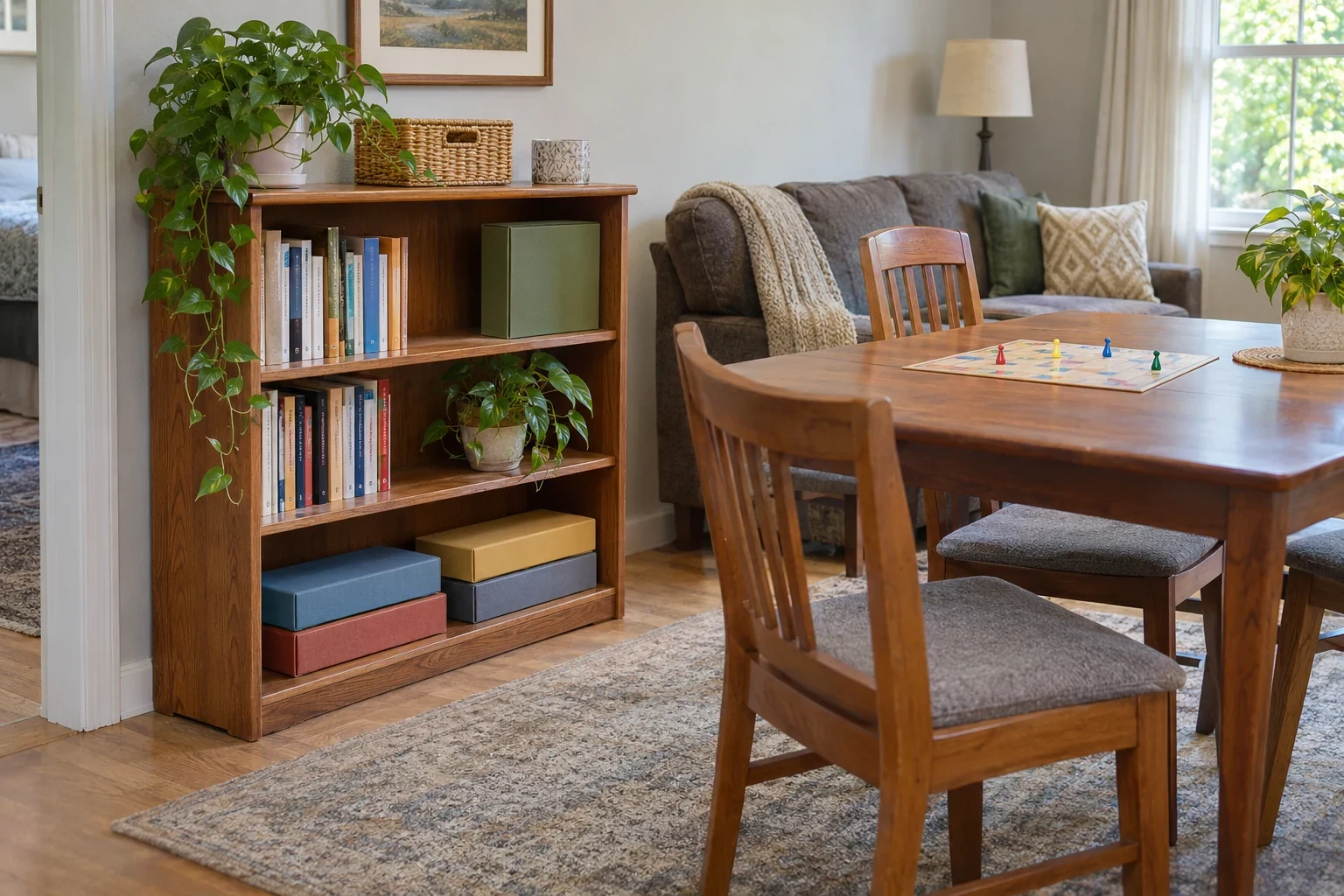
Group current favorites in a position the intended users can reach and return to. Keep larger or heavier boxes in suitable lower positions when that makes handling practical. Check the furniture's actual instructions, shelf loading and installation rather than assuming a low-looking unit is appropriate for any collection.
Use the usable shelf opening, not just the cabinet's outside width. Doors, hinges and fixed dividers can reduce the space through which a box comes out. A box that fits behind a closed door may still be awkward to turn or grip during retrieval.
IKEA's living-room storage examples show adjustable shelves for adapting to a collection's height. Apply that idea to the actual game boxes while keeping the furniture within its instructions. Do not remove a structural part to gain one more game slot.
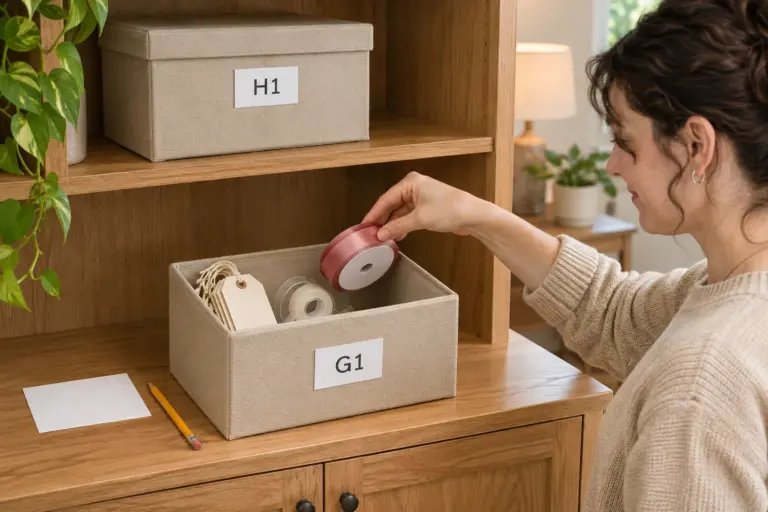
Keep the game's label visible in its chosen orientation. If the boxes look similar, an ordinary shelf-location label can help people return the right set without creating a second unexplained numbering system. Keep the game name or household code consistent between box and component groups.
Make the End-of-play Check Part of the Routine
Before clearing the table, return each group to its own position. Check the floor and the area around chairs for pieces that may have fallen during play. Keep unrelated household objects out of the box, even if they resemble a token or seem convenient to tidy at the same time.
Use the game's actual component list or a simple checklist derived from it. For the G01 example, the return check is four red pawns, four blue pawns, six tiles and twelve tokens, then the remaining items in that game's list. A quick glance at a full-looking bag does not necessarily establish the count.
Return cards in their intended groups and put the instructions with the box. Close the component packaging, replace the board and check the lid before returning the set to its shelf. The useful sequence ends with a complete box, rather than with a table that merely looks clear.
If the household stops a game halfway through, give that state a deliberate temporary location. Keep the packed components and any permitted record of the game together. Do not mix a partly cleared session into the normal ready-to-play shelf and expect the next person to know what is missing.
Keep Missing Parts and Expansions Visible in the Record
For an incomplete set, note the part, expected quantity and the edition information needed to identify it. Keep a small reminder with the box so the next player does not discover the problem only after setting up. Check the publisher's appropriate support route if a replacement is needed.
Keep an expansion's identity even when it shares a larger box with the base game. Record what was combined and retain the relevant instructions. A combined box is helpful only if the contents remain understandable and the packaging still closes without pressure.
Review the shelf when actual use changes. Move a newly popular game into a practical position and remove unrelated items from its space. The strongest storage system is the one people can repeat: check the set, enclose the groups, close the box and return it where the next game can begin.