Choose open storage for things you want to see and retrieve directly, opaque closed storage for things you want contained out of view, and a mix when your living room needs both. Start with the actual contents and the way you use them. A room full of matching doors can still be awkward to use, while a carefully chosen open shelf can be useful without becoming a display project.
The important choice is not a fashionable percentage of open shelves. It is which objects deserve immediate access, which belong together behind a front and whether the furniture still works when someone opens it. Glass doors add another possibility: visible contents with a physical front, rather than hidden storage.
Sort the Contents Before Choosing the Front
Gather a representative group of living-room possessions. Separate books you reach for, objects you enjoy displaying, loose supplies that travel together and things that actually belong elsewhere. Keep the categories specific enough to size: “current drawing project” is more useful than a general pile called clutter.
Then ask two separate questions about each group: do you want to see it, and do you need to reach it often? A favorite bowl may belong on view even though you rarely handle it. A charging cable may be used daily while adding little to the room's appearance. Frequency alone does not decide whether a front should be open.
Do not buy capacity for objects that are simply passing through the room. Returns, laundry and papers waiting for another destination can fill any new cabinet. Decide what the living room genuinely stores before turning a temporary backlog into a permanent furniture requirement.
Measure the largest rigid objects and the containers you intend to keep. Note height, depth, width and the orientation needed for retrieval. A tidy front does not tell you whether the game box inside can come out without unloading its neighbors.
Use Open Shelves for Useful Visibility and Direct Access
Open shelves suit a working book collection, a modest display and a small task kit whose contents can remain visible. You can see what is there and take it without opening a door. In the reading arrangement, books and a folder occupy their own shelf spaces while a throw sits in a separate compartment.
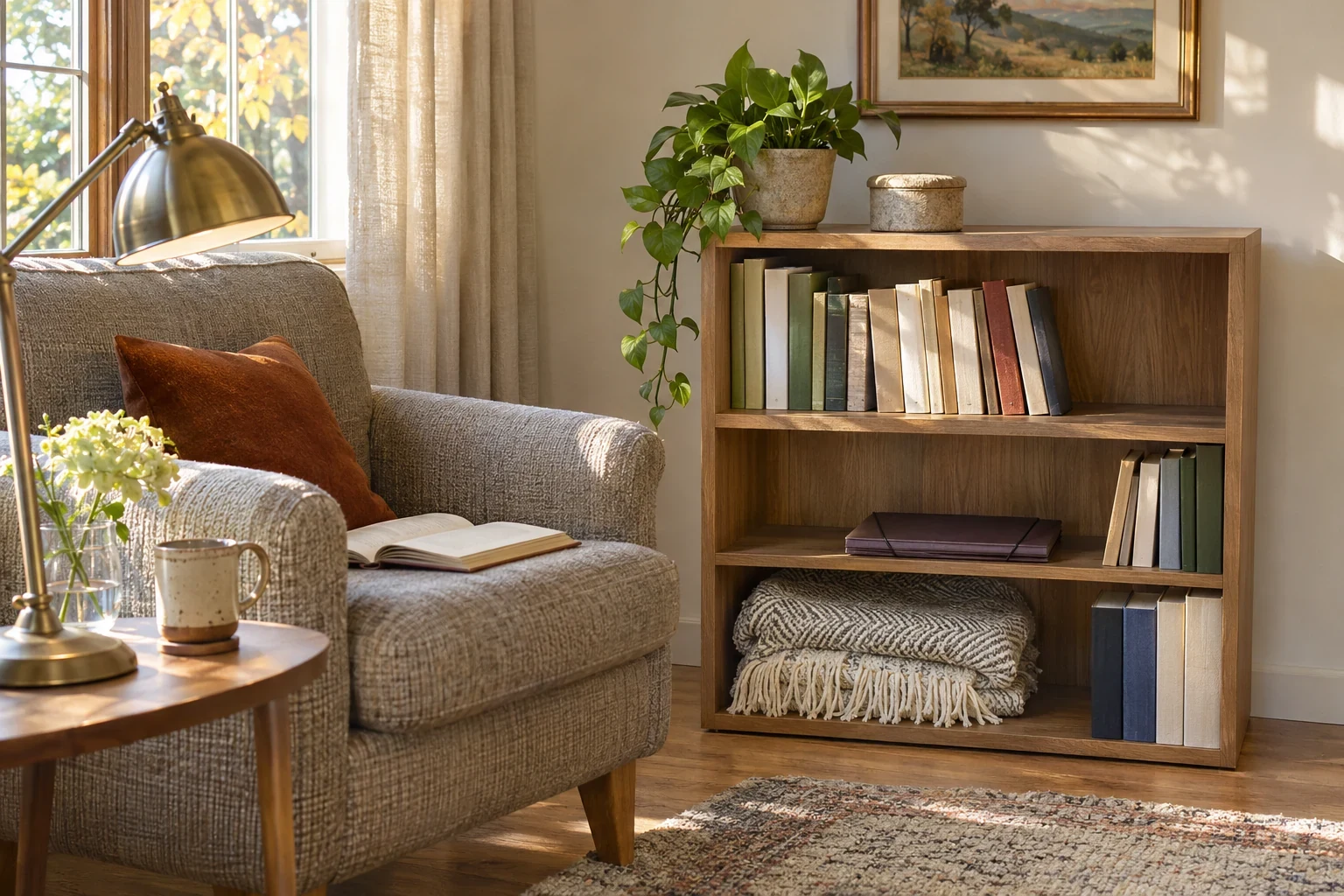
Keep retrieval in mind when arranging the row. A book pressed tightly beneath a shelf can be hard to grip. A basket that fits the opening edge to edge may have no comfortable place for your fingers. The useful capacity includes the way an object comes out, not just the rectangle it occupies while stored.
Open storage also puts everyday changes on view. A half-finished project may look entirely appropriate in your home; a mixture of unrelated receipts and spare cables may be harder to live with. Use a suitable small container where it genuinely groups a task. Avoid filling every open compartment with matching boxes if that removes the direct access that made open shelves attractive.
Leave cleaning access around the objects you expect to keep. If maintaining a carefully layered arrangement would require repeatedly moving fragile pieces, make the display simpler or choose a different front. “Open” does not have to mean many separate decorative objects.
Choose Opaque Doors When Concealment Earns the Opening Step
Opaque doors can keep mixed-looking supplies, occasional games or a household work kit out of the room's main view. They are useful when the contents have a clear home but do not need to contribute to the visible arrangement. Closing a door conceals the contents; it does not sort them or make their capacity unlimited.
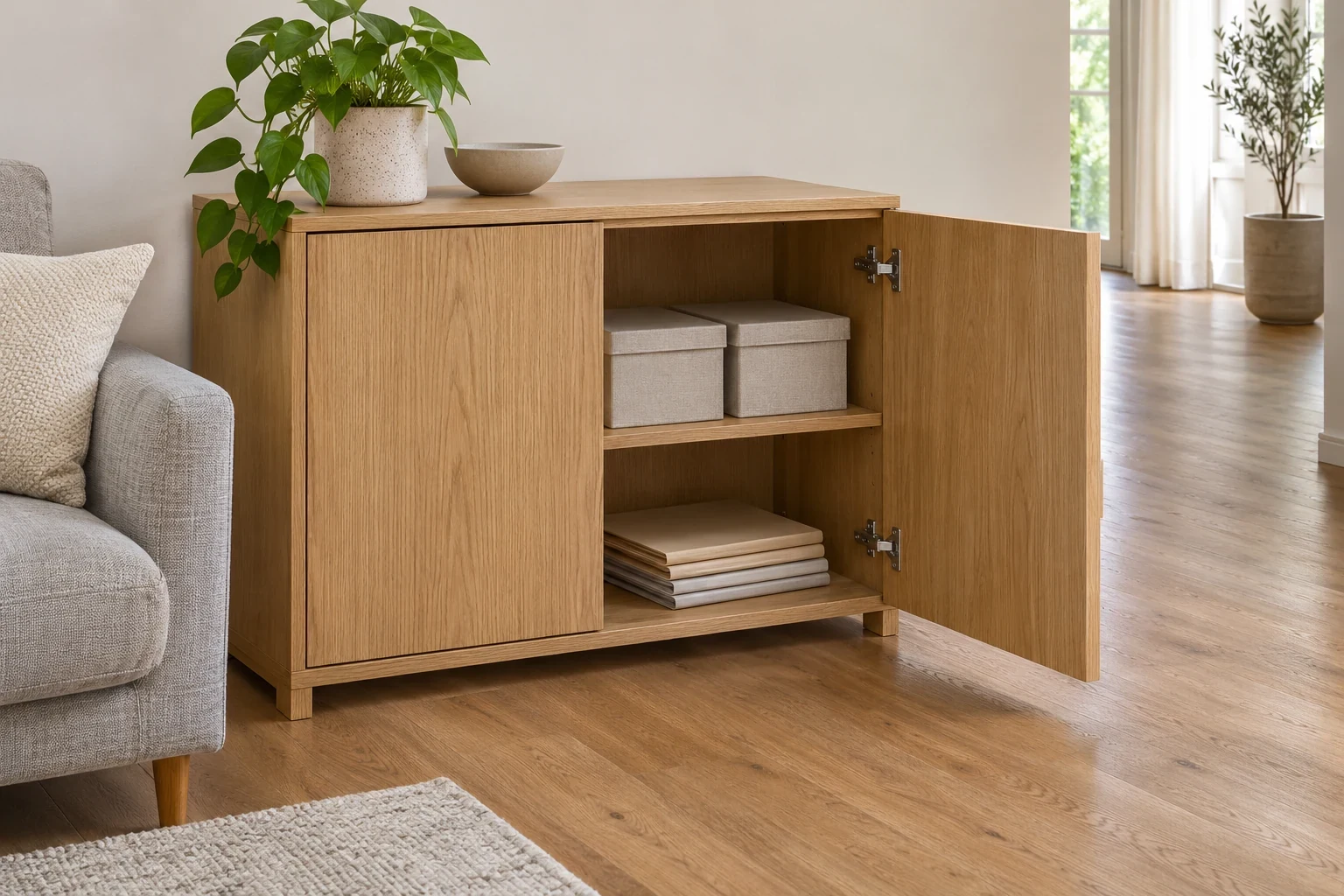
Imagine the complete retrieval: approach, open the door, take the item and close it. A lower cabinet might suit a folder you use once each evening. It may be a poor location for something another person needs repeatedly while you sit in front of its doors.
Check the front's actual operation. Hinged doors sweep into the room. Sliding fronts need their permitted travel and leave only part of the opening available at once. A drawer needs extension room and an accessible standing or reaching position. None is automatically the smallest arrangement simply because the closed body looks shallow.
The open-door scene shows a low cabinet with usable floor in front and a passage beyond its end. Transfer those relationships to your own measurements rather than borrowing the pictured gap as a standard. Open the nearest room door and use the adjacent seat during the check, too.
Do not assume a decorative cabinet provides child-resistant storage, locks valuables securely or seals out dust or moisture. Choose appropriate specialist provision when the actual contents need those properties. For ordinary living-room belongings, the useful question is whether the front improves the routine enough to justify its movement and access requirements.
Treat Glass-front Storage as Visible Storage
A glass door changes access and separates the contents from the room without concealing their appearance. It can suit a collection you want to see while reducing direct contact with the displayed objects. It does not turn a mixed pile of papers into hidden storage.
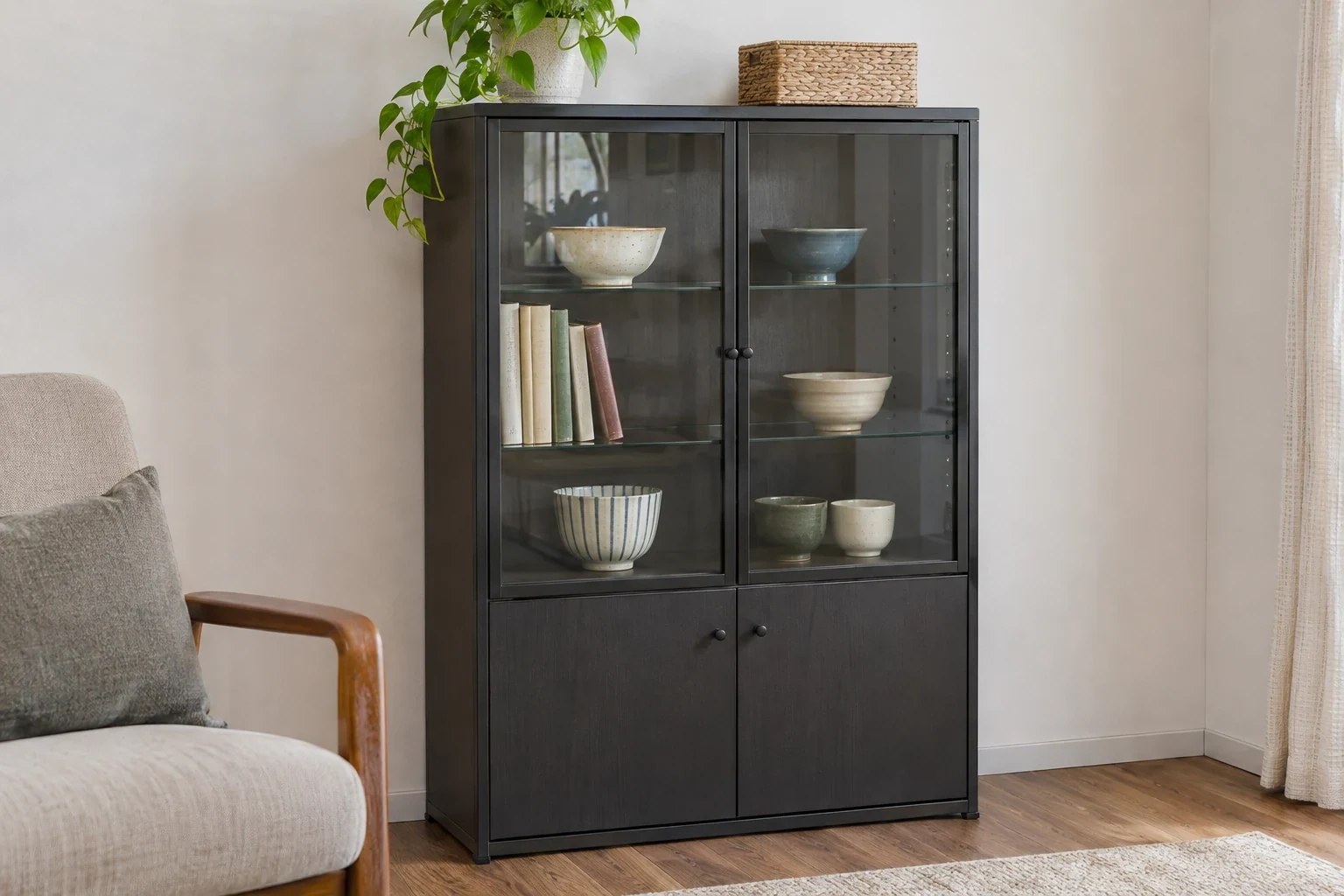
IKEA's open-and-closed storage guidance distinguishes opaque cabinets for hiding things from glass-door cabinets for displaying a collection. Its examples use adjustable shelves to accommodate different object heights. That is a useful distinction when you compare fronts, rather than a requirement to buy a pair of matching cabinets.
Check the actual door frame, shelf opening and the objects behind it. A tall display piece may fit the cabinet body but not pass through the usable opening in the intended orientation. Keep the items stable and use the furniture according to its instructions; a glass front does not establish protection for every fragile or valuable object.
If most of what you want to hide remains visible through the glass, choose an opaque front or relocate that category. Buying a glass cabinet and immediately covering every shelf with unrelated boxes can mean the original front choice did not match the task.
Plan Mixed Storage from the Actual Groups
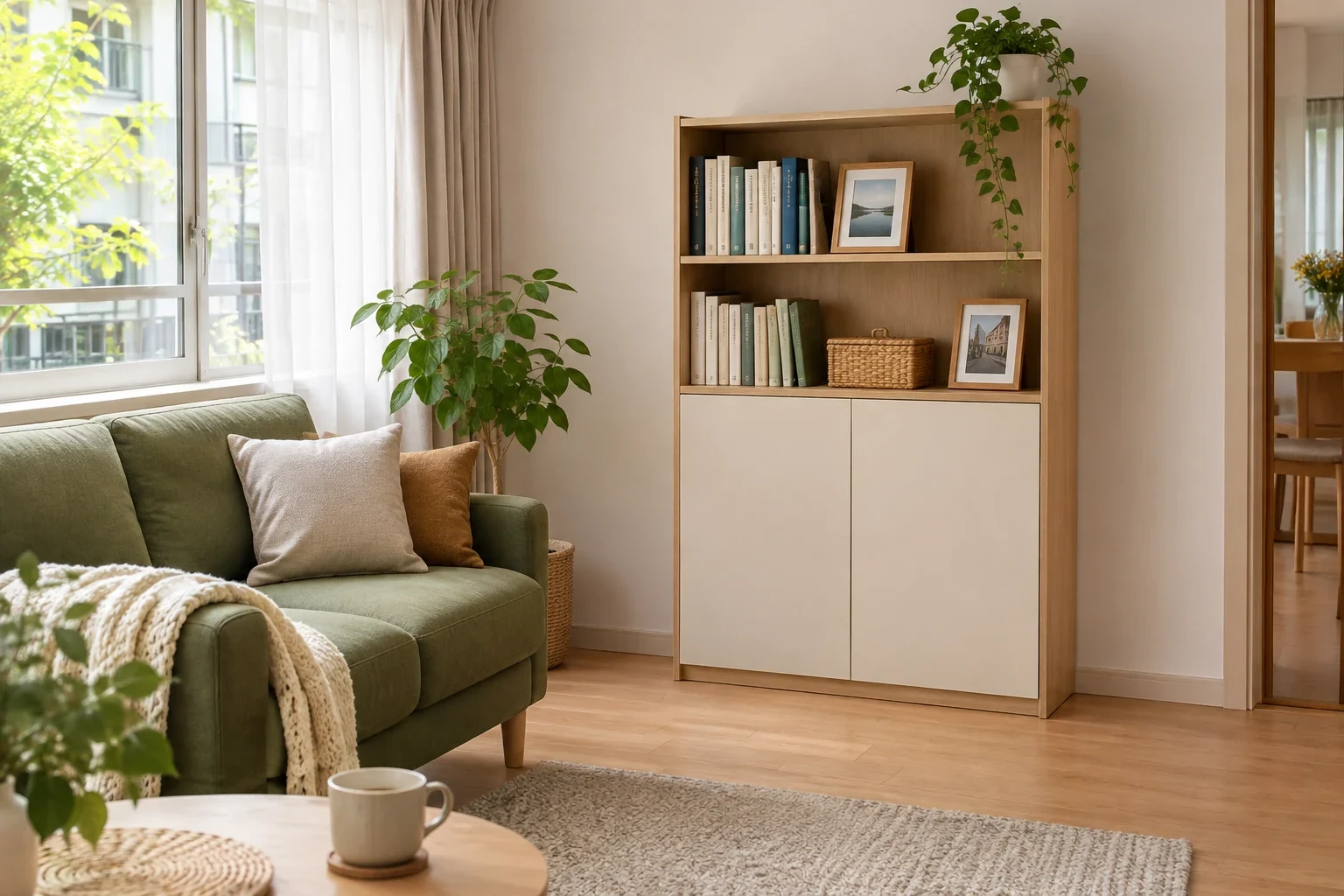
Mixed storage can be one unit with open upper shelves and closed lower sections, or two existing pieces that divide the jobs. The opening scene uses the upper part for books and a small display, while the lower doors conceal another category. Its usefulness comes from that division, rather than the height at which the doors happen to stop.
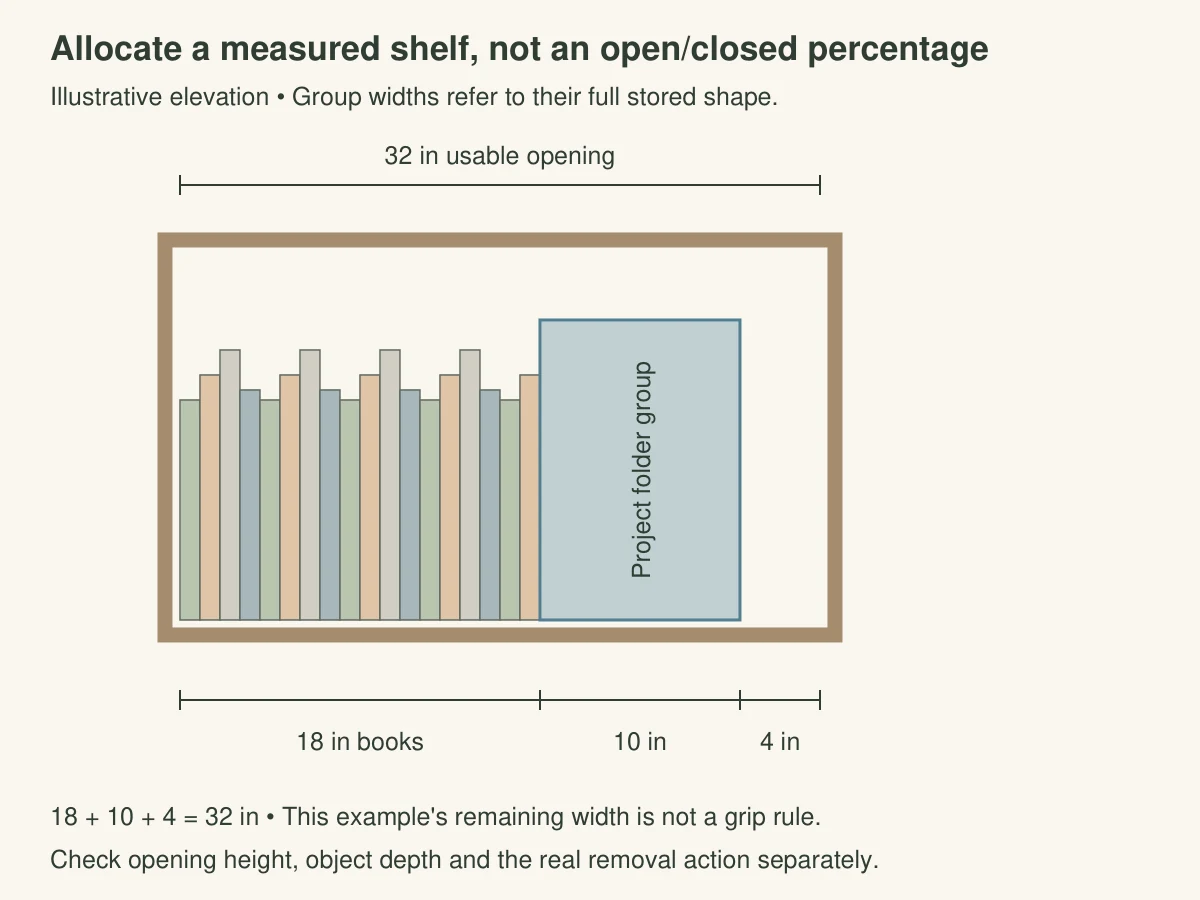
Work with measured groups instead of a fixed ratio. For an example, suppose a usable shelf opening is 32 inches wide. An 18-inch book row and a 10-inch project folder group occupy 28 inches, leaving 4 inches in total. That remainder may help with spacing and handling, but it is not a universal grip allowance. Check the actual object shape, opening height and way you remove it.
Now size the hidden group separately. Two containers 13 inches wide occupy 26 inches before accounting for their handles, the cabinet opening and any hinges. They do not automatically fit behind a nominally 32-inch-wide cabinet front: the usable interior can be smaller than the outside width.
Keep the daily-use group in a position the intended user can reach comfortably. An attractive high open shelf is not an improvement if retrieving the current project requires access equipment every afternoon. Put occasional items elsewhere when that makes the whole arrangement easier.
Check Furniture Fit with Its Front in Use
Measure the proposed body footprint, then add the selected item's opening movement from its actual instructions or a reliable drawing. Keep these as separate shapes on the floor plan. The diagram uses a generic two-door cabinet to show why the closed depth and door swing are different areas; it is not a specification for a particular product.
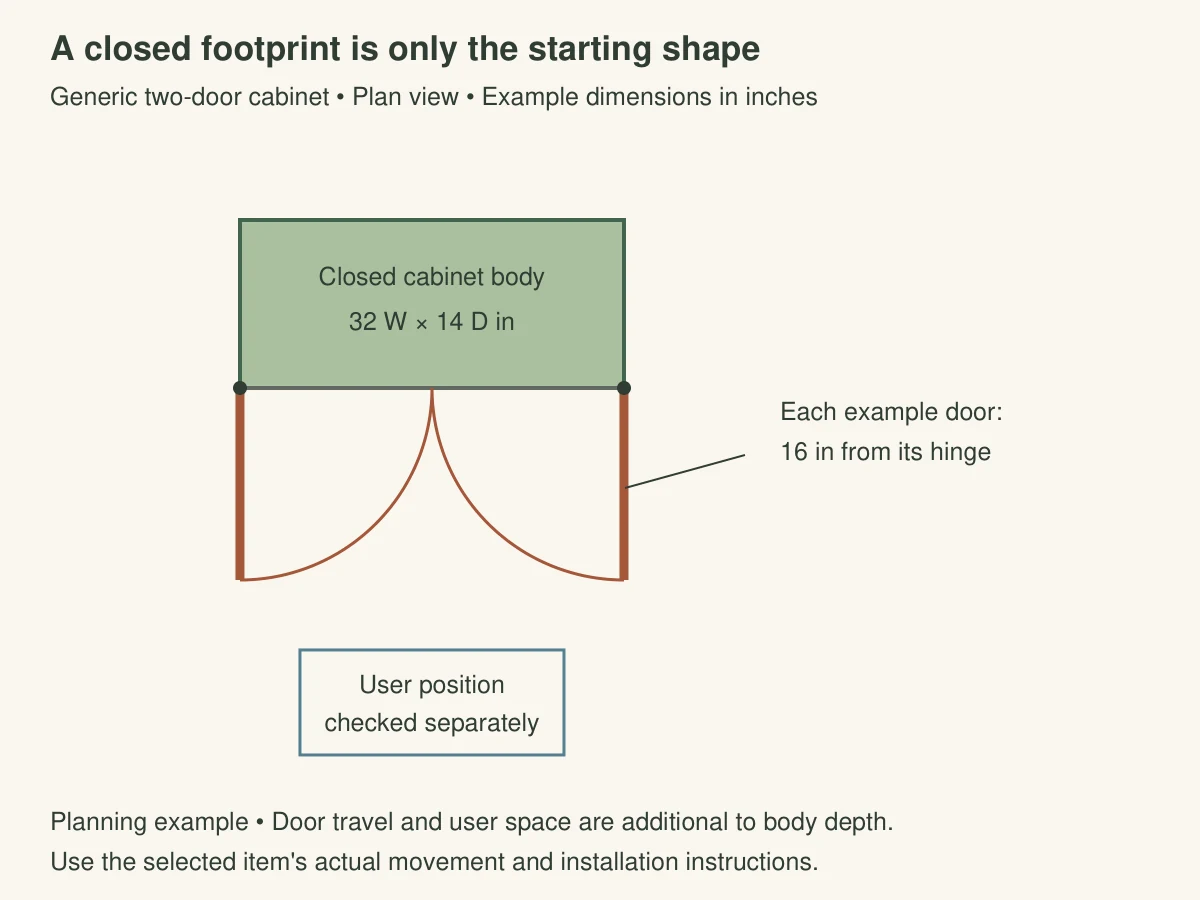
Add the person using the storage and any route that must remain available. A door may open fully on paper while leaving no useful position from which to lift a box. Conversely, a low-frequency cabinet can sometimes involve an agreed temporary reset, provided required access remains available and the household finds the sequence practical.
Check installation as well as floor fit. Follow the furniture's assembly and anti-tip instructions for the actual wall and location. A room illustration with a cabinet behind a sofa does not establish that a wall-anchored unit may be used freestanding. Do not remove structural or safety components to create a more open appearance.
Keep equipment requirements separate from the desire to hide things. A device that needs ventilation, accessible controls or a particular cable route must still have those conditions behind a front. Read its instructions before choosing closed storage; an attractive cabinet should not decide an equipment installation by itself.
Try the Front Decision Before Replacing the Furniture
Use a normal week to observe an existing shelf or cabinet. Name the groups, give each a defined position and notice the retrievals. Are doors left open because access is frequent? Does an open shelf keep accumulating objects that belong elsewhere? Does the display remain enjoyable when the room is actually in use?
A suitable box on an existing open shelf may solve one hidden category without another cabinet. A curtain can conceal a busy section when its support, travel and nearby conditions work, as IKEA's guidance illustrates, but it also adds an opening step. Neither approach changes the shelf's structural limits or usable interior.
Use the trial to write a short purchasing brief if replacement is needed: open book space of a measured size, one concealed project group, reachable shelves and an opening method that works in the occupied room. Compare exact products against that brief, including interior dimensions and installation, rather than shopping for an appealing front alone.
Choose the arrangement that gives each real category a usable home. That may be mostly open, mostly closed or a modest combination. The right balance is the one that remains easy to retrieve from and put back when the living room is doing its everyday work.