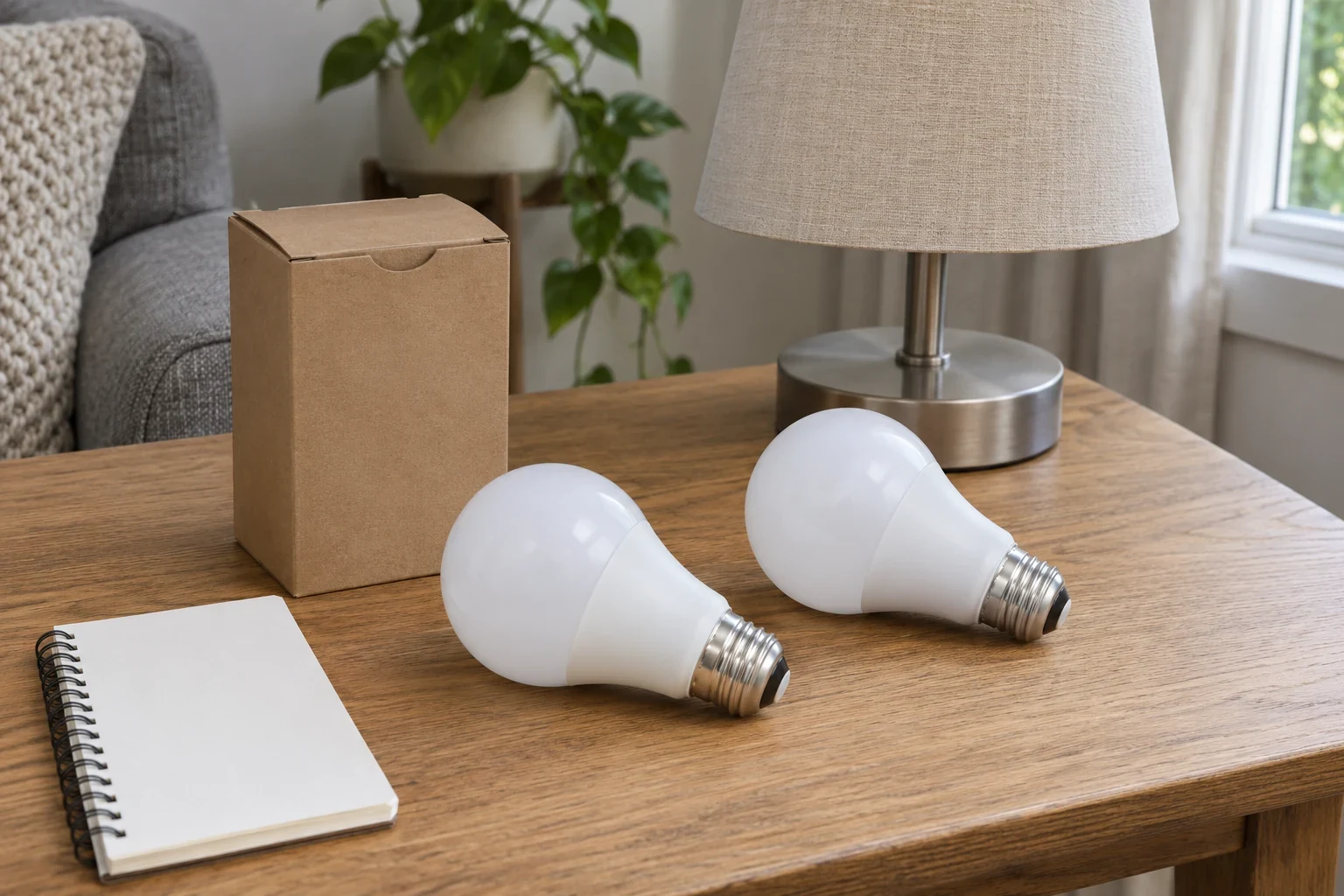
Choose a bulb's light output in lumens and its light appearance in Kelvin. Use its actual wattage to check power consumption and the fixture's limits. These are separate decisions: a cooler-looking bulb is not automatically a higher-output bulb, and a “60-watt replacement” LED does not necessarily consume 60 watts.
Start with the lamp you are filling and the job it needs to do. Then compare the numbers on the selected bulb's packaging, rather than choosing from a warm-looking photograph or the largest number on the front of the box.
Read Lumens as Light Output
Lumens, often shortened to lm, describe the amount of light a bulb produces. A higher lumen rating means more light output. The Department of Energy's consumer guide recommends comparing LEDs by lumens rather than relying on the wattage habits associated with incandescent bulbs.
Suppose two otherwise suitable bulbs are labeled 400 lm and 800 lm. The second has twice the rated light output. That does not mean a book will look exactly twice as bright, or that one 800 lm bulb will adequately light every small room. The shade, direction, distance and surrounding surfaces affect where that output goes.
Use the existing bulb as a reference if it has been doing the job well. Record its lumens before comparing alternatives. If it has been too dim, decide whether you need more bulb output, a better-positioned task light or a change to a shade that blocks the useful light. Replacing the bulb alone does not move the lamp closer to your pages.
For a fixture with several bulbs, check whether a quoted output is per bulb or for the whole fixture. Four bulbs in a pack are not one four-times-brighter bulb. Keep the individual rating and the quantity separate when comparing an order.
Read Kelvin as Light Appearance
The Kelvin number, written K, describes color temperature: the light's warm or cool appearance. Lower values look warmer or more yellow; higher values look cooler or bluer. DOE explains this direction of the scale separately from brightness. The number is not the temperature you should expect the bulb or shade to reach.
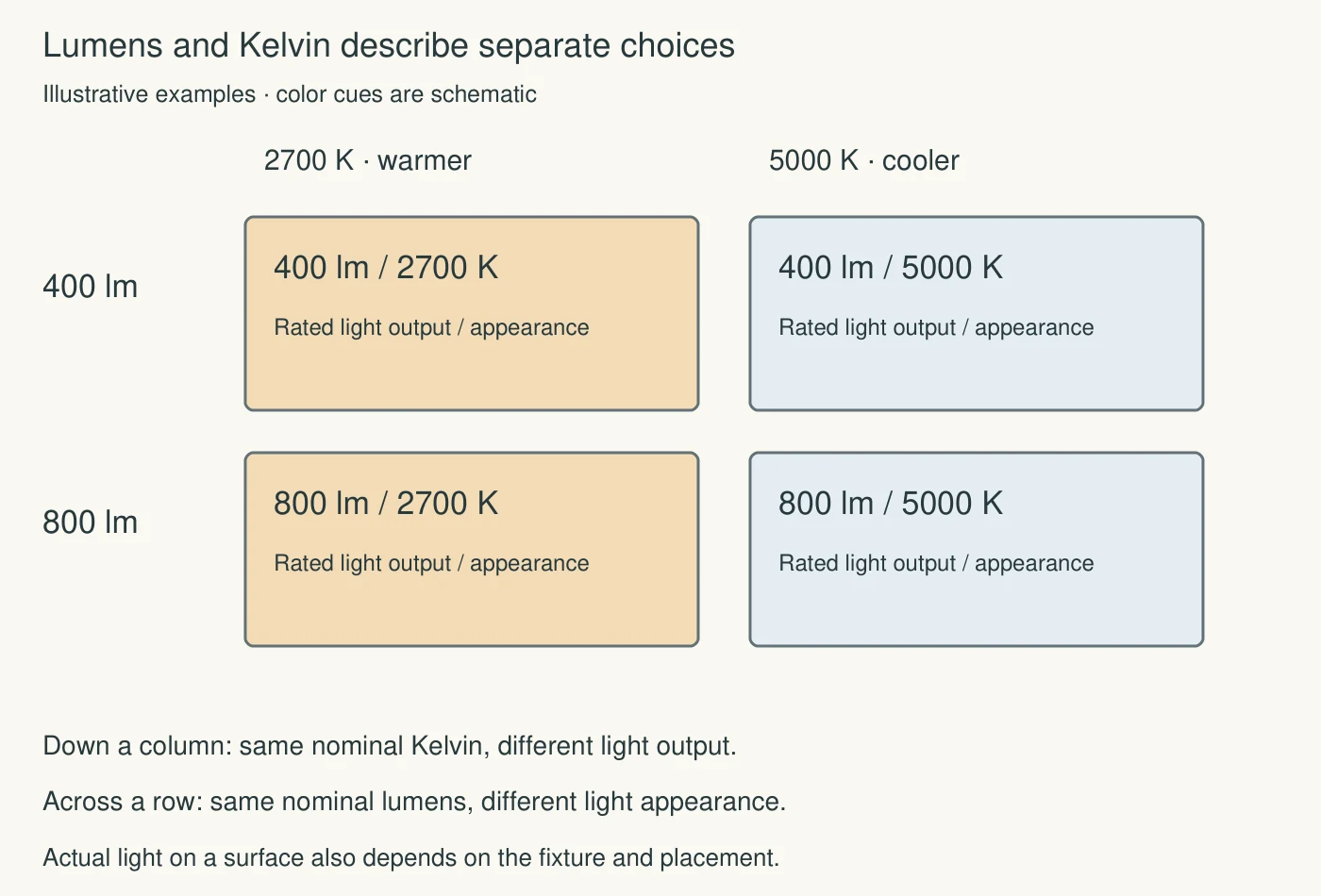
For familiar reference points, 2700 K is a warm-white appearance, while 4000 K and 5000 K are progressively cooler-looking examples. Treat names such as “soft white,” “cool white” and “daylight” as clues, then read the selected Kelvin number. Names can vary between ranges and retailers.
A 400 lm, 2700 K bulb and an 800 lm, 2700 K bulb share the same nominal color temperature but have different light output. An 800 lm, 2700 K bulb and an 800 lm, 5000 K bulb share the same nominal output but look different in color. The illustrated comparison keeps those two changes separate.
Choose an appearance you like with the room's actual finishes and activities. Warm light may suit the evening atmosphere you want; a cooler appearance may suit another person's preference for a work area. Neither preference establishes how much output the task requires. Compare an actual suitable bulb in the room before ordering enough for every lamp.
Separate Actual Watts from Replacement Watts
Actual watts describe electrical power consumption. “60-watt equivalent” or “60-watt replacement” refers to an approximate comparison with an incandescent bulb's output. It is not a direction to put a 60-watt-consuming bulb in the socket, nor permission to ignore the fixture's instructions.
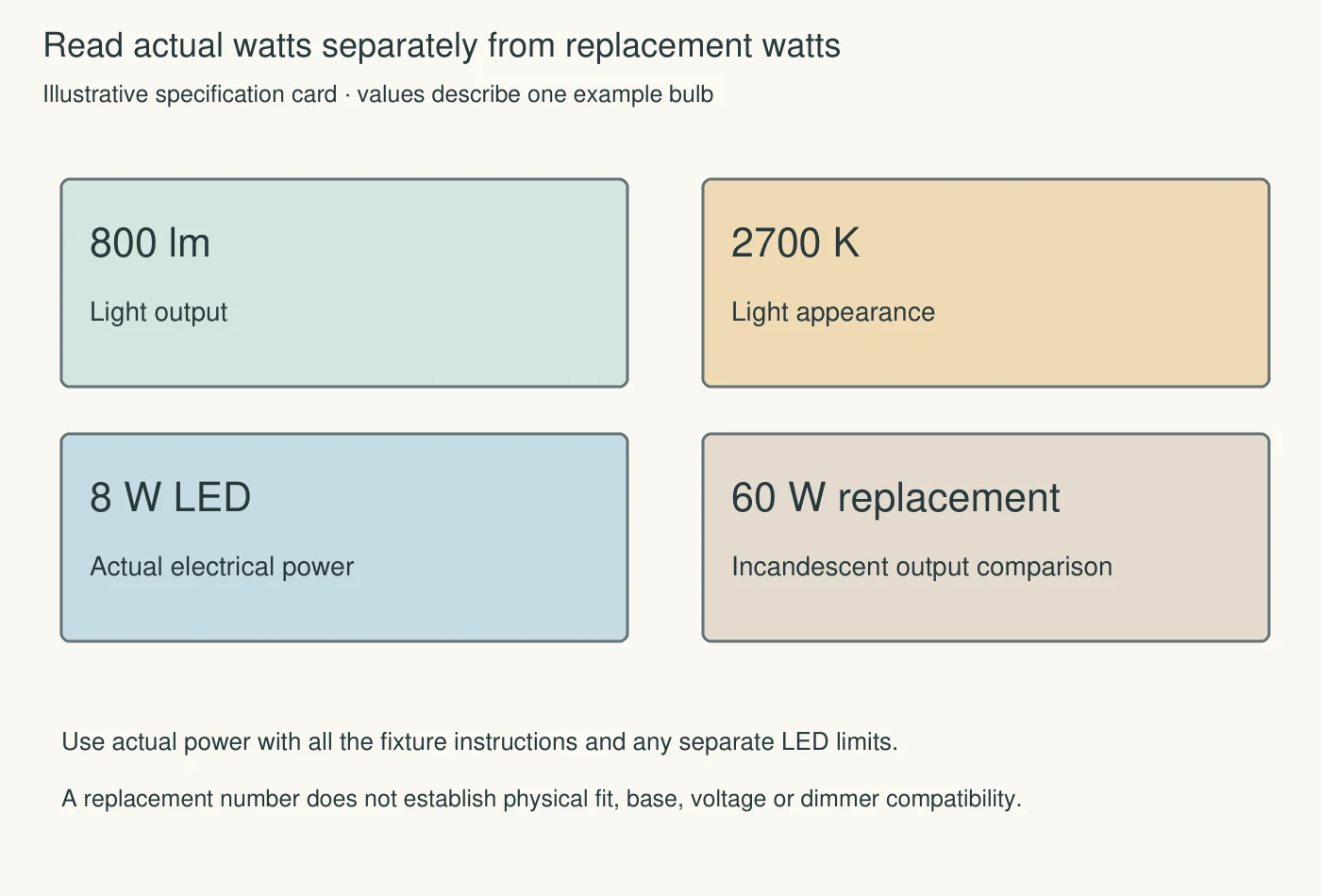
An illustrative specification card might say 800 lumens, 2700 K, 8 W LED and 60 W replacement. Read that as output, appearance, actual power and the incandescent comparison respectively. When checking a maximum-wattage instruction, identify the bulb's actual consumption and follow all the fixture's requirements, including any separate LED limits.
Do not use actual wattage alone to rank the brightness of different LED models. A bulb consuming more watts is not necessarily the better choice for the job. First compare the lumen output you need, then the power and other conditions of the selected products.
When a retailer's generic table conflicts with the package or model-specific information, clarify the selected item before buying. A listing can contain both a replacement-wattage field and a consumption field without making the distinction clear. The printed model and its current specification matter more than a broad search-result title.
Check Fit and Compatibility Before Choosing the Pack
Read the fixture label and instructions, and identify the required base, supply voltage and permitted bulb shape and size. A19 describes a bulb shape; E26 describes a base. One does not replace the other. An ordinary screw-base lamp and a fixture using another fitting require different candidates.
Check the actual bulb against the shade, socket position and any retaining arrangement. Outside dimensions matter in a tight shade or enclosed fitting. Do not infer physical fit from a photograph, a replacement-wattage label or a generic diameter field that contradicts the listed width and height.
Also check whether the chosen bulb is permitted in an enclosed fixture or the location's conditions. A bulb labeled for one environment does not establish suitability for another. Manufacturer specification sheets can list base, voltage, dimming and enclosed-fixture ratings separately; treat them as separate checks rather than transferring a feature from a similar bulb.
If you use a dimmer, confirm that the bulb and the particular control are compatible. “Dimmable” does not mean every dimmer and bulb combination works identically. Follow the selected products' compatibility information and fitting instructions. Before changing a bulb, turn the lamp off, disconnect power as appropriate and allow it to cool; follow the fixture's directions rather than working on an energized socket.
Decide What Dimming Should Change
For many fixed-color bulbs, dimming mainly changes light output while the nominal color temperature remains the selected value. Other bulbs intentionally become warmer as they dim; Philips describes that distinction in its warm-glow guidance. Adjustable-white products offer another kind of control: changing the white appearance as well as the output, according to their specifications.
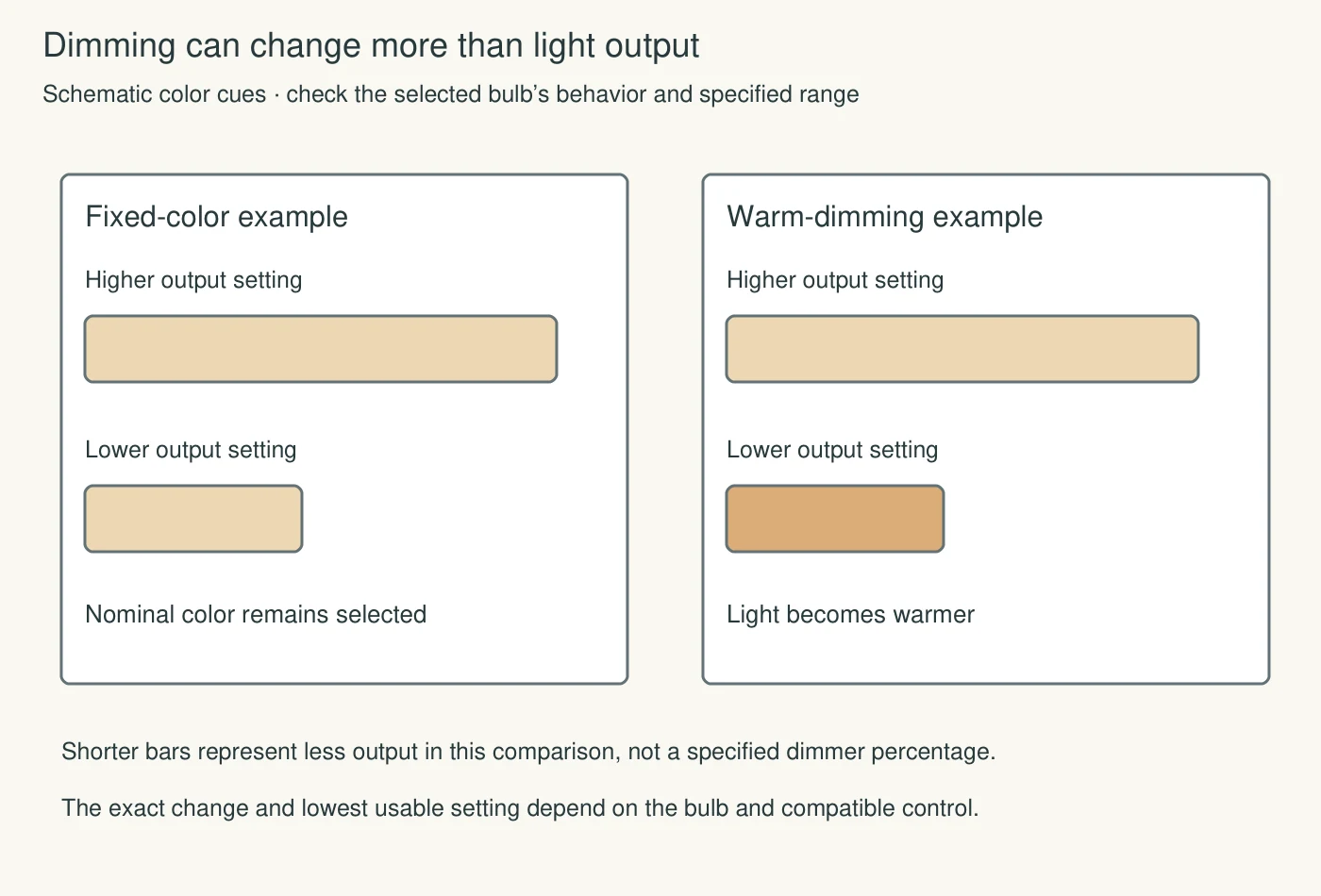
Check which behavior you are choosing. A warm-dimming bulb is useful when you want that linked change, but it is not an example of maintaining one color temperature through the whole dimming range. A package offering several selectable colors may also require you to choose the setting before installation.
Color temperature does not describe every aspect of color quality. Color-rendering information is a separate specification, and two bulbs with the same nominal Kelvin number need not make every object look identical. For this choice, keep the basic comparison clear, then check any additional color requirements relevant to the activity.
A Verified Warm-white Purchasing Example
The Philips Ultra Definition 576116, ASIN B0B92VRHJ2, is a selected four-pack of A19, E26, 120 V bulbs. Its selected soft-white configuration is nominally 2700 K, with 800 lm maximum output per bulb and 8 W actual consumption. The 60 W figure is the incandescent replacement comparison. The matching product photograph shows the four-bulb pack and those output and power labels.
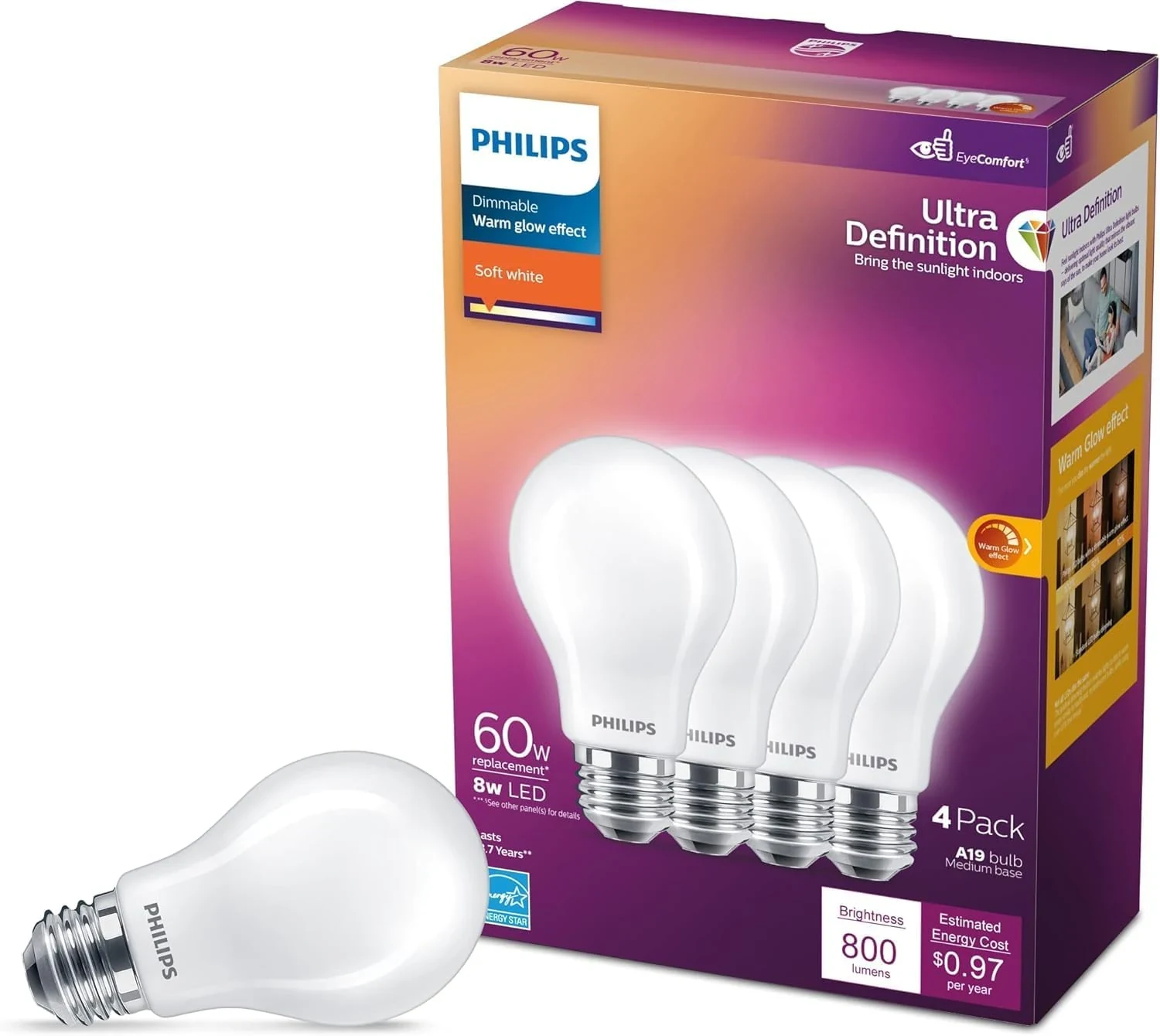
This model is described as dimmable with a warm-glow effect, so expect appearance to change with dimming rather than assuming fixed 2700 K throughout. Confirm the current dimmer information and the details that matter to your fixture. The listing's width-by-height and generic diameter fields conflict; get a reliable current dimensional confirmation before buying for a tight shade. Enclosed or wet-location suitability is not established by the specifications used here.
Disclosure: As an Amazon Associate, Livable Corners earns from qualifying purchases.
Check the Philips 576116 soft-white four-pack on Amazon
Choose that exact color, model and pack only if its behavior and your fixture checks suit the job. Do not substitute the eight-pack, daylight variant or another replacement-output option without comparing its own specifications.
Keep a Short Repeat-order Note
Once a suitable bulb works in the room, record the model, base, lumens, Kelvin setting, actual watts and dimming behavior. Note the lamp and any relevant fitting restrictions too. This helps you replace the bulb deliberately instead of guessing from a loose bulb's general shape.
Evaluate the result at the times you normally use the light. If the appearance suits the room but the task remains dim, revisit output and placement. If the output is sufficient but the color feels wrong, compare another suitable color temperature. Keeping those decisions separate makes the next purchase much easier.