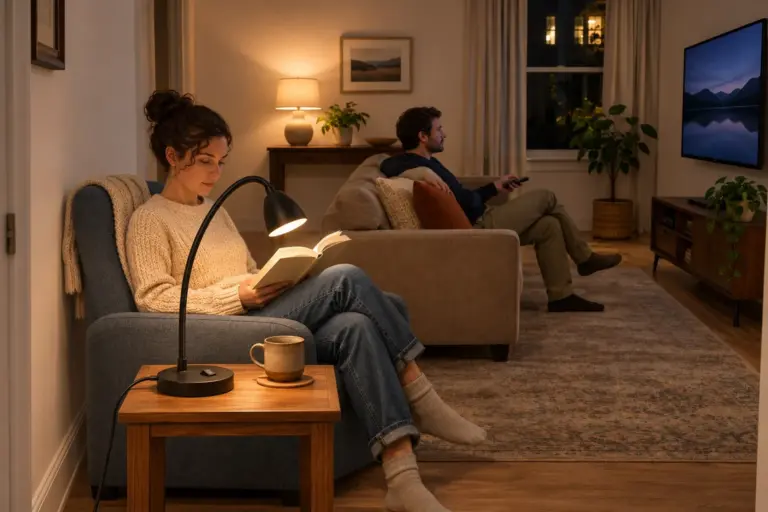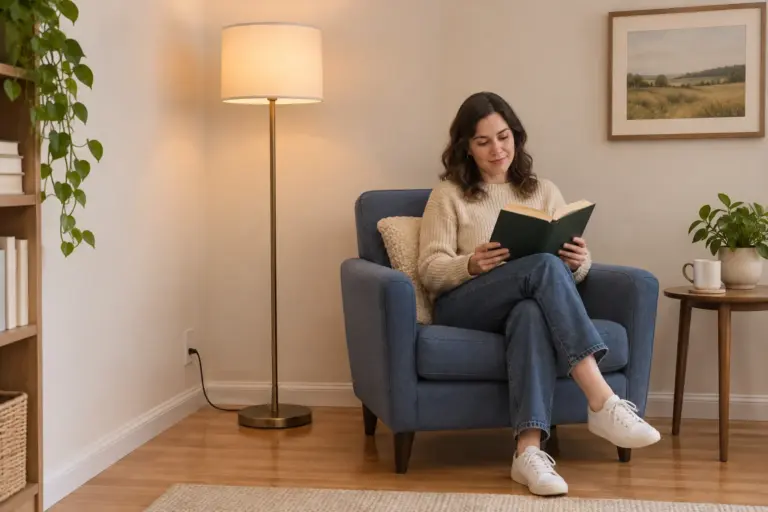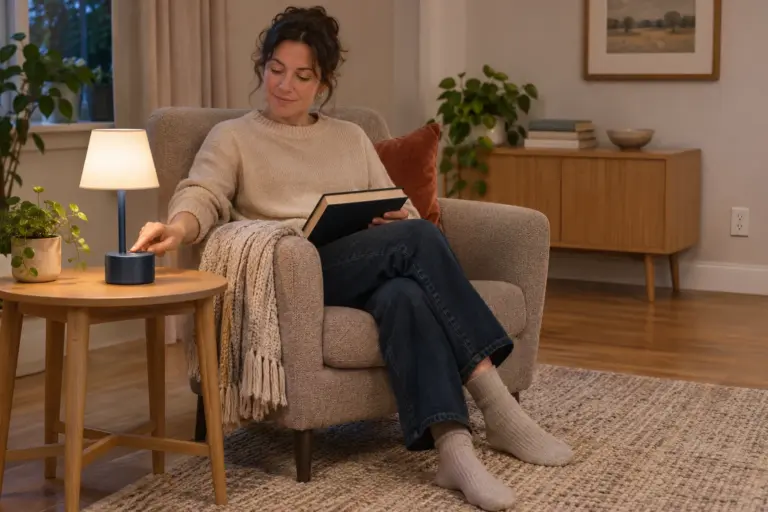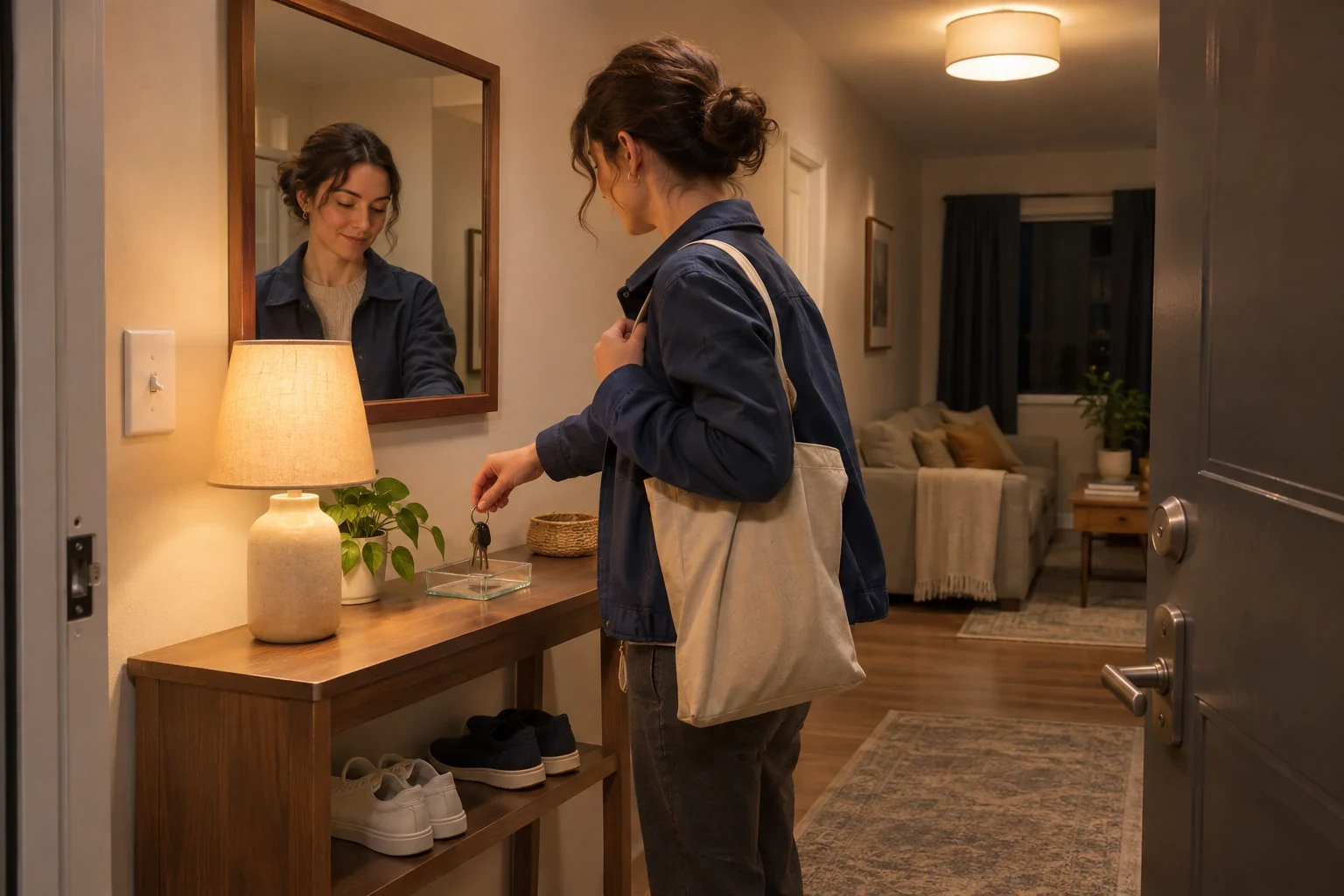
Check entryway lighting through an ordinary arrival: reach the first control, put down keys, see yourself in the mirror and find the right shoes. Those targets occupy different heights and face different directions. A light that makes the hallway look bright from another room may still leave one of them in your own shadow.
Start with the fixtures and controls you already have. Add or reposition a suitable source only when the actual evening trial reveals a missing function. The useful result is an entrance you can operate with everyday belongings, rather than a photograph with every lamp turned on.
Reach Useful Light from the Entrance
Identify the first appropriate control from the position where you enter. Try it while holding an ordinary bag and your keys. You should not have to cross the dark hallway, reach behind a coat or move a shoe rack to switch on the light you need.
Check the full door movement and where the arriving person stands. A wall switch beside the doorway can still be obscured by an open door or something stored nearby. Restore its practical access before buying a lamp whose own switch has the same problem.
If the existing control arrangement cannot support the entrance, choose a suitable authorized solution and use qualified help for electrical changes. Do not improvise wiring or run an extension across the route to achieve a convenient switch position.
IKEA's lighting guide distinguishes wider room light from light directed at a task. Use the existing general light for arrival, then check the specific tasks before deciding whether anything more is needed. An attractive glow on a wall is not evidence that a key label or shoe is identifiable.
Put Real Objects at the Key Landing Place
Stand where you normally release your keys or empty a pocket. Place the actual key ring, case or other small everyday object at its assigned landing place. Can you distinguish and retrieve it without lifting it into another room's light?
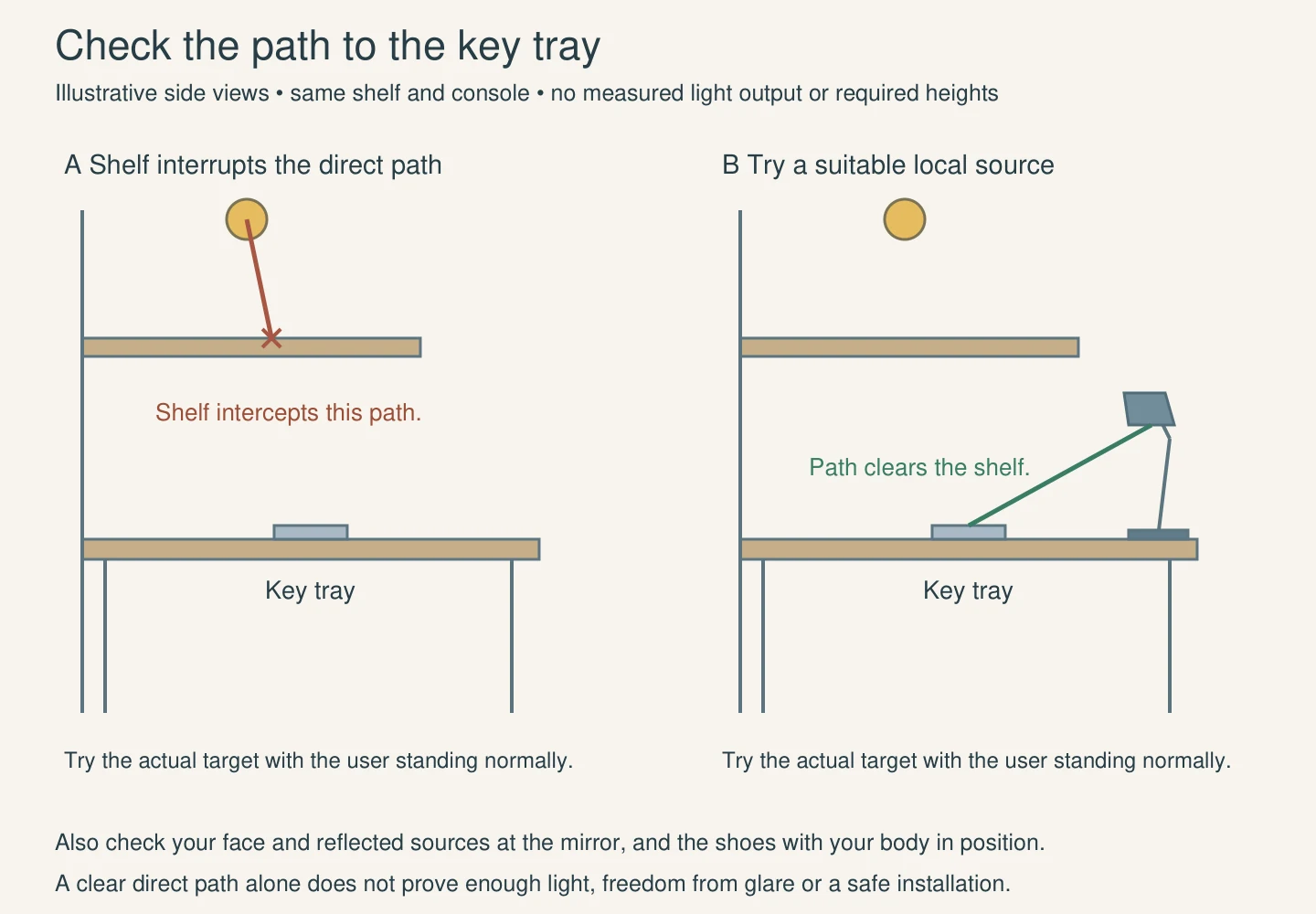
Check what your body does to the light. A fixture behind you may leave the tray in shadow when you lean forward. A deeply shaded table lamp may illuminate the tabletop beside the tray while leaving the tray itself under a shelf. An overhead source can also have its direct path interrupted by a shelf above the landing point, as in the side-view example. Reposition only where the fixture, its support and required surrounding space permit.
Keep some landing surface available. Moving a lamp into the exact patch needed for the arriving object trades one problem for another. Trace any cord to an appropriate outlet outside the door movement and walking route, following the lamp instructions.
If the existing ceiling light already lets you identify and use the keys comfortably, keep that result. A separate key-tray lamp is an option for a particular failed task, not a required accessory for every entrance.
Check Your Face as Well as the Mirror
Stand at the actual mirror position and check an ordinary departure task, such as adjusting a scarf or seeing whether glasses are sitting as intended. Do not judge the light only from the mirror's bright frame or the illuminated wall beside it.
Look for your own head or a shelf blocking the useful light, and for a bright source reflected into the normal viewing position. Try appropriate existing fixtures and permitted lamp positions while standing normally. A result that works only with your head tilted to one side needs reconsideration.
The mirror is also a viewpoint into the rest of the room. Check what happens when someone opens the entrance door or stands behind you. Avoid placing a lamp where the next person's movement knocks it or where a coat covers its shade. Follow the chosen fixture's installation and spacing instructions rather than copying the proportions of an illustrative scene.
See the Shoes from the Position Used to Retrieve Them
Put the everyday footwear in its normal storage positions. Stand, bend or sit as you normally do to choose and retrieve a pair. Check the lowest shelf and any dark compartment, not just the empty patch of floor in front.
Your body may block light that reached the shoes when the hallway was empty. Open the actual compartment if one is used, and include the shoe in your hand. Check the same task on return so footwear can go back without being left in the route.
Keep the storage suitable for the footwear and follow the fixture instructions. Do not install an improvised light among shoes, fabric or moving compartment parts to solve a shadow. If an existing suitable light cannot reach the task, reconsider the storage or choose a lighting format intended for that installation.
Treat a Night Light as an Additional Guiding Source
If the approach to the first control remains dark, an appropriate plug-in night light is one format to compare. It still needs an available outlet in a useful unobscured location and an actual evening trial. It does not establish that you can read small key labels, check your face or inspect every shoe without the task and general lighting above.
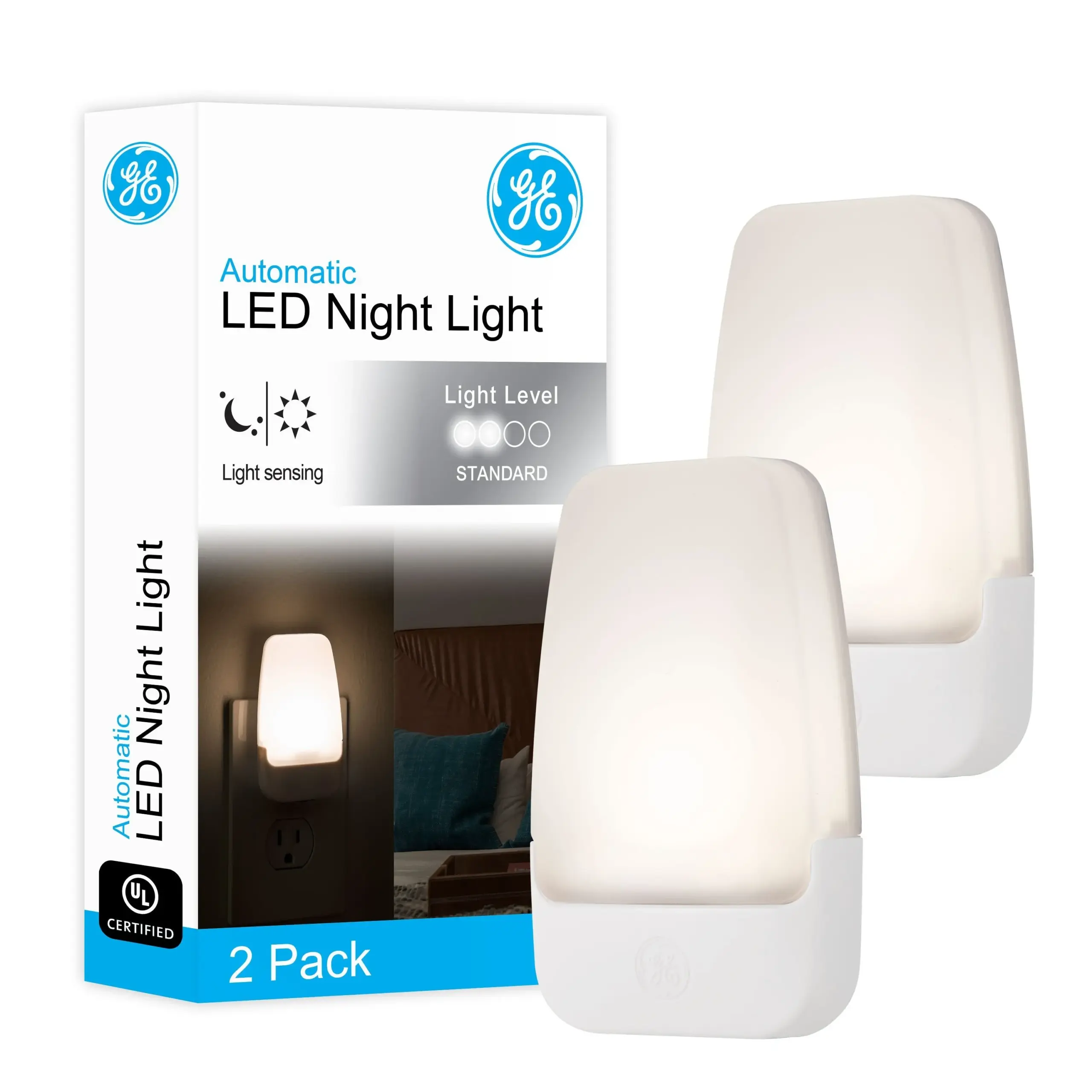
The white GE light-sensing LED night lights, model 30966, ASIN B01C634M98 and UPC 030878309660, come as two night lights in the selected pack. They turn on when the surroundings are dark and off when they brighten. This is light sensing, not a claim of motion activation or emergency battery backup.
The retailer lists nominal dimensions of 2.1 inches deep by 1.6 wide by 3.5 high. Check the unit's installed projection and neighboring plugs at the actual outlet. Follow its indoor-use instructions and test the sensor with other room lights on and off; do not assume a unit hidden behind furniture will perform as intended.
Disclosure: As an Amazon Associate, Livable Corners earns from qualifying purchases.
Compare the white GE 30966 two-pack night lights on Amazon.
Finish by walking the whole routine in both directions. Arrive carrying your normal items, switch on, use the keys, mirror and shoes, and leave with the controls still accessible. Before switching off the last useful source, check how you reach the exit. Repeat the trial after the entry is loaded normally; an empty hallway can hide the shadows and obstructions that matter every evening.