Measure the books before choosing shelf positions. A collection of short paperbacks, medium hardbacks and tall illustrated books rarely needs identical gaps from top to bottom. Grouping the sizes can recover useful shelf space, provided every book remains supported and the shelves stay within the bookcase's actual design and limits.
Start with the existing case and its instructions. Identify the fixed shelves, permitted adjustable positions, shelf supports, load limits and any required anchoring. Adjusting storage is a different job from altering the structure; do not remove a fixed board or improvise new pin holes to copy an attractive arrangement.
Sort the Collection Into Measured Groups
Gather the books that belong in this case. Separate things that need another home rather than trying to absorb every loose object in the room. Within the book collection, identify the heights, front-to-back depths and the titles you regularly take out.
Measure the tallest and deepest book in each proposed group with its normal cover or dust jacket in place. Record the group's combined spine thickness too. Height determines an opening requirement, depth determines support and width determines how much of the row the group occupies.
Keep related titles findable. A height group can contain a clear subject or reading category rather than a random mixture you cannot remember. When a set has mixed sizes, choose a practical nearby arrangement and make its locations understandable instead of forcing all volumes into one unsuitable gap.
The Library of Congress recommends shelving similarly sized books together and keeping upright volumes supported rather than leaning. Use appropriate bookends when needed. These are support principles, not a requirement to sort your whole home library by height alone.
Measure Clear Openings and Shelf Thickness
Measure the actual usable width, depth and height of each compartment. Include the underside of the shelf above, any lip or projecting hardware and anything that narrows the opening. A nominal bookcase depth can include its back or frame rather than describe the book's supported surface.
Record the thickness of boards when planning several openings. In the illustrative case, the usable internal height is 54½ inches and four shelf boards are each ¾ inch thick. The boards consume 3 inches, leaving 51½ inches of total clear opening height to distribute.
The example has a fixed board whose bottom is 24¾ inches above the inside base and whose top is at 25½ inches. That divides the planning into lower and upper sections. You cannot freely redistribute all 51½ inches across that fixed point.
Your actual case may offer different holes, shelf thicknesses and fixed positions. Use the manufacturer-permitted positions and check the resulting clear openings directly. The diagram is a space-budget example, not a drawing for drilling or rebuilding a cabinet.
Allocate the Tall Groups Without Wasting Every Gap
The example's bottom opening is 13½ inches high for a 12½-inch-tall book group. The next opening is 10½ inches high for books up to 9½ inches. Each leaves 1 inch above the illustrated books, but that allowance still needs a real handling trial.
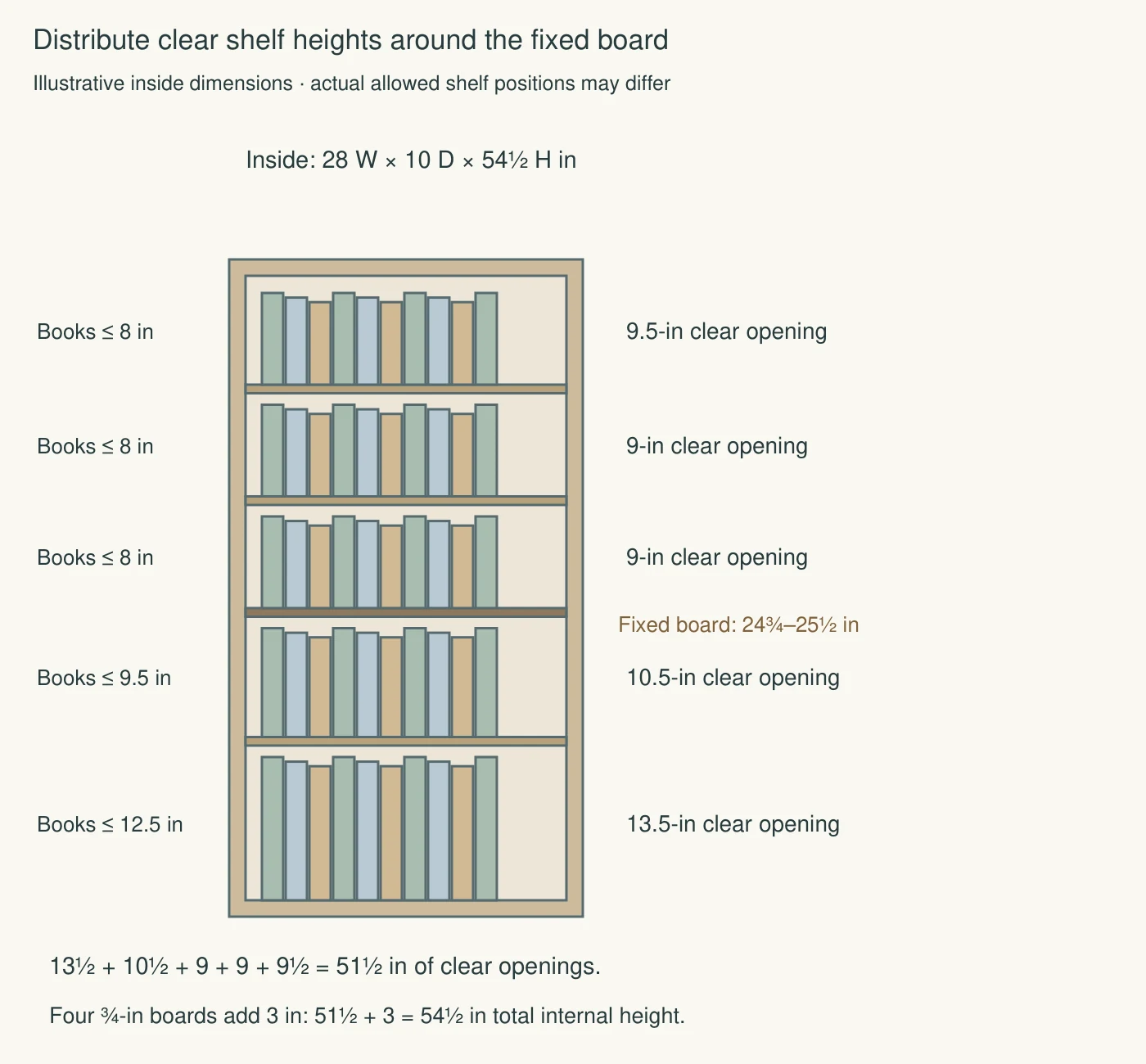
Above the fixed board, the three clear openings are 9, 9 and 9½ inches. They hold the example's 8-inch books with different amounts of remaining height. Those openings, plus the lower pair and the four boards, add back to the full 54½-inch internal height.
IKEA's storage guidance describes adjustable shelves as a way to adapt height to a collection. The useful step is checking each actual opening after adjustment, rather than spacing every board equally because it looks orderly when empty.
Keep the books you use often in positions you can approach and handle normally. Tall volumes do not automatically belong on the highest shelf, and an awkward reach should not become part of every retrieval. Follow the case's load and stability requirements when deciding which groups go where.
Before moving adjustable shelves, unload them and use the actual instructions for supports and placement. Set every required support correctly and confirm the board is seated as intended before reloading. Do not change a shelf under a loaded row or stand on the furniture to reach an upper position.
Check Depth Before Calling a Tall Book Solved
A book can pass the height check and still lack proper front-to-back support. In the example, the case has 10 inches of usable shelf depth. A 12½-inch-tall book that is 9 inches deep can stand within that depth, subject to the actual opening and handling checks.
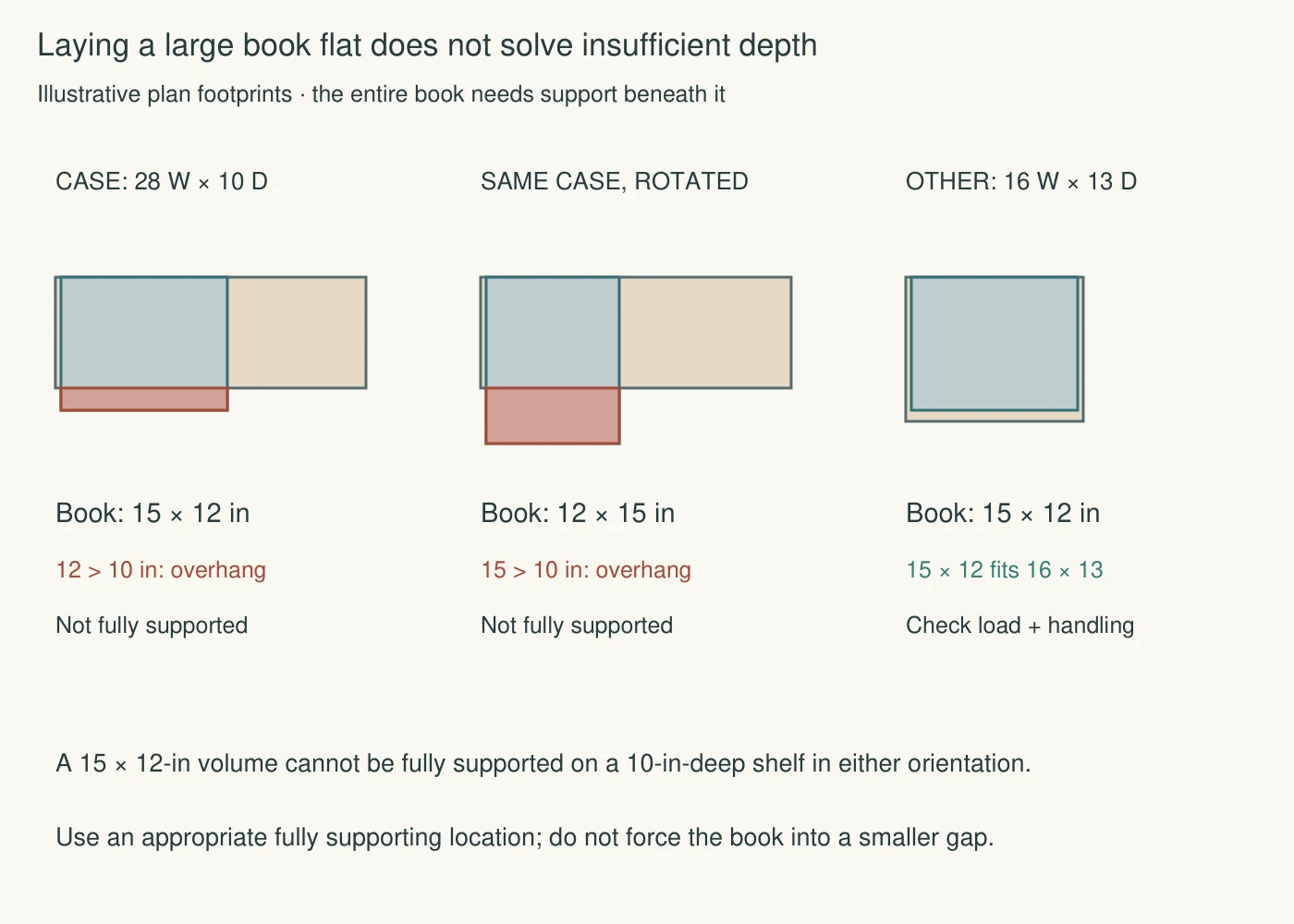
A different oversized volume is 15 inches tall and 12 inches deep. It exceeds both the example's ordinary openings and its 10-inch shelf depth. Turning it flat does not solve the depth problem: its 15-by-12-inch footprint still cannot be fully supported on that shelf in either orientation.
The separate flat-storage example uses an appropriate existing surface with 16 inches of usable width and 13 inches of depth. The 15-by-12-inch volume fits those bounds with full support. Check its load, condition and retrieval there rather than treating the change of orientation as the only decision.
The Library of Congress allows books too large to stand upright to be stored flat and horizontal with full support underneath. Fragile or damaged volumes may need additional appropriate support or an enclosure; seek suitable specialist guidance rather than forcing a valuable book into a convenient gap.
Budget Row Width and Retrieval Together
The hypothetical case has 28 inches of usable width. The books' combined spine thickness, any bookends and the space needed to handle the row all have to work within that opening. A group whose spines total 28 inches has not left room for anything else.
Load one group and try taking out a normal title. Keep the neighboring books supported while you remove and return it. If the row is too tight, reduce the group or give part of it another appropriate position rather than forcing the covers against the sides.
Avoid a second hidden row when it makes frequently used books inaccessible. A deep shelf does not require filling every inch of depth. Likewise, a decorative horizontal pile in front of upright books adds a moving step to every retrieval behind it.
For flat-stored volumes, include handling in the arrangement and keep the group manageable. Do not slide a desired book out from beneath a heavy pile simply because its footprint fits. The useful storage position supports the book and permits a sensible return.
Keep a Simple Map and Recheck New Additions
Record which groups occupy each opening, with the actual clear height and depth where that helps. A short shelf-edge label can identify a category without changing or attaching anything to the books. Keep the method easy to update when the collection changes.
Add new books to a measured group only when the row, support and load still work. A new tall title may need another home rather than another shelf adjustment that disrupts every short-book row.
Finish by retrieving and returning the commonly used titles from each group. Keep the arrangement when the books remain supported, the actual case requirements are met and the daily titles are straightforward to find. Useful capacity comes from fitting the collection and its handling, not from filling every visible gap.