An owned suitcase can hold suitable household items between trips, but it still has another job. Before you can pack for travel, everything stored inside must leave. The useful arrangement therefore includes both the storage position and the real homes that will receive those contents before departure.
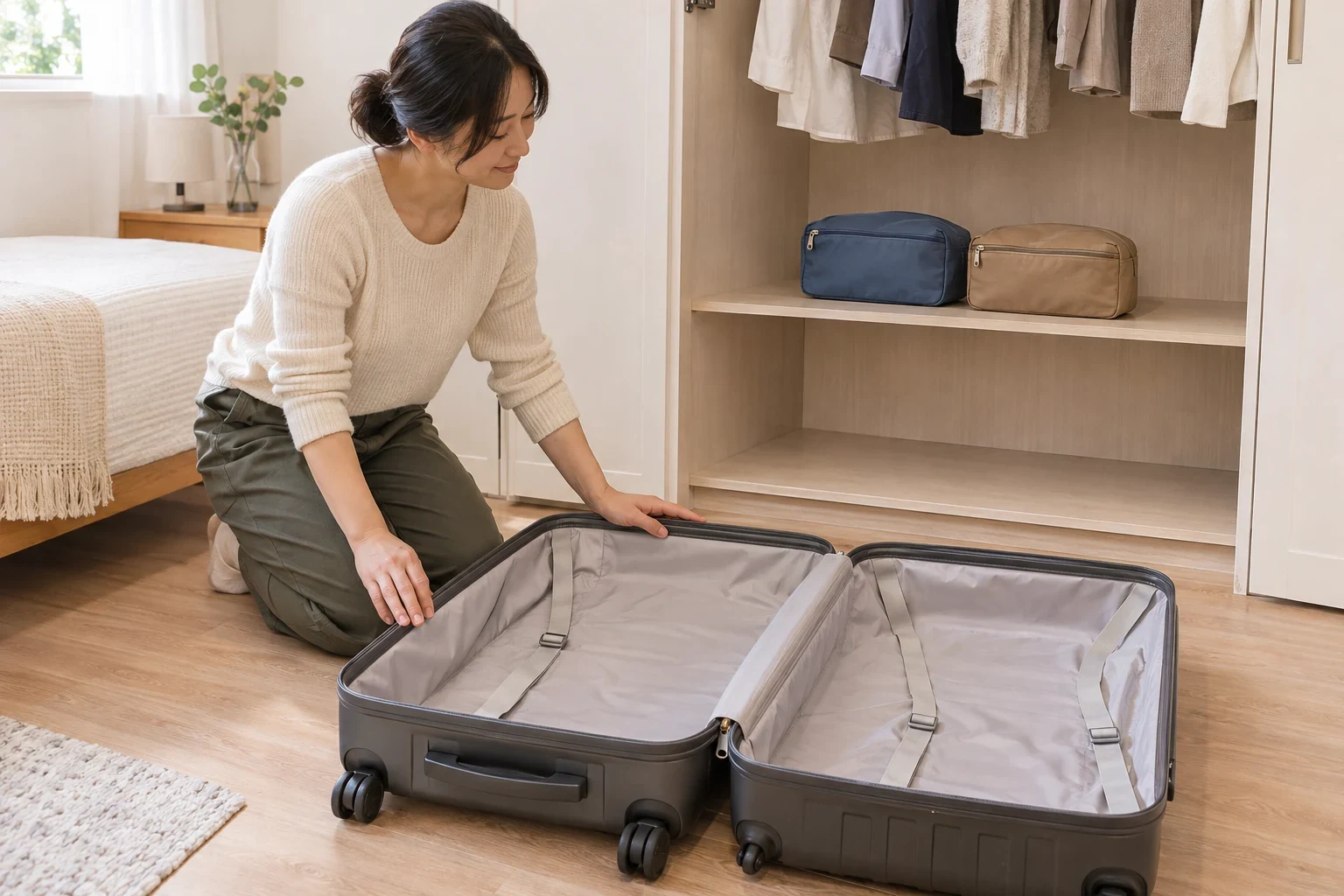
Start with one case and a small, finite group of low-frequency belongings. Keep the contents easy to remove together. If emptying the case would cover the bed, block the room, or fill a cupboard that is already full, solve that problem before treating its interior as available storage.
Choose Contents That Suit the Actual Case
Look for things you own, use infrequently, and can appropriately store together. In this example, one blue soft pouch holds four fabric gift bags. A tan pouch holds two clean fabric cushion covers. These are household groups, separate from the clothes and equipment needed for the next trip.
Check the care needs of the contents and the suitcase itself. A zippered shell is not evidence of waterproof, humidity-controlled, pest-resistant, or archival storage. Do not use a suitcase to avoid a requirement that the objects' own care instructions specify.
Samsonite's luggage-care guidance warns about storing its luggage in extremes of temperature and humidity. That supports checking the storage environment; it does not turn every suitcase into an appropriate container for every textile. Follow the guidance for your actual case and contents, including cleaning and drying as applicable.
Fit the Groups Inside Without Forcing the Closure
Measure the usable compartment around its actual lining, divider, straps, and internal obstructions. External case dimensions include parts that do not hold belongings. A stated travel capacity also does not tell you whether a particular rigid or filled pouch will fit through the opening.
The illustrative main compartment has 24 inches of clear width, 16 inches of clear depth, and 5 inches of usable height. The filled blue pouch is 10 by 12 by 4 inches; the tan pouch is 10 by 12 by 3 inches. Side by side, they occupy 20 by 12 inches, with a maximum height of 4 inches.
The arithmetic leaves 4 inches across the width, 4 inches in depth, and 1 inch above the taller pouch. These are chosen example measurements, not recommended packing gaps or a promise that the case closes correctly. Test the real filled shapes, straps, divider, and zipper without forcing them. Keep the groups removable rather than squeezing loose items around them until removal becomes a sorting project.
Give the Case an Accessible Storage Position
The case itself needs a home you can use. Check its complete exterior, including wheels and handles, against the proposed cupboard, floor position, or other suitable location. Check how you will remove it and where it can open fully without blocking access through the room.
Opening space matters even when the case is rarely needed. Do not count an under-bed gap as useful if the case cannot be pulled out or if other furniture prevents opening it. Choose a location you can handle appropriately with the actual filled case.
IKEA's bedroom storage lesson discusses using overlooked locations for less frequently needed belongings. Apply that idea together with access: a hidden location should still let you retrieve the case and its contents.
Reserve Real Homes for the Pre-trip Change
Before putting the pouches inside, identify where both will go when the case becomes luggage again. In this household, an existing cupboard shelf has a reserved clear space 24 inches wide, 14 inches deep, and 6 inches high. Neither the bed nor the room's walking space is the destination.
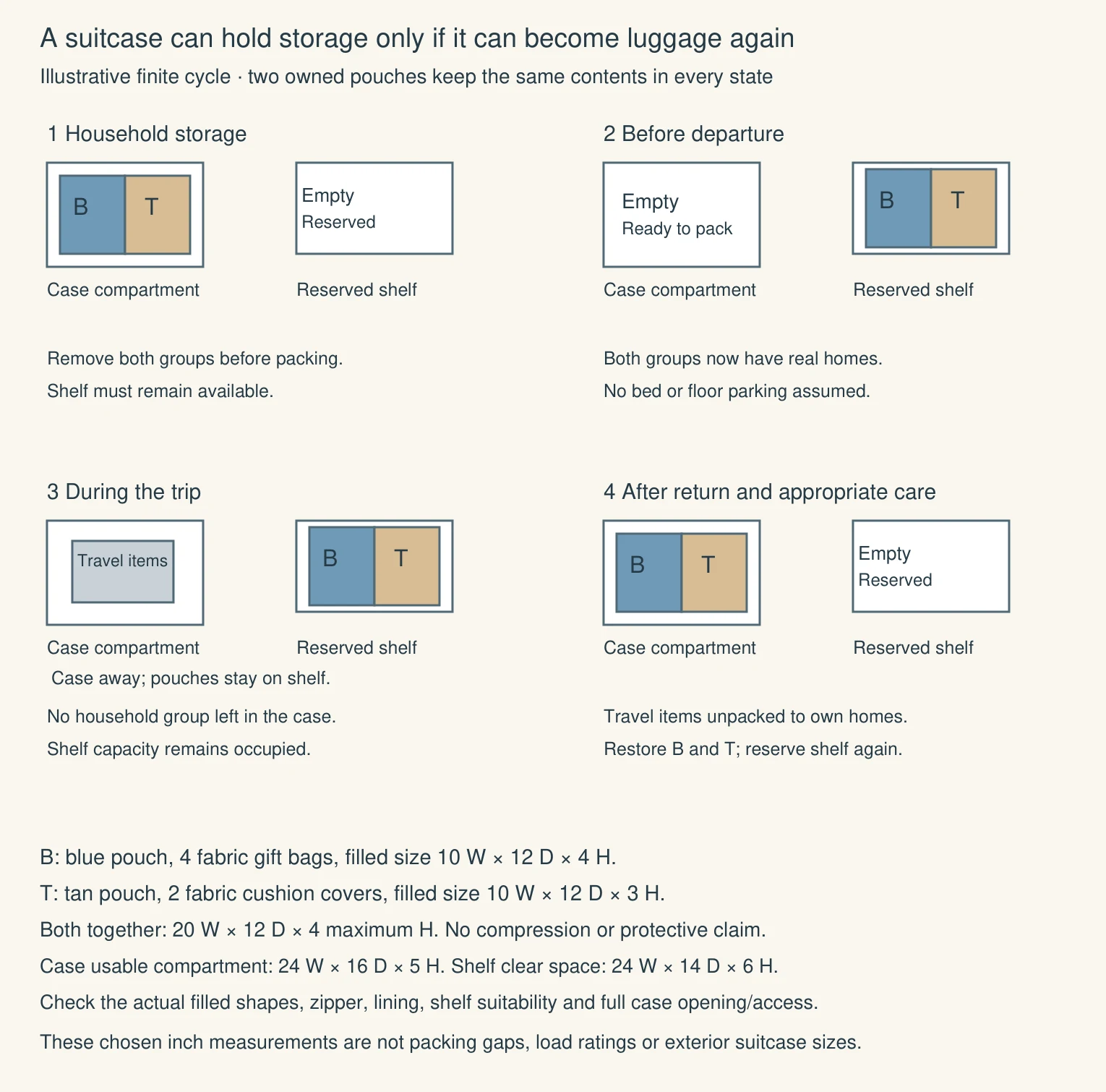
The same two filled pouches occupy 20 by 12 inches with a maximum height of 4 inches on that shelf. The example therefore leaves 4 inches of total width, 2 inches of depth, and 2 inches of height. Check actual retrieval and shelf suitability as well; those differences do not establish a load rating or handling clearance.
Keep that reserved space available. Filling it with another collection removes the fallback and changes the arrangement. This system uses an owned case as an additional storage location; it does not create unlimited capacity or eliminate the space needed when travelling.
Empty the Suitcase Before Starting to Pack
Move the blue pouch, with all four gift bags, to its reserved shelf position. Move the tan pouch, with both cushion covers, beside it. Check the case's other compartments and pockets for household storage too. The suitcase should now be genuinely empty of those contents, rather than merely clear on top.
Only then begin the actual trip packing. The two household groups remain together on the shelf throughout the trip, and the suitcase contains the travel belongings you selected. If either stored group is needed while you are away, another household member can find it without depending on the absent case.
For a borrowed or shared suitcase, agree on this change with its owner and users. A plan that depends on somebody remembering to empty it at the last moment is less useful than one with a clear, repeatable preparation step.
Restore Storage After the Trip
On return, unpack the travel belongings to their ordinary homes. Check the suitcase and follow its appropriate care instructions before putting household storage back inside. Do not close the storage cycle while the case or contents need further care.
Return the blue pouch with four gift bags and the tan pouch with two cushion covers to the usable compartment. The reserved shelf space is empty again and remains available for the next departure. Store the closed case in its accessible home.
Repeat the whole change once before relying on it. You should be able to retrieve the case, move every stored group to its real destination, and begin with an empty suitcase. That complete cycle is what keeps the storage useful without sacrificing the luggage you need.