Opaque boxes can make a shelf look consistent while hiding the information you need to use it. A label solves part of that problem: it tells you what belongs in the box. When similar containers live in different cabinets, a small location index adds the missing step—where to look for the right box before opening anything.
Build the system around the objects and people in your home. You do not need a label printer, an app, or a new matching set of containers to try it. A few readable cards and one current list can be enough for a small collection.
Give Each Box a Category People Recognize
Open the containers and decide what actually belongs together. Use names that someone else in the household can understand. “Gift supplies” is more useful than “bits,” and “spare USB cables” is more useful than a label saying only “office.” Avoid combining unrelated objects merely because they fit in the same box.
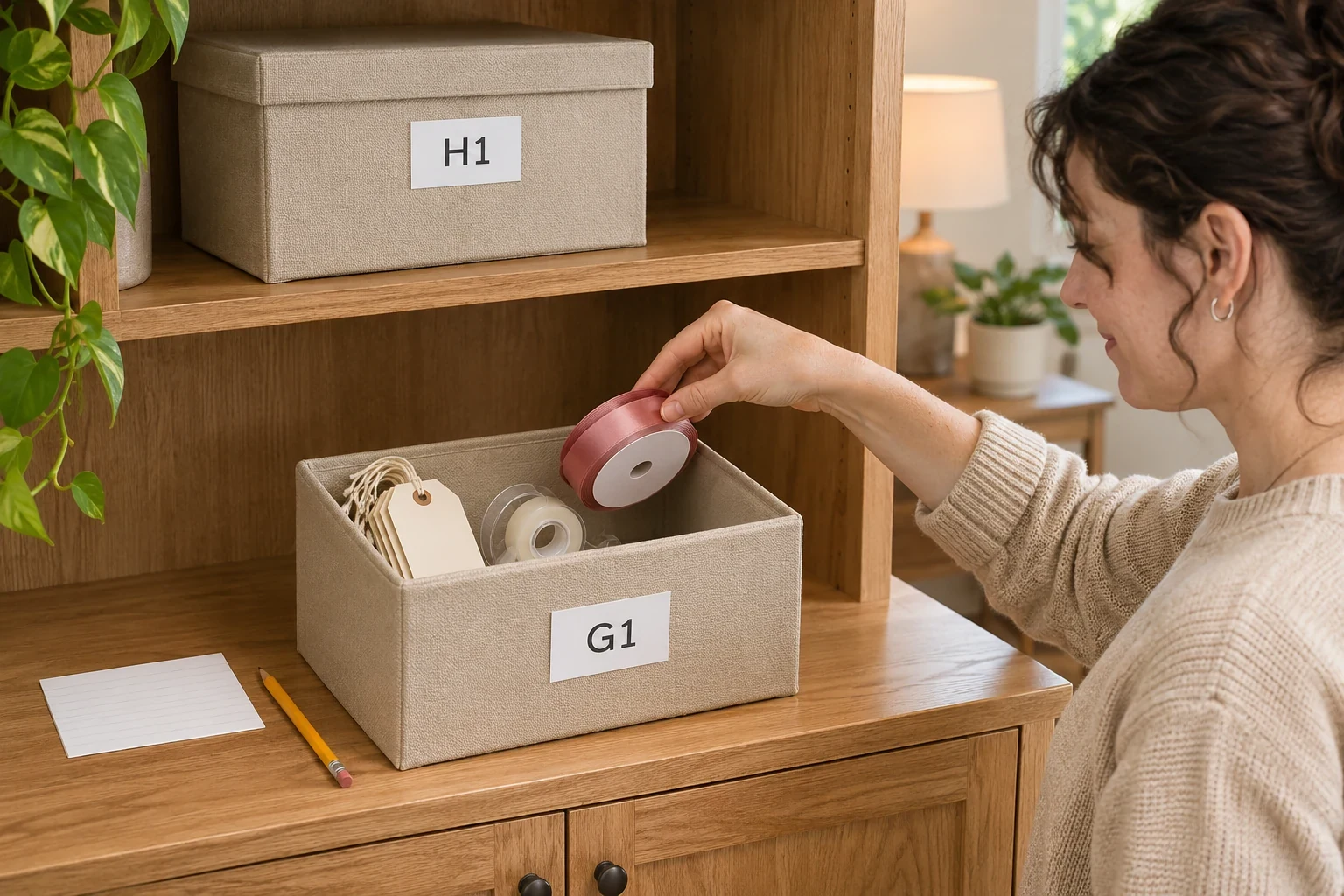
For the example, three existing opaque containers have these jobs: gift supplies, winter hats, and spare USB cables. Gift supplies contains ribbon, gift tags, and tape. The category does not include every object that might someday be useful when wrapping a present. Keep its contents manageable enough to recognize and return.
IKEA's small-space clothes-storage ideas suggest labeling storage boxes to make things easier to find. The useful extension here is to connect that recognizable category to a particular container and its current cabinet position.
Put the Identity on the Face You Can Actually See
Use a short identifier alongside the category: G1 — Gift supplies, H1 — Winter hats, and C1 — Spare USB cables. The identifier helps distinguish similar boxes when you write the index. It is not a location code: G1 can remain G1 if the box moves to a different room.
Place the label where it is visible in the normal stored position, rather than on a lid hidden by a shelf above. Check it from the approach you use, with the normal room lighting. Use readable words and contrast instead of relying on color alone. If someone uses pictures more easily, agree on a clear picture as well as the identifier.
Choose a labeling method appropriate to the container's finish. A loose card in an existing holder may work where adhesive would mark a fabric surface. Check compatibility before attaching anything permanently. The label must stay associated with the box through ordinary handling without obstructing its opening or grip.
Make One Small Location Index
Write a list with three useful fields: category and representative contents, box ID, and current location. Use household names for locations, such as “Hall cabinet — lower shelf,” rather than a description only the organizer understands. Agree which cabinet is meant if there are two in the hall.
| Category and useful search words | Box ID | Current location |
|---|---|---|
| Gift supplies: ribbon, tags, tape | G1 | Hall cabinet — lower shelf |
| Winter hats | H1 | Hall cabinet — upper shelf |
| Spare USB cables | C1 | Bedroom cabinet — upper shelf |
Keep the list in one agreed place the household can reach. A paper card can suit three boxes; a shared note may suit a household already using one. The aim is one current reference, not several beautiful copies that disagree. Include enough detail to find ordinary items without trying to catalog every small object.
Test a Lookup and a Complete Return
Ask another intended user to find the ribbon without pointing at the cabinet. They should be able to connect “ribbon” with Gift supplies, identify G1, read its location, and find that labeled box. If they search under a different natural word, add a useful search word rather than expecting them to memorize your naming choice.
Open the box in its actual storage location, or remove it to a suitable supporting surface if necessary. Take the ribbon out, then close or replace the container appropriately. When the task is finished, return the ribbon to G1 and G1 to the recorded shelf. A correct label cannot compensate for an opening that is blocked or a container too awkward to handle.
The University of Illinois Extension's decluttering guidance emphasizes giving an item one logical home. Apply that principle to the return as carefully as the search. Avoid creating a second unrecorded ribbon box simply because another shelf is closer during one task.
Update the Location When a Box Moves
Suppose G1 moves from the hall cabinet's lower shelf to the bedroom cabinet's middle shelf. Keep the same G1 identifier and Gift supplies category because the box and its job have not changed. Change its location in the index, remove the old location entry, and tell the other users where the current list is.
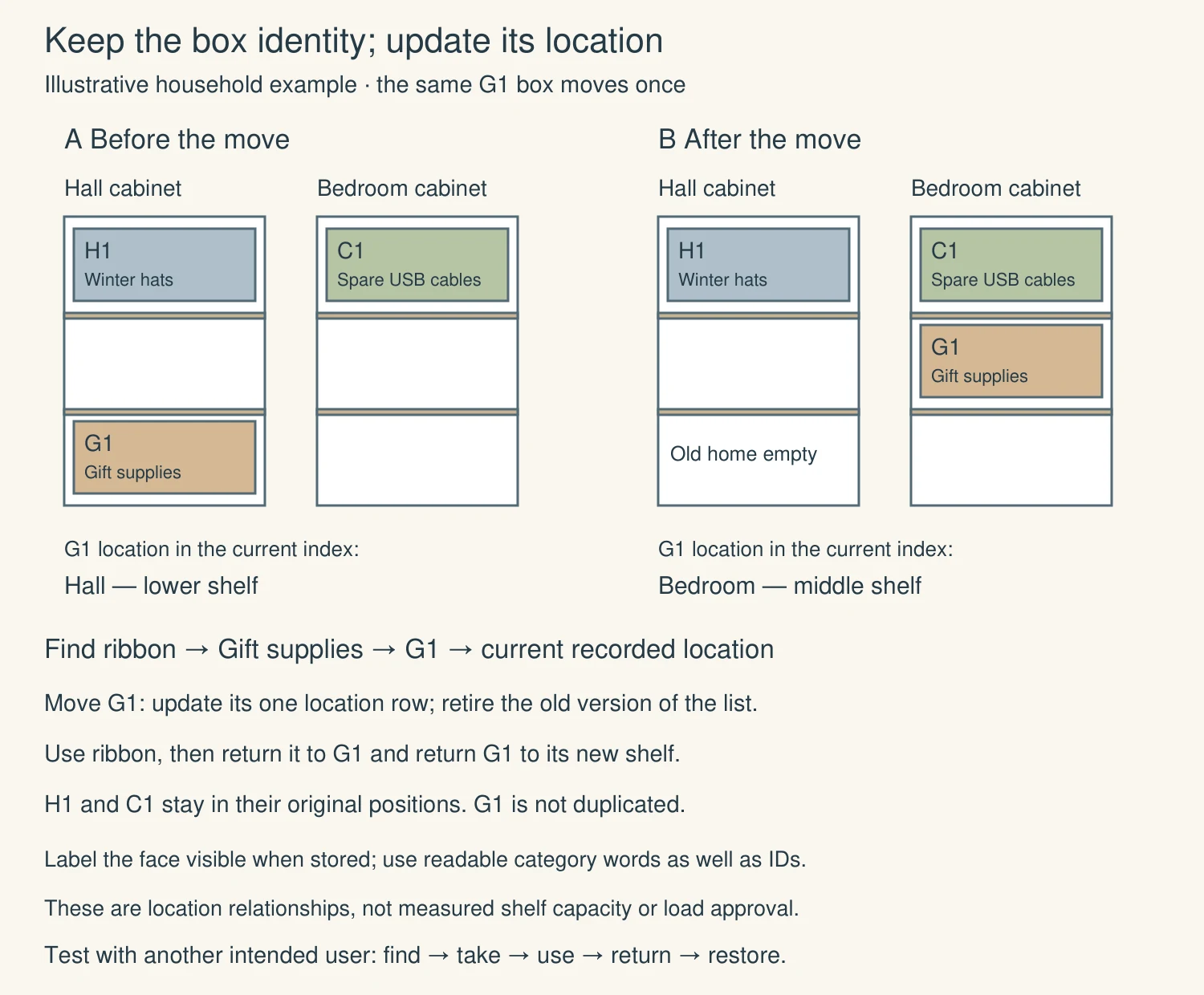
The hall's old position should no longer imply that G1 lives there. Remove any temporary location marker that would send someone back to that empty shelf. Do not leave the old paper list in circulation beside a new version. If the household uses a shared note, update that same note rather than making a second competing index.
Repeat the ribbon lookup from the list after the move. This time it should lead to G1 in the bedroom cabinet, and the return should end there too. The illustration follows this single box between two places; it does not create two homes for the same supplies.
Keep the Index as Simple as the Collection
When a category changes, update its label and index together. If a box becomes empty, decide whether it is still a reserved home or whether its entry should be retired. Do not reuse an identifier for unrelated contents while leaving the old description in the list.
Review the system when it stops answering a normal question: a person cannot find an item, a box repeatedly lands elsewhere, or a move changes the cabinet arrangement. You may need a clearer category or a more usable location. The useful result is a container that looks at home on the shelf and a household that can find, use, and return its contents.