Fair living-room storage gives everyone an agreed place for their belongings, keeps common items available, and makes the rules for borrowing clear. It does not necessarily mean buying identical boxes or dividing every shelf exactly in half. The arrangement has to suit the people, the objects and the way the room is used.
Start with a short household conversation before reorganizing. A person finding their things moved into an unknown box has not been included simply because the cabinet looks tidier. Agree on the purpose of the space, then make its boundaries visible enough that everyone can use them.
Separate Ownership from the Place an Item Happens to Sit
Gather the decisions first, rather than gathering everyone's belongings into a pile. List the living-room activities: watching television, reading, playing a game, working on a project or hosting friends. For each activity, identify what needs a regular home nearby.
Mark the relevant objects as common household items, personal items, or personal items shared only under stated conditions. A privately owned game console may be used by everyone while still belonging to one person. A book on a common shelf is not automatically available to borrow outside the home.
University of Rhode Island's roommate guidance recommends agreeing on what is communal, what is personal and what needs permission before borrowing. Its broader advice is to write down shared expectations and revisit them as circumstances change. Those principles work as a starting point for a living-room storage conversation.
Do not make disposal decisions for another person. If nobody knows who owns an object, put that question on the discussion list rather than treating the object as abandoned. The first useful result is a common understanding of what the storage must support.
Agree on Usable Capacity, Including Access
Look at the actual cabinet or shelving unit together. Note which openings people can reach comfortably, which containers can be removed, and whether doors or lids need extra space. Follow the furniture's installation and load instructions; a shelf is not available capacity if using it would make the unit unstable or exceed its limits.
Reserve space for the common items the room needs before negotiating the remaining personal areas. Otherwise the first person's project can take all the convenient storage while remotes and shared games remain loose on the sofa. Keep ordinary retrieval simple enough that common things can return to their homes.
IKEA's living-room examples distinguish display storage, concealed storage and working materials. Apply that task distinction to the household's actual objects rather than putting everything behind the same door. A fragile personal collection and the remote used every evening may need different positions and handling.
Equal-size spaces can be a useful first proposal, but they are not proof of fairness. Reach, mobility, object size and frequency of use can make two nominally equal shelves very different. Agree on a different allocation when needed, with the affected people involved, instead of letting the first occupied shelf settle the matter permanently.
Mark Personal and Common Homes Clearly
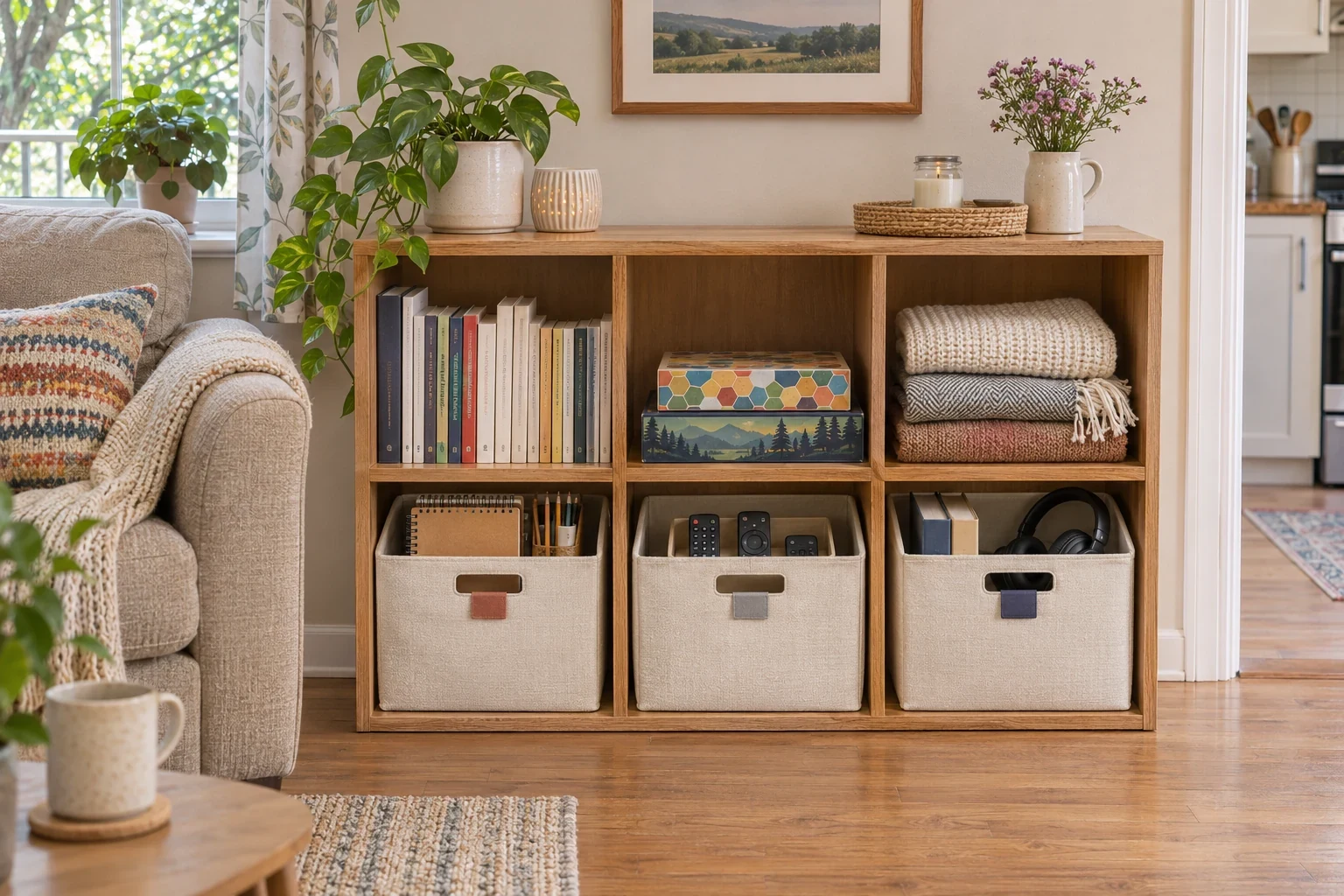
In the illustrated six-compartment example, the upper row holds common books, games and throws. The lower row has Ari's personal project bin on the left, a common daily-items bin in the middle and Mei's personal bin on the right. This is one household's starting arrangement, not a recommended distribution for every home.
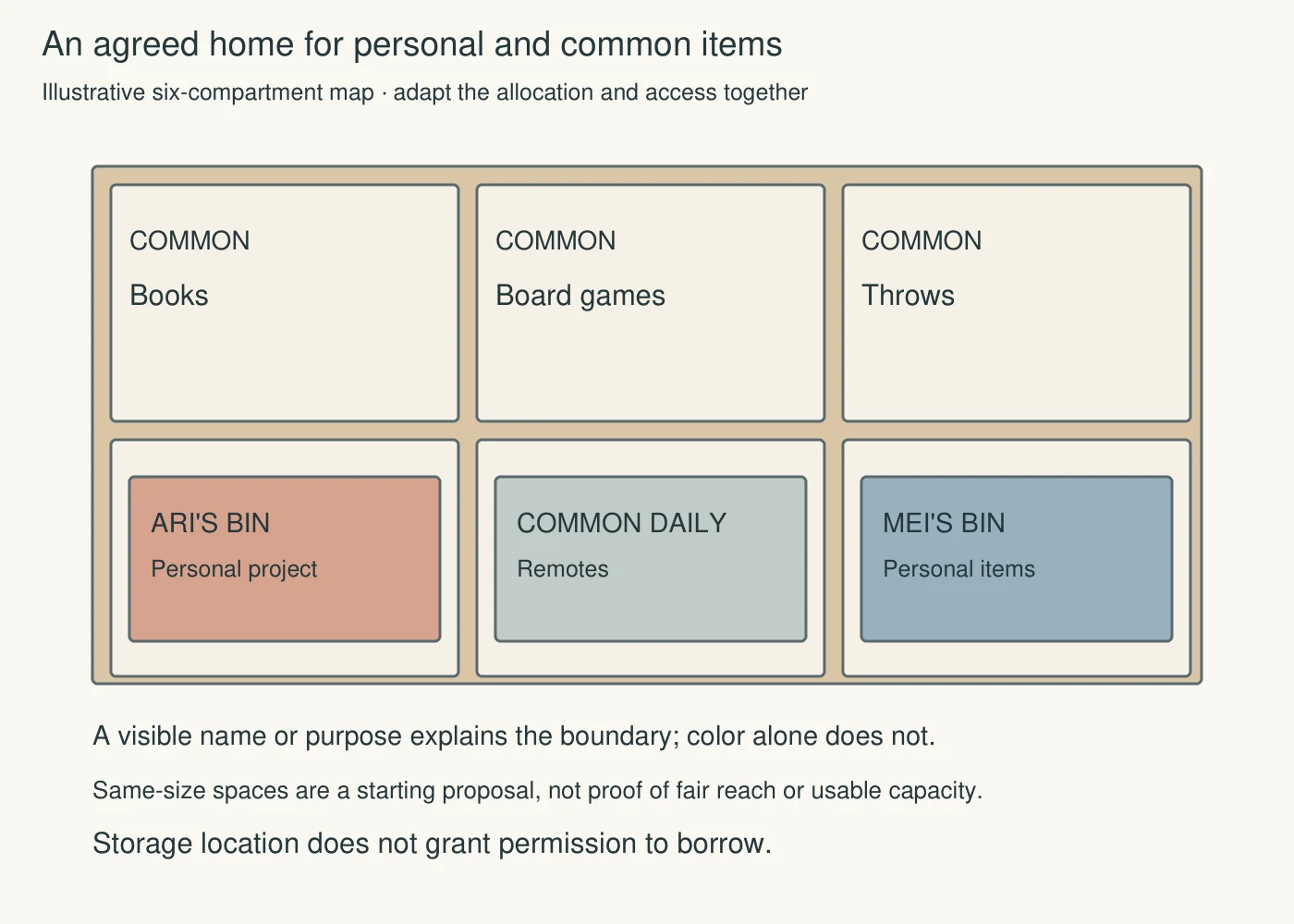
The two personal positions are recognizable, and the shared daily items remain accessible without opening either person's bin. A small label on the visible front makes the meaning clearer than relying on color alone. Use names or agreed descriptions that everyone can read and understand.
Treat a label as a storage boundary, not a security device. A closed box does not make private documents, valuables or hazardous materials appropriate for an ordinary common-room shelf. Give objects with special privacy, safety or care requirements suitable storage elsewhere.
Then test the contents. A bin should hold its assigned items without forcing them through the opening or letting them spill into the neighboring position. Keep enough access to grip and remove it. If a large item needs a different home, discuss that actual requirement rather than silently absorbing another person's space.
Write the Borrowing and Return Rules Beside the Layout
Location and permission answer different questions. Decide whether a common item can leave the room, whether a personal item can be borrowed, and how a borrower returns it. A storage map alone cannot tell someone whether the headphones in Mei's bin are available for a visitor.
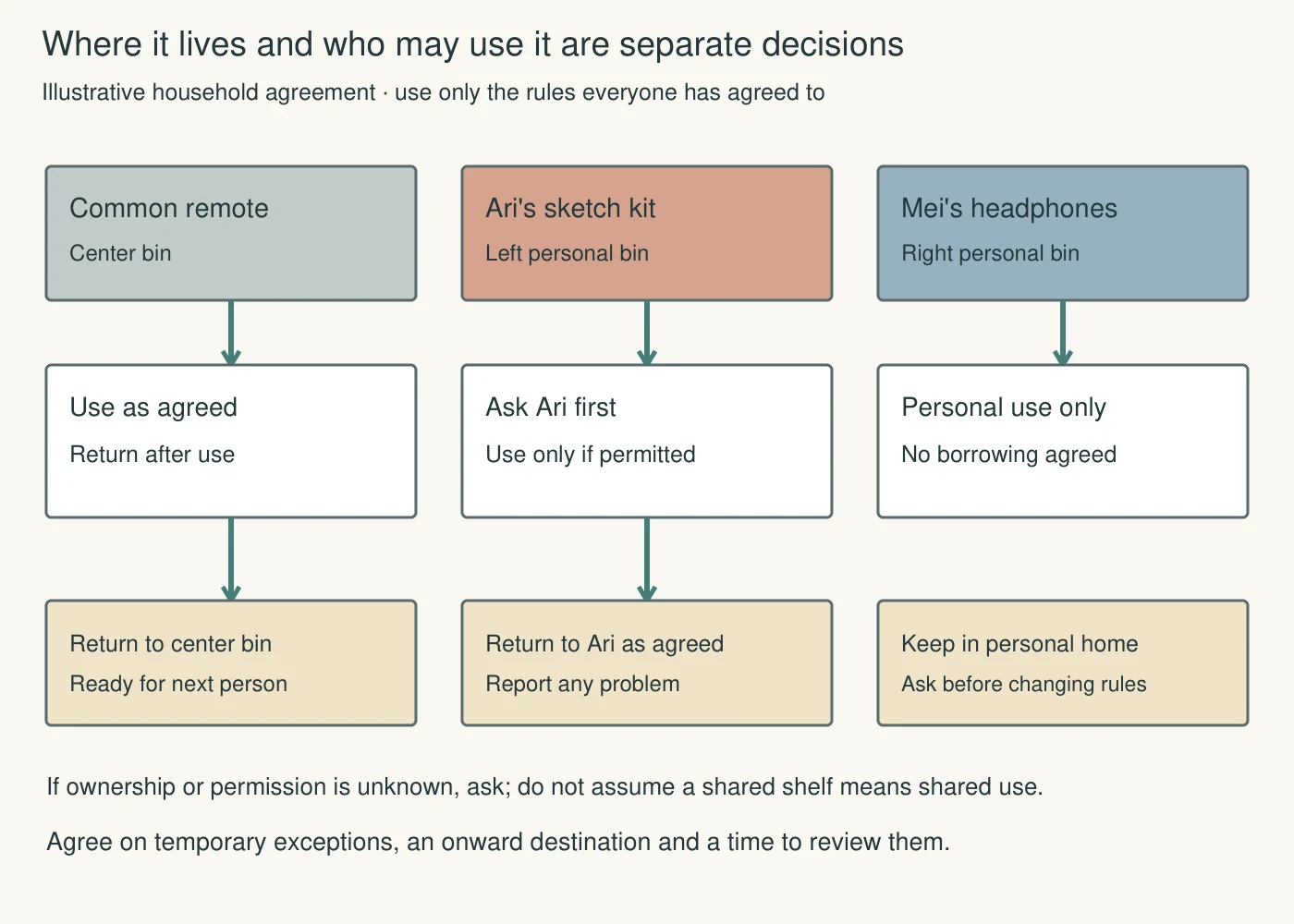
Keep the agreement brief and specific. For example: “Common remotes return to the center bin after use. Ask Ari before using the sketch kit. Mei's headphones stay personal. Ask the owner before taking a personally owned book out of the home.” Use rules the actual household has agreed to, not a printed template that nobody discussed.
Include what happens when something needs attention. Put a game with a missing piece on the agreed repair or check list rather than returning it as if it were complete. Tell the owner about damage or a misplaced item. Do not hide the problem inside someone else's bin.
Choose a shared place for the agreement, such as a household note or a small card inside the cabinet. Everyone affected should be able to find and update it through the agreed process. Avoid public labels that reveal private information to guests.
Give Temporary Overflow a Limit and an Onward Step
Personal projects change size. Guests arrive, a board game remains unfinished, or a bag of materials needs sorting. Agree on where a temporary exception can sit and when the person responsible will deal with it. Otherwise the overflow becomes an unannounced permanent allocation.
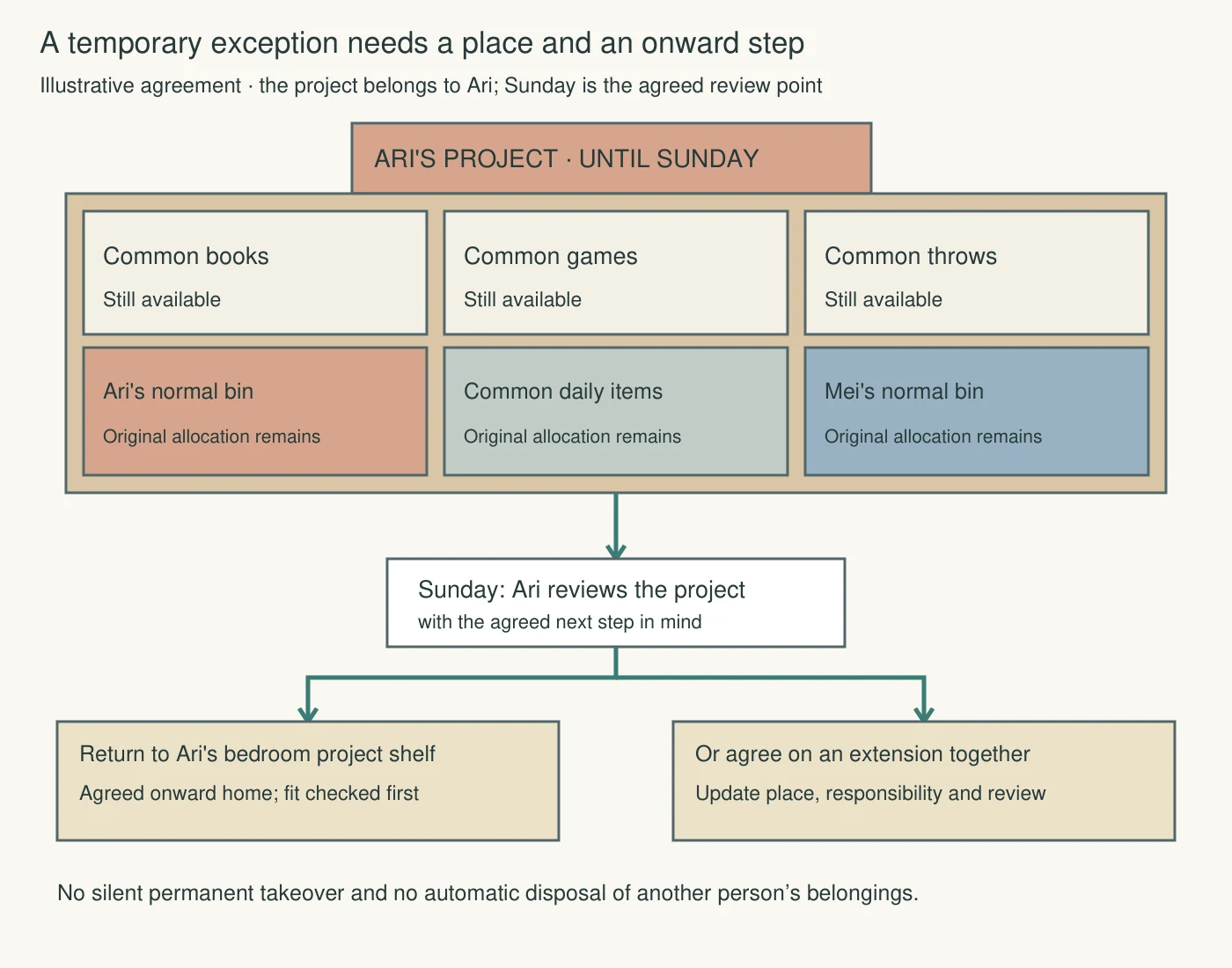
A small existing tray can be a bounded place for loose items awaiting their owner's attention. Decide together what belongs there, who checks it and how to ask for collection. It should not become a place to sweep another person's belongings without telling them, or a deadline after which anyone may throw them away.
For a longer project, agree on a temporary space and a review point. In the example, the household reserves a bounded tray on the unit for Ari’s project until Sunday; the ordinary common compartments remain available. The agreed onward home is Ari’s bedroom project shelf, checked to take the kit. At the review, Ari returns it there or asks everyone affected to agree on an extension. Another household might need a different arrangement. Make clear which shared storage remains usable during the exception and where the project will go afterward.
If the same person's things repeatedly exceed the agreed space, revisit the amount or type of storage and the activities the room supports. Buying another bin before that conversation can simply turn a disputed shelf into a disputed floor area.
Review the Arrangement After Ordinary Use
Try the agreed layout for a period the household chooses, such as two weeks. Notice concrete problems: a shared remote cannot be found, one bin is difficult to lift, someone cannot reach their shelf, or common supplies keep landing in a personal area.
Discuss the observation and the change it needs. Move a daily common item nearer its point of use, adjust an inaccessible personal position, reduce an overfilled category or agree on a different allocation. Confirm the change with everyone affected and update the map or labels.
Give people privacy and control over their own belongings throughout the process. Ordinary storage agreements can support a shared home, but labels and a meeting are not a remedy for threats, coercion or concerns about personal safety; seek appropriate help when those are present.
Keep the final arrangement understandable: what is common, what is personal, what needs permission and what happens when space runs short. A fair system is one everyone can use and revisit, with belongings returned to known homes and changes agreed openly.