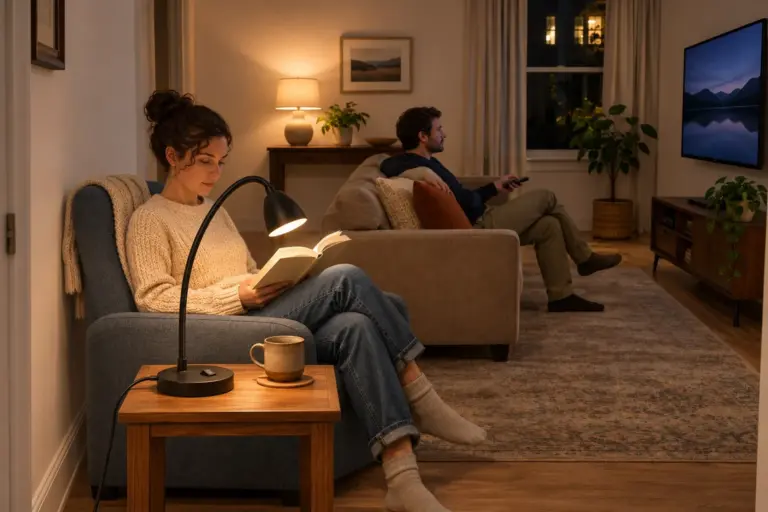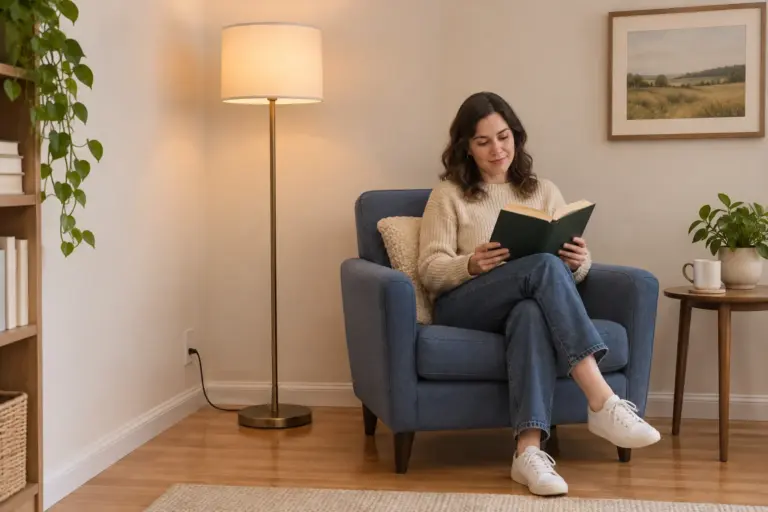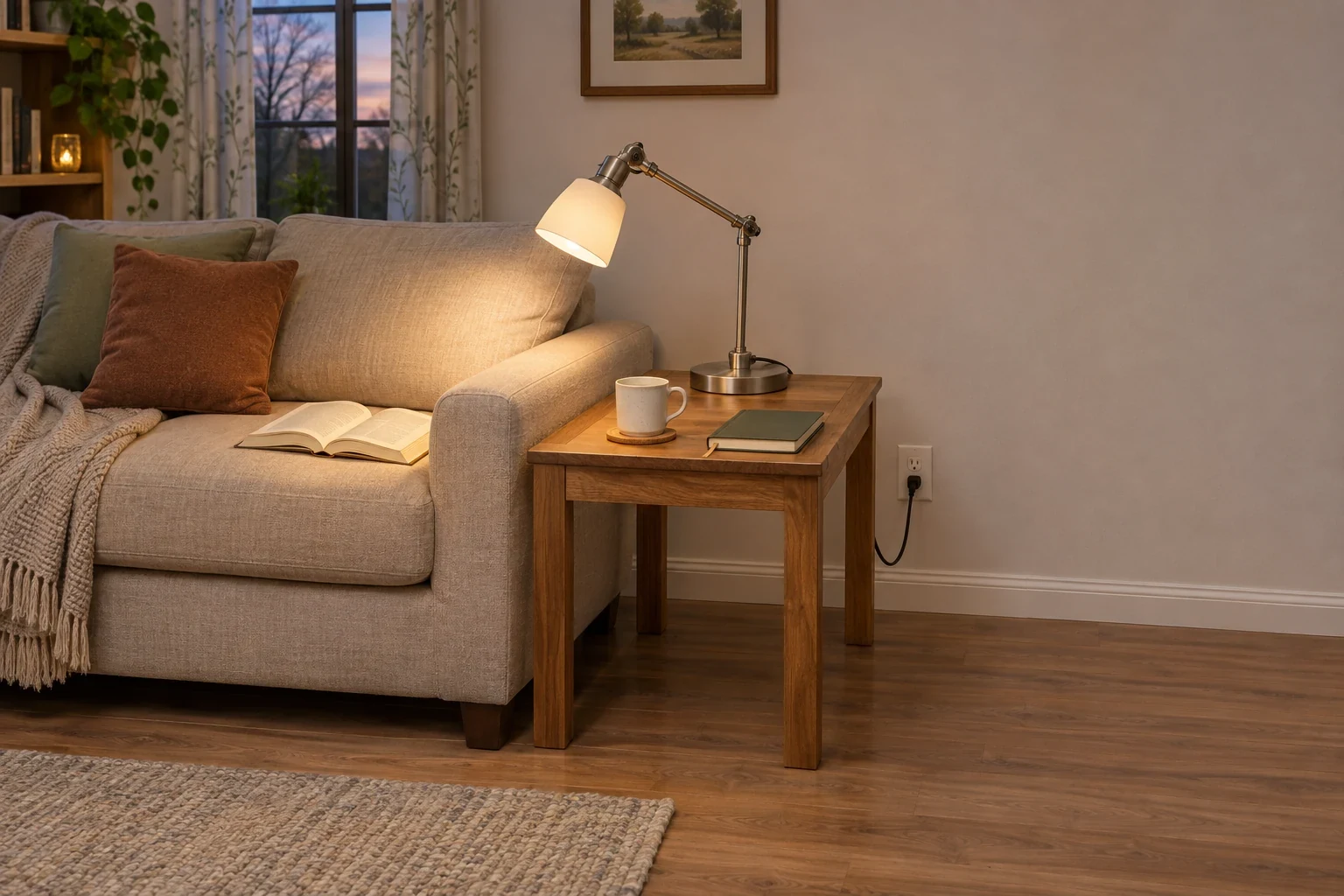
Choose a table lamp when an existing suitable surface can support it and still do the jobs you need beside the sofa. Choose a floor lamp when you want to preserve that surface and can give the fixture's base, pole and shade a workable place on the floor. Check both arrangements from the occupied seat before deciding that either is more compact.
Keep the lighting job the same during the comparison. A lamp for reading a book and a lamp for softly lighting the wall may need different source positions. Choosing a furniture format first can leave you with a tidy table and light that does not reach what you want to see.
Compare the Whole Arrangement, Not Just the Lamp Base
List what belongs beside the seat: a cup, book, phone, controls or another everyday object. Include the side table if you would still want it with a floor lamp. Removing the table from only one version makes the comparison misleading when you continue to need its landing surface.
Next mark the available floor and tabletop. Include the sofa arm, projecting feet, curtains, outlet and the approach to the seat. If the sofa reclines or has another moving part, show that operating shape as well as the closed body.
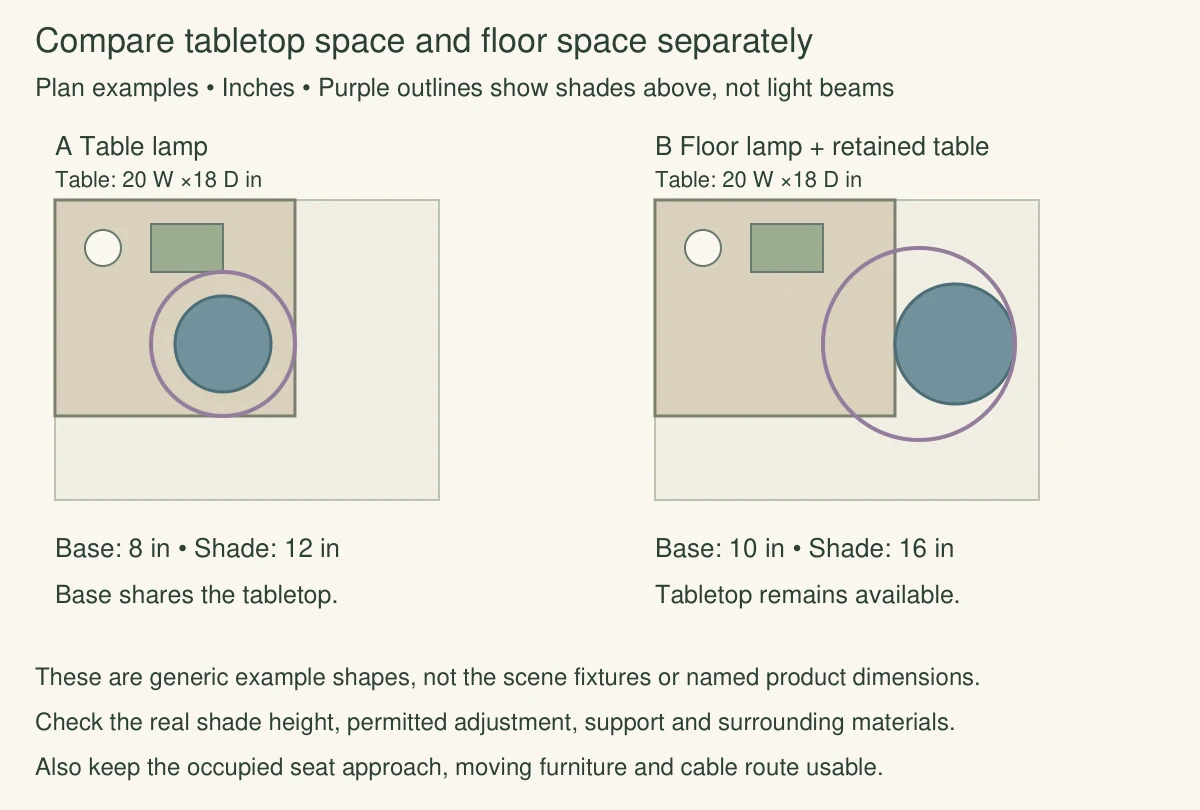
The plan examples separate a lamp base from the shade's projection above it. A fixture can have a small base and a much broader shade. Check that full shape against the user, wall and nearby materials using the actual product instructions; the base alone does not describe the arrangement.
IKEA's lighting guidance distinguishes direct task light from general and mood lighting. Start with that purpose, then find a floor or tabletop format that can put its source in the useful position. Neither format automatically provides a particular quality or amount of light.
Let a Table Lamp Share a Surface Only When It Genuinely Fits
The opening arrangement puts a generic adjustable table lamp on the rear part of an existing side table. Its head aims toward the book area while the front remains available for a cup and notebook. The whole base is supported, and the cable reaches the nearby wall outlet behind the table.
Check the actual objects on your surface. Can you place and lift the cup without reaching around a hot or fragile part of the lamp? Can you use the notebook without moving the fixture each time? Keep the lamp and nearby materials within the clearances its instructions require.
In the dimensioned example, the tabletop is 20 inches wide and 18 inches deep. The generic lamp base is 8 inches across and its shade projects 12 inches across above the table. Those are example shapes, not the specifications of the photographed lamp or the named buying option later in the article.
A footprint fitting within the table does not settle everything above it. Check the shade's actual height and the way the head adjusts. A broad low shade may interfere with the objects you need even though its base occupies little surface.
A table lamp is especially worth trying when the table is already part of your routine. If you need to buy a table solely to support it, compare the whole new furniture arrangement with the floor-lamp alternative rather than calling the lamp alone a smaller solution.
Give a Floor Lamp a Real Position Outside the Approach
The floor-lamp alternative retains the same sofa and side table. The lamp stands beside the table on a separate visible base, leaving the tabletop free for the cup and notebook. Its head reaches toward the same book area. The two scenes illustrate placement choices, not a measured light-output comparison.
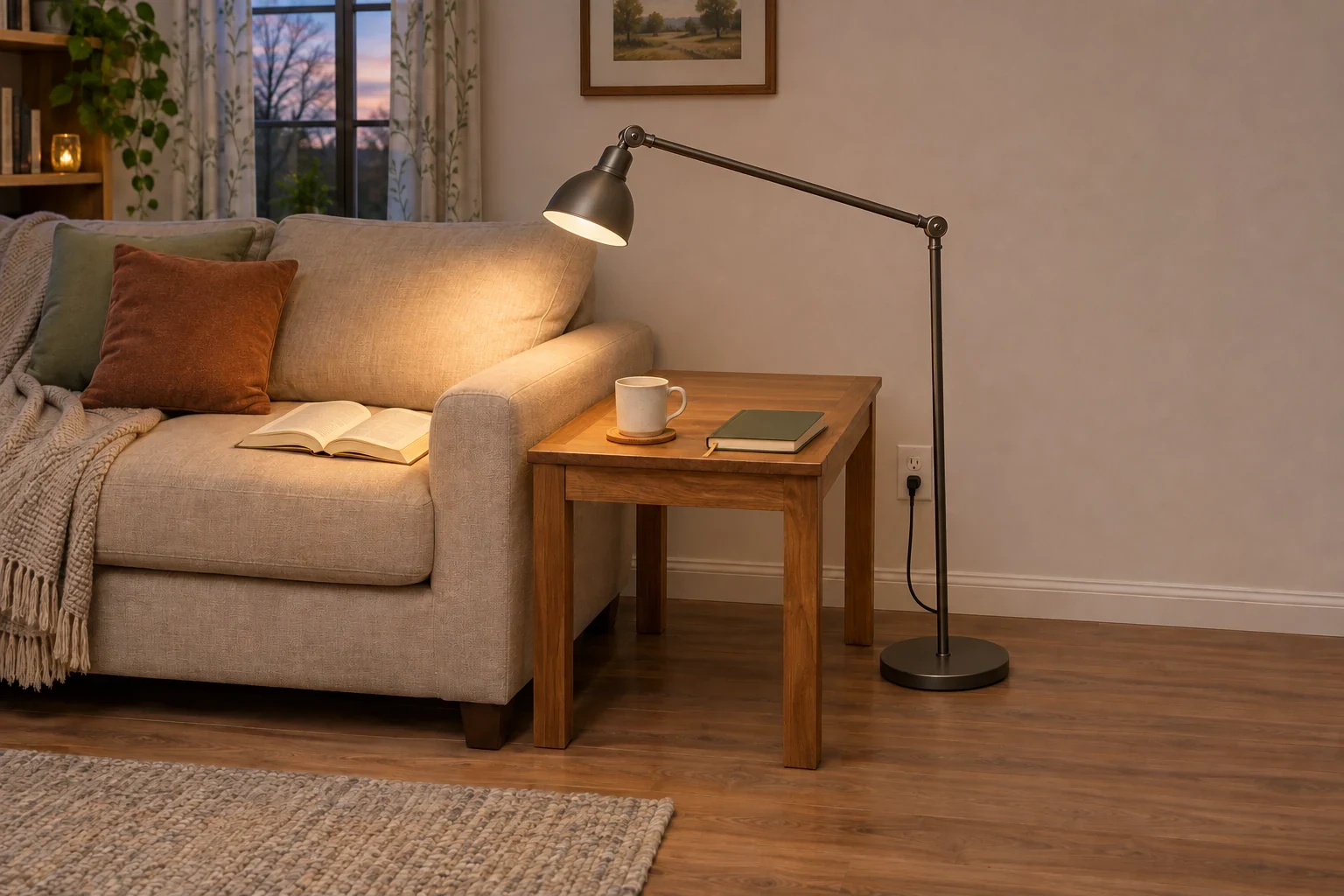
Mark the entire base, including any projecting edge, and the pole's position. Do not place it where feet, a reclining mechanism or the normal approach to the seat will meet it. A base partly hidden in a photograph still occupies the floor.
The plan example uses a 10-inch floor base and a 16-inch shade projection beside the retained table. The shade reaches beyond the base's outline, so check the sofa, wall and nearby materials at that height too. These example dimensions show what to measure; they do not establish that a particular fixture fits your home.
Keep the controls usable from the intended position. A switch hidden behind the sofa may mean standing or reaching awkwardly for every adjustment. Try reaching the actual control while seated and when entering the area, without pulling on the lamp or its cord.
Do not assume a floor lamp removes the need for a drinks surface. If you still need one, keep it in the plan. The useful advantage may be a clearer tabletop, rather than less total furniture.
Check the Same Page, Viewpoints and Power Route
Sit normally with the book or other task in its real position. Test whether the lamp can reach it using only its permitted adjustment. Check whether the sofa arm or your shoulder blocks the source, and look at the shade opening from the neighboring seat as well as your own.
Keep useful background room light during the trial. An attractive glow on the wall is not proof that the page is adequately lit. Conversely, a focused lamp on the page need not provide the whole room's evening lighting. IKEA's guidance treats those roles as complementary.
For compatible replaceable bulbs, compare output in lumens, light appearance and the intended beam. Confirm the exact fitting, permitted wattage and any dimmer compatibility. Wattage describes power use; it does not tell you by itself which arrangement will light the task better.
Trace the cord all the way to a suitable outlet. Keep it out of walking routes, moving furniture and the seat approach according to the product instructions. A different lamp height does not solve an outlet that requires a cable across the doorway.
Compare a Table Format with the Actual Measurements
One optional adjustable tabletop format is the LEPOWER UT2032 Metal Desk Lamp, ASIN B078W61H9P, in Sandy Black. The selected listing describes one corded tabletop lamp with an E26 fitting, a base switch and a flexible gooseneck. Its nominal overall dimensions are 6.69 inches deep, 5.7 inches wide and 14.17 inches high, with a listed 5.7-inch base diameter.
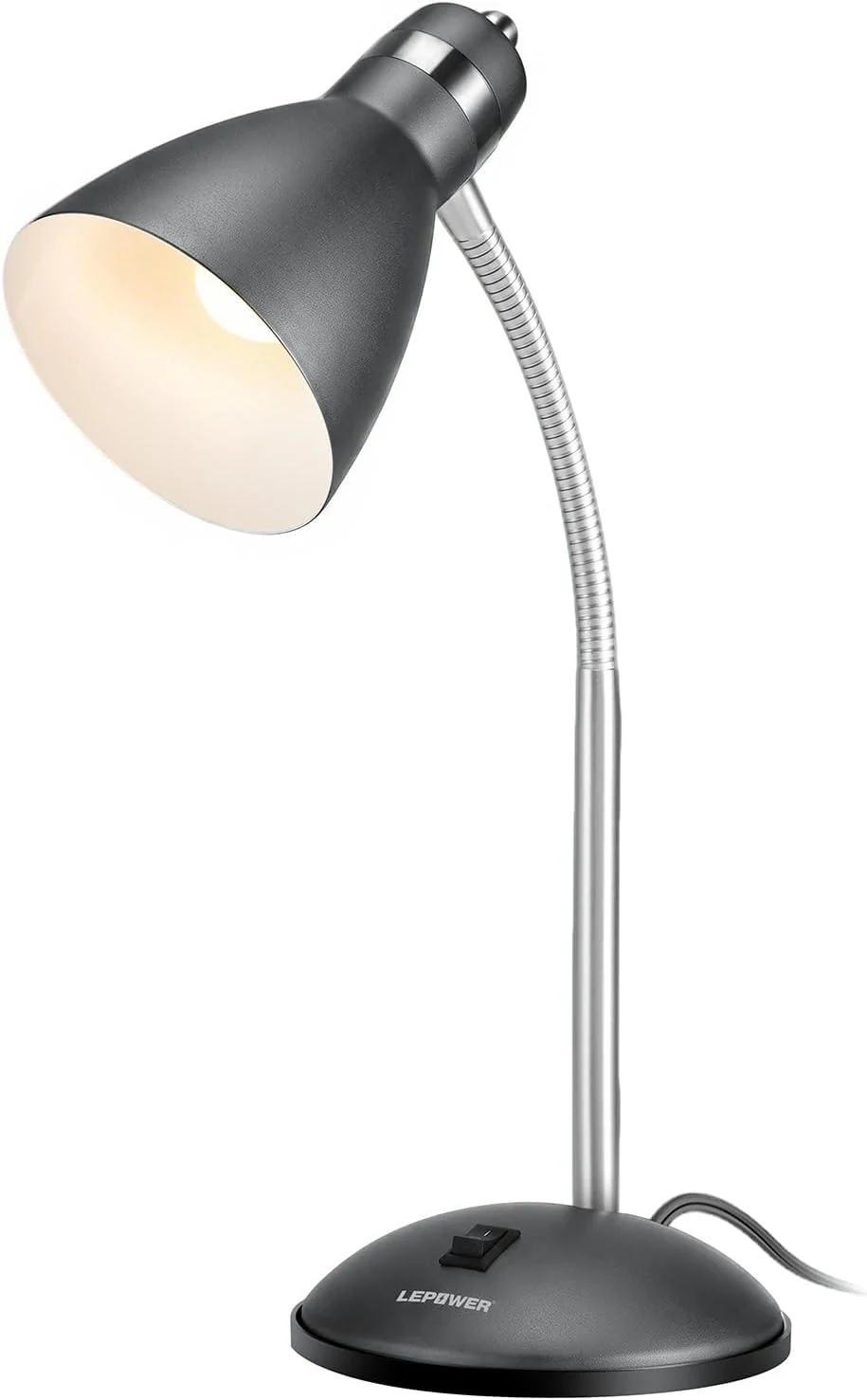
That is a smaller task-lamp format to compare when your existing table can put its head where the book needs it. Check the adjusted reach, shade space, current bulb instructions and what is supplied before buying. Its listed height is not a promise that it reaches over your sofa arm.
As an Amazon Associate I earn from qualifying purchases.
Check the LEPOWER tabletop lamp on Amazon
The real product photograph identifies this option. The room scenes and the numerical plan examples use generic fixtures. For a floor-lamp purchase, obtain the selected item's assembled height, base and shade dimensions, adjustment, control position and cable information before deciding it fits beside the sofa.
Use the Comparison to Make the Choice
| Your actual condition | Format to try first | Check before keeping it |
|---|---|---|
| A stable existing table has useful spare surface | Table lamp | Base support, shade space and the objects still needed there |
| The table is needed but its top is already doing essential work | Floor lamp beside it | A separate base position outside the occupied approach |
| The floor beside the sofa is part of a required route | Table lamp on a suitable existing surface | The full fixture and cable stay clear of movement |
| There is no suitable table and no usable floor position | Another arrangement | Neither format solves the missing support or space automatically |
Use the same task and household routine for both trials. Sit down, put down the book or cup, switch and adjust the light, then stand and leave. Include the people who use the neighboring seat and the route past it.
If one arrangement repeatedly needs resetting, identify why. A crowded tabletop, a base in the way or a source that cannot reach the page is a concrete reason to change the plan. A different decorative style will not necessarily alter those relationships.
Keep the format that completes the lighting job while leaving the sofa end usable. The decision may be a table lamp, a floor lamp or a revised furniture position; it should come from the whole occupied setup rather than the smallest base in a catalog.