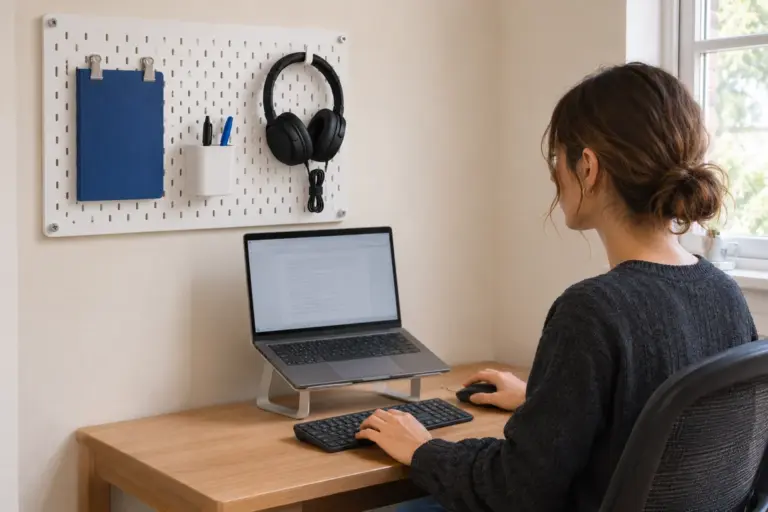
A folding desk saves useful space only when you can work at it, close it and put it somewhere practical. Its folded thickness answers one part of that decision. The open frame, the chair, the folding operation and the journey to storage all need their own space.
Before buying, plan four states: working, clearing and folding, carrying or otherwise transferring as instructed, and stored. A desk that fails one of those states may spend most of its life open in the room—or folded in front of a cupboard you need to use.
Start with the Working Position
Set out the equipment for a normal session. Include the laptop or monitor, keyboard, mouse and any paper used at the same time. Mark a candidate desktop footprint on an existing suitable surface to see whether those objects and their working movements fit. Do not expect a small folding top to accommodate equipment simply because each item fits separately.
Next consider the underside. Side frames, braces, shelves and the folding hardware can occupy space that an overall width measurement hides. Check where your knees and feet would go with the chair at the actual working height. A rear shelf may be useful storage in one arrangement while restricting foot space in another.
OSHA's workstation guidance separates the usable work surface from the clearance beneath it, including room for legs and changes in working posture. Apply that distinction to the actual desk rather than treating its outer dimensions as proof of a suitable workstation. Leave room to approach, move the chair back and leave without hitting another piece of furniture.
Establish How the Desk Becomes Fully Supported
Find the instructions for the exact model and finish you are considering. Establish how the legs, braces, top and any locks reach their intended working position. “No assembly required” does not tell you how to verify that a folding frame is ready for use.
Look for a clear explanation or demonstration of the support points and the way the desk is opened and closed. If the information is missing, ask the maker before choosing it for a daily setup. Do not copy the release or latch sequence from a similar-looking desk: folding designs differ.
Use the desk on a suitable surface and follow its operating and load instructions. A top that seems level is not evidence that all supports are engaged. Do not add a monitor arm, clamp lamp or heavy equipment unless the desk and accessory instructions allow that particular support arrangement. A folding joint or thin edge may make an otherwise familiar attachment unsuitable.
IKEA's small-workspace material includes foldable and multipurpose surfaces among several ways to use a room. Choose the type from your activity and setup routine, not from the promise that it will disappear quickly.
Measure the Folded Object Independently
Ask for all three folded dimensions and whether any parts detach. The tallest folded dimension can be greater than the open desk's height. A slim thickness is useful only if the remaining width and height fit the storage place and its access route.
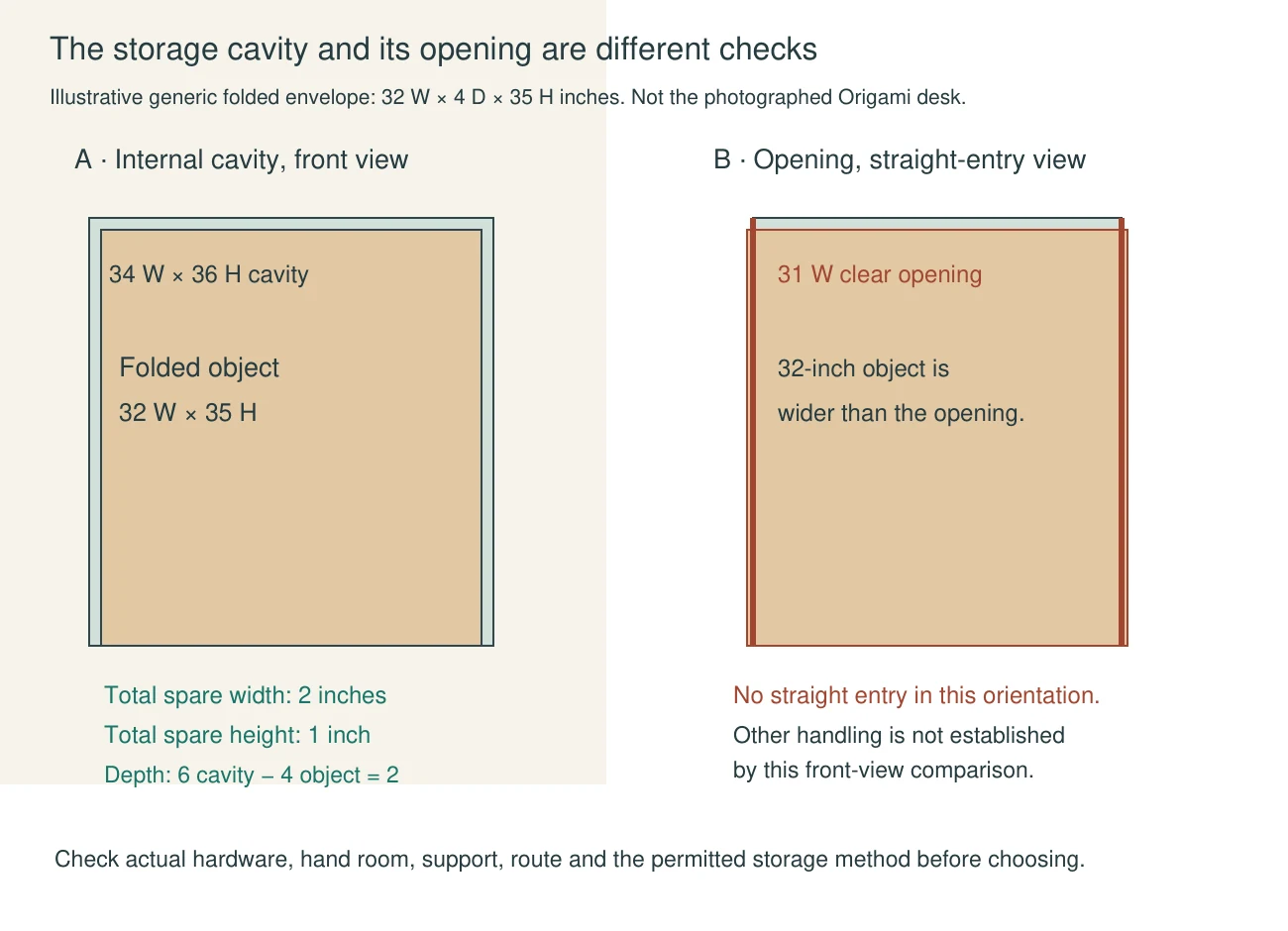
For an illustrative comparison, suppose a generic desk is 32 inches wide, 20 inches deep and 30 inches high in use. Its separately stated folded envelope is 32 inches wide, 4 inches deep and 35 inches high. Those folded measurements are hypothetical inputs, not something calculated from the open dimensions or the room photograph.
A storage cavity measuring 34 inches wide, 6 inches deep and 36 inches high has 2 inches of total spare width, 2 inches of total spare depth and 1 inch of total spare height around that folded envelope. That is an initial geometric fit, before accounting for hinges, handles, a retaining arrangement or your hands.
Now check the opening. If its clear width is only 31 inches, the 32-inch-wide envelope cannot pass straight through in the illustrated upright orientation. The larger cavity behind the opening does not solve that straight-entry mismatch. The drawing does not prove that every possible rotation is impossible; it shows why an internal measurement alone is insufficient. Establish a supported, permitted way to enter and remove the actual object rather than forcing it past a frame.
Clear the Whole Desk Before Folding
Decide where each working item will go. Include objects on a lower rack or shelf if they must be removed for closing or moving. An empty desktop with a power supply and books still on the frame is not necessarily ready to fold.
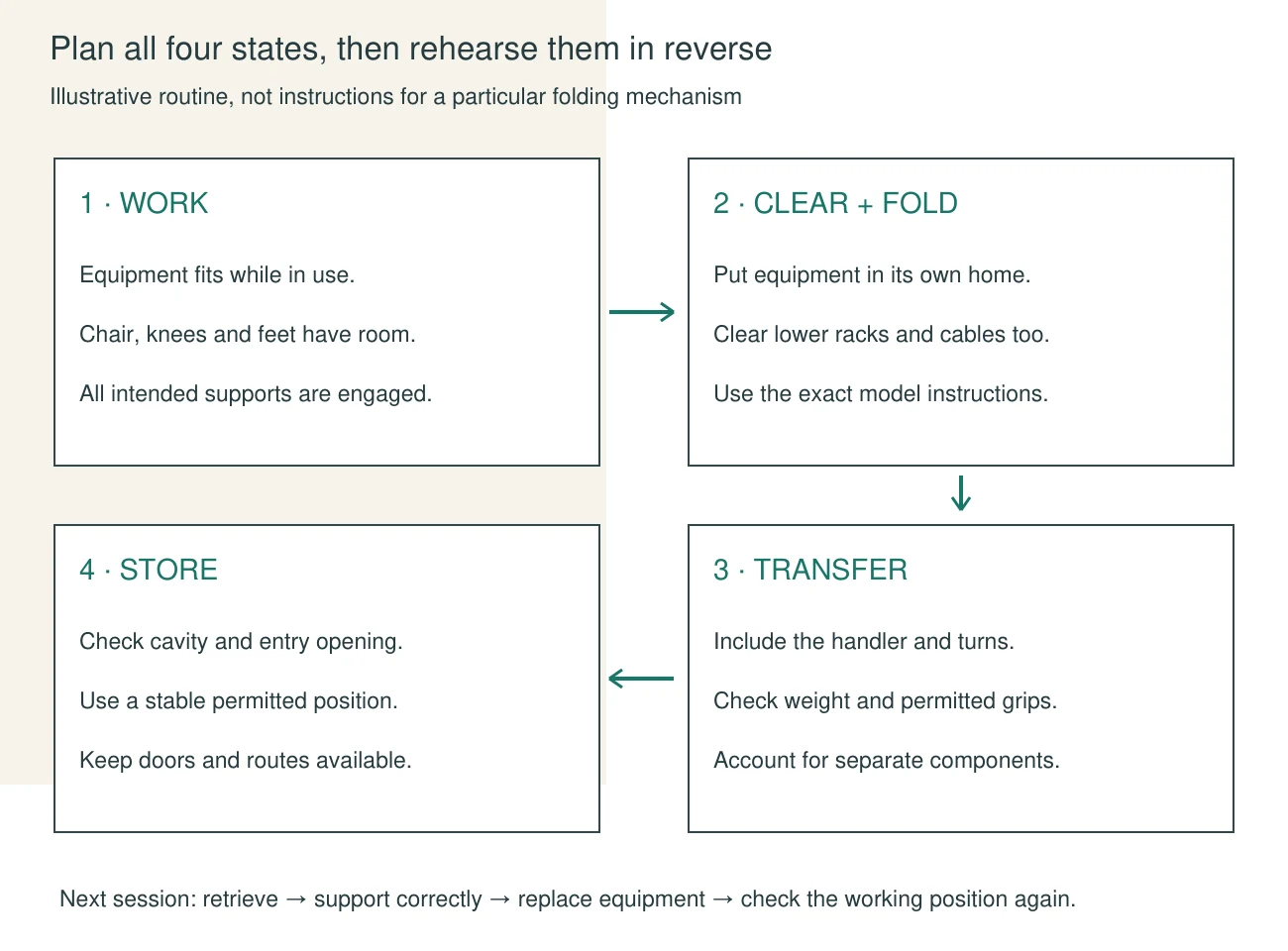
Shut down, disconnect and handle equipment as its instructions require. Put the equipment in its normal storage home before releasing the desk's supports. Keep cables clear of the moving parts and the transfer route. Do not leave a connected cord to pull taut when the frame moves.
Follow the model's folding instructions, including any help, orientation and hand positions they require. Keep hands away from moving joints as directed and do not force a resistant mechanism. Identify a place for a removable top or brace if the model has one. Count those components in the stored arrangement so that next time's setup does not begin with a search for a missing part.
The routine illustration connects the four states without supplying a generic hinge-release procedure. Use it to find omitted objects and steps, then use the exact desk instructions for the operation itself.
Check the Transfer and the Storage Position
Trace the route from the working location to the storage place. Include the person handling the desk, turns, door handles and anything projecting from the folded frame. A desk that fits upright in a recess may still be awkward to turn into that recess.
Consider the actual weight and the handling instructions. Foldable does not mean light enough for every person to carry alone. Do not assume the frame can be dragged or rolled unless it is designed for that method. If the required handling is impractical for you, choose another arrangement or leave a suitable desk in a permanent working position.
The stored desk needs an appropriate stable position under its instructions. Do not rely on an unsecured lean against a frequently used door. Check that cupboard access, the room door and necessary routes remain usable while it is stored. Include any permitted restraint or support in the space calculation; do not improvise wall fittings from a product photograph.
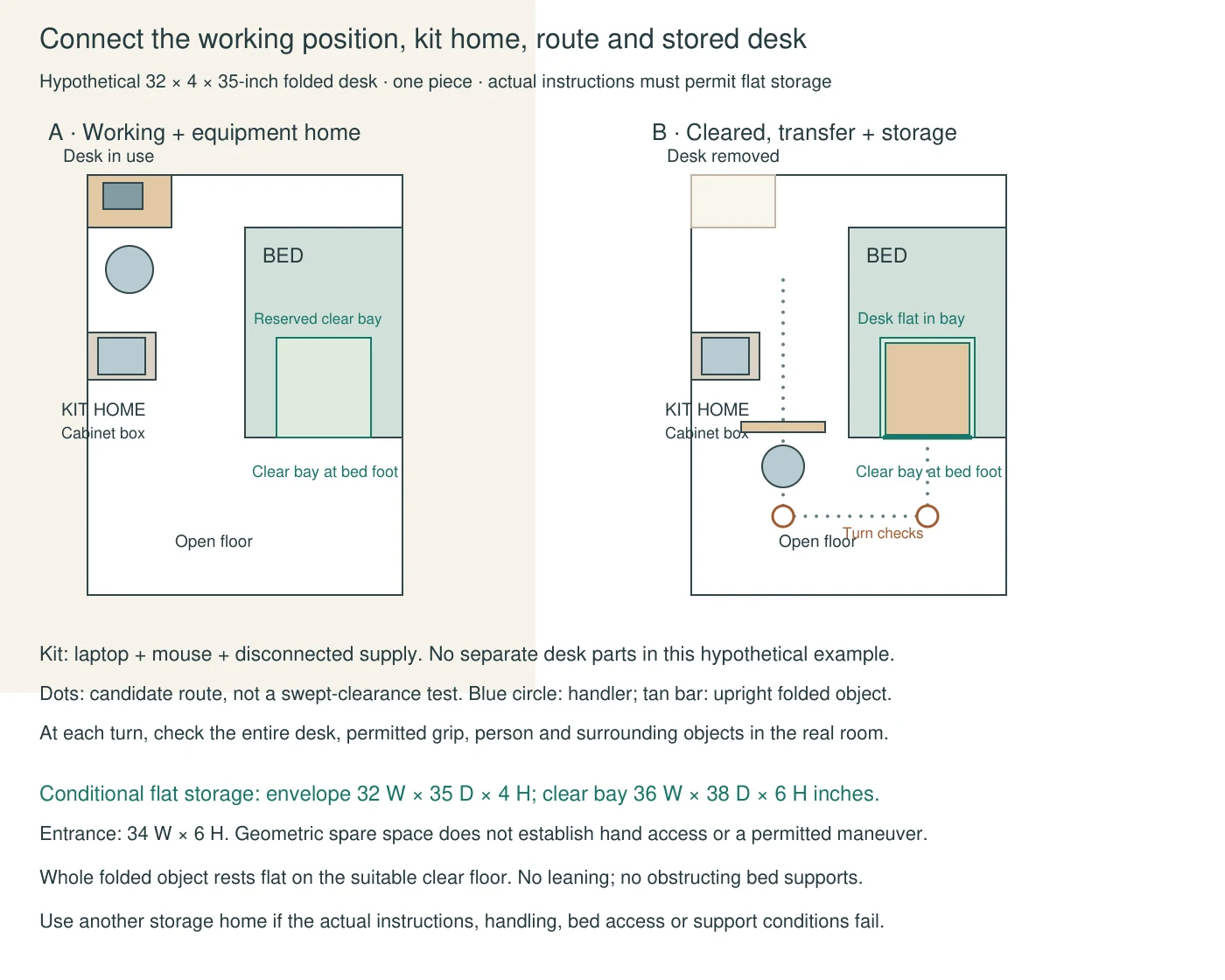
The connected room plan follows the same hypothetical 32-by-4-by-35-inch folded desk. Its laptop, mouse and disconnected power supply return to a box on an existing cabinet. This example assumes one folded piece, with no detached top or brace; a different design needs homes for those parts too. The dotted route includes two turns to check with both object and handler. It is a candidate route, not a proven carrying maneuver.
The alternative storage home is a clear under-bed bay, used only if the actual desk instructions permit flat storage. Laid flat, the example envelope occupies 32 inches across, 35 deep and 4 high. The bay is 36 wide, 38 deep and 6 high, with a 34-by-6-inch clear entrance. Its dimensions exceed the envelope, but support members, hand access, permitted handling and removal still need checking. The complete object rests flat on the suitable clear floor; it does not lean against the bed. If that method is not permitted or cannot be handled, reject this storage home.
A Real Folding Desk Shows Why Height and Weight Matter
The black Origami RDE-01 illustrates the difference between open and folded measurements. Its maker lists an open size of 47.5 inches wide by 23.75 deep by 30 high, and a folded size of 24 wide by 5.5 deep by 49.5 high. The stated weight is 38 pounds. The maker also says its dimensions are rounded to the nearest quarter inch and calls for allowance.
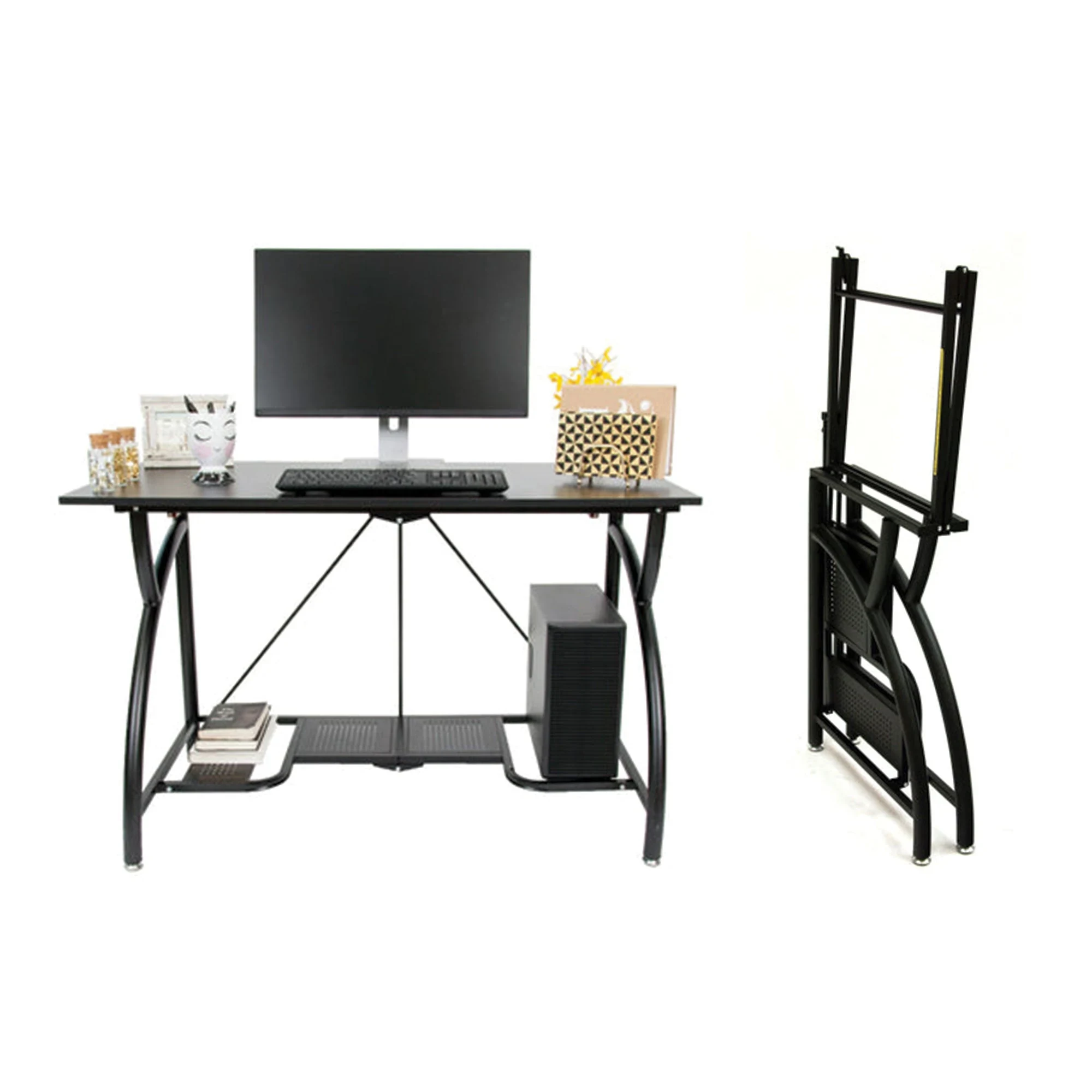
Those figures make it a useful comparison for a storage recess: the folded height is 19.5 inches greater than the open height. They do not establish that you can carry it comfortably, that your chair clears the lower rack, or that it fits a tightly measured opening. The real manufacturer photograph shows the black RDE-01; the generic 32-inch desk example and room illustration describe separate arrangements. The computer and objects styled in the manufacturer image are not a verified contents list.
Rehearse the Return to Work
Finish by reversing the routine. Retrieve the desk, place and support it correctly, set out the equipment and sit down. Check the chair and leg space again before treating the setup as finished.
If clearing and rebuilding the workstation takes more effort than the space recovered is worth, reconsider the folding format. A suitable permanent shallow desk may serve better. Choose a folding desk when all four states work for the room and the person using it, including the ordinary morning when it has to come out again.