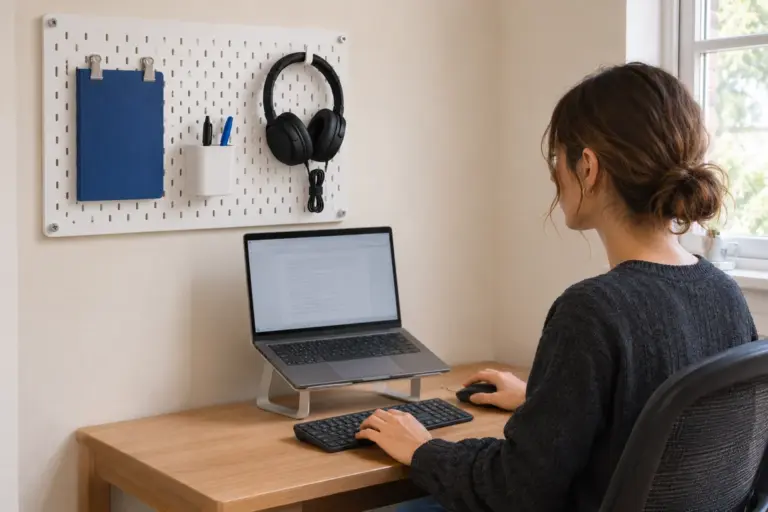
Choose a compact office chair by the space its complete body and your ordinary movements require. The seat's width is only one measurement. Casters, arms and the backrest may extend farther, and the chair needs room to move away from the desk when you stand. Compare those requirements with the workstation before deciding that a small-looking chair fits.
Keep personal fit in the same decision. A chair that parks neatly but prevents an appropriate working position has not solved the problem. Try suitable candidates with the desk and equipment you will use, then check both the working position and the route out.
Record the Seat and Outside Dimensions Separately
Start a comparison card for each exact chair and configuration. Record the seat width and depth, overall width and depth, caster-base dimensions where confirmed, backrest shape and arm positions. Note which measurements change with permitted adjustments. Do not use a shipping-carton dimension as the assembled chair's size.
If a listing provides only overall dimensions, ask for the missing detail or measure a display example. An overall 28-inch width does not establish that the caster base is a 28-inch circle. Nor does a seat measurement tell you how far the arms project or how much the back moves during tilt.
In the generic illustration, the seat is 18 inches wide, the caster base has a measured 24-inch diameter, and the complete chair is 28 inches wide in the selected position. A 26-inch clear opening beneath the desk exceeds the base diameter by two inches, but is two inches narrower than the complete chair. That subtraction cannot approve pushing the chair under the desk.
Check the actual narrowest opening between legs, drawers and supports. A wide desktop can conceal a much smaller opening below it. Keep cables and stored items out of the space needed for the user's legs and the chair's intended position.
Check Arm Height Against the Actual Underside
Measure from the floor to the lowest relevant obstruction under the desk. Include an apron, drawer or keyboard tray rather than using the desktop's top height. Compare it with the chair's arms at the settings the user needs.
In a separate illustrative height check, a desk underside is 27 inches above the floor and the chosen chair-arm top is 28 inches high. The arm cannot pass beneath that obstruction in that setting. The one-inch conflict is different from the width conflict; solving one does not resolve the other.
Do not lower the seat simply to hide the arms if doing so makes the person's working position unsuitable. Check the chair, desk, keyboard and screen as a combination. OSHA's chair guidance recommends trying chairs before purchase and adjusting them alongside the workstation components. It also identifies armrests interfering with chair positioning as a problem to resolve.
Use only adjustments or configurations allowed by the furniture instructions. If you prefer an armless version, assess whether it supports your own work appropriately. Removing required parts or altering the desk to force a fit is not part of this comparison.
Add the Movement Needed to Stand and Leave
Put the complete chair in its intended working position. Move back, turn as needed, stand and leave in the normal direction. Include the user, foot placement and the backrest, not just a circle representing the casters.
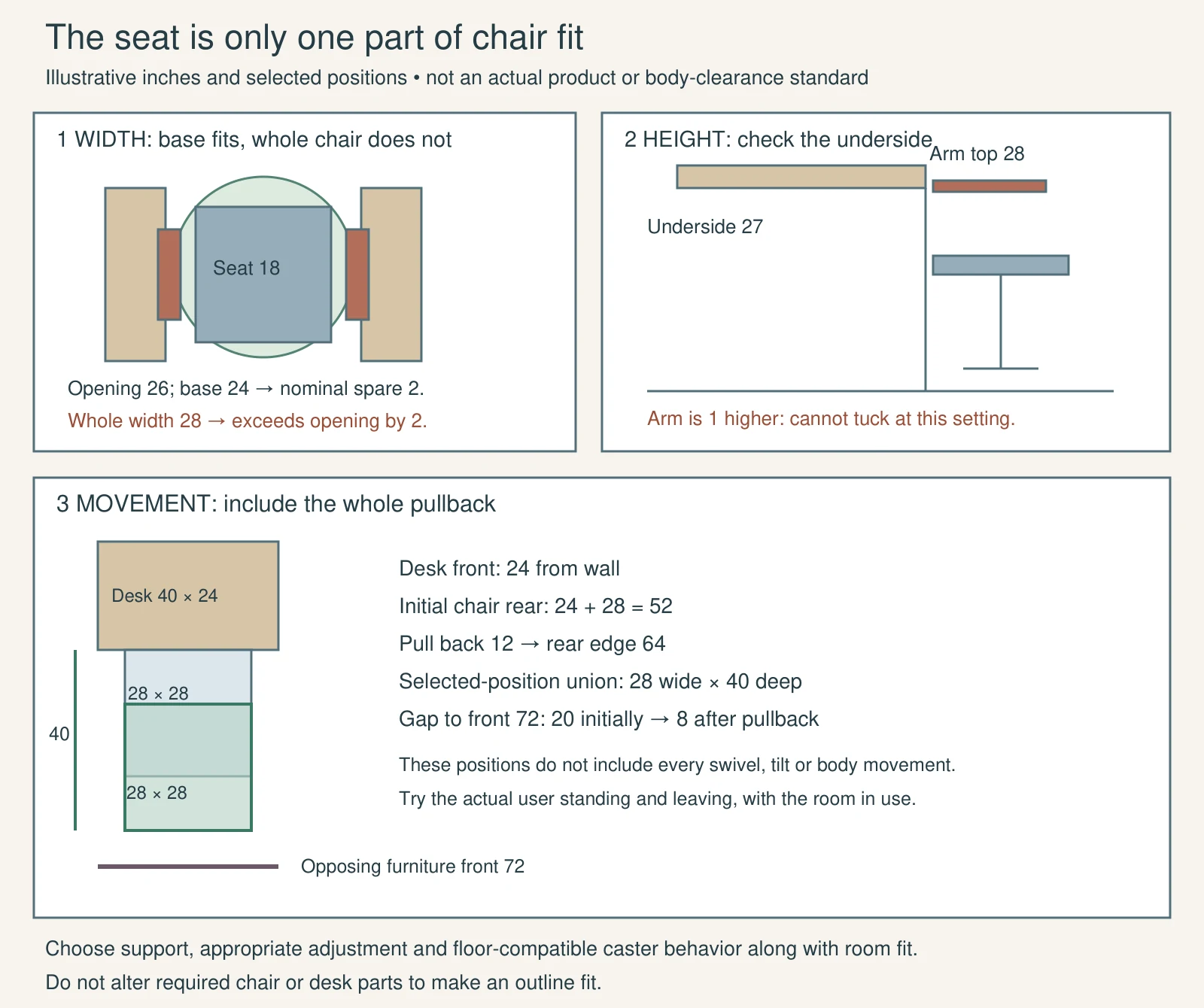
The top-view example uses a complete 28-by-28-inch chair outline entirely in front of a desk. The desk front lies 24 inches from the wall; the chair initially occupies the next 28 inches, ending at 52. Moving the same outline straight back by 12 inches puts its rear edge at 64 inches from the wall.
The union of those two selected chair positions is 28 inches wide by 40 deep. With an opposing furniture front at 72 inches, the remaining geometric gap changes from 20 inches to eight. The drawing does not prescribe that pullback distance or establish that eight inches is usable standing or passing space. It shows why a parked rectangle understates the area you must investigate.
Try the complete motion with another person using the surrounding room when that reflects normal life. Check nearby drawers, doors and sofa access. Include the chair's permitted rotation and back movement; the two straight positions do not demonstrate every part of that movement.
Keep Support and Floor Behavior in the Choice
Sit in the candidate and use the actual keyboard, pointer and display. Check that the seat and back support you appropriately, your feet have suitable support, and you can use the controls without leaning around an obstruction. A narrow seat is not automatically a better match for a narrow room.
Check the chair's permitted floor use and caster behavior. Follow its instructions rather than changing wheels or defeating a locking feature just to make a tight arrangement roll differently. Try ordinary entry, sitting, repositioning and standing with the configuration you intend to keep.
If several people share the chair, repeat the fit and movement checks for each user and establish how their settings change. A setting that allows one person to park the chair does not prove that another can work or leave comfortably.
Separate the Exact Chair from Its Options
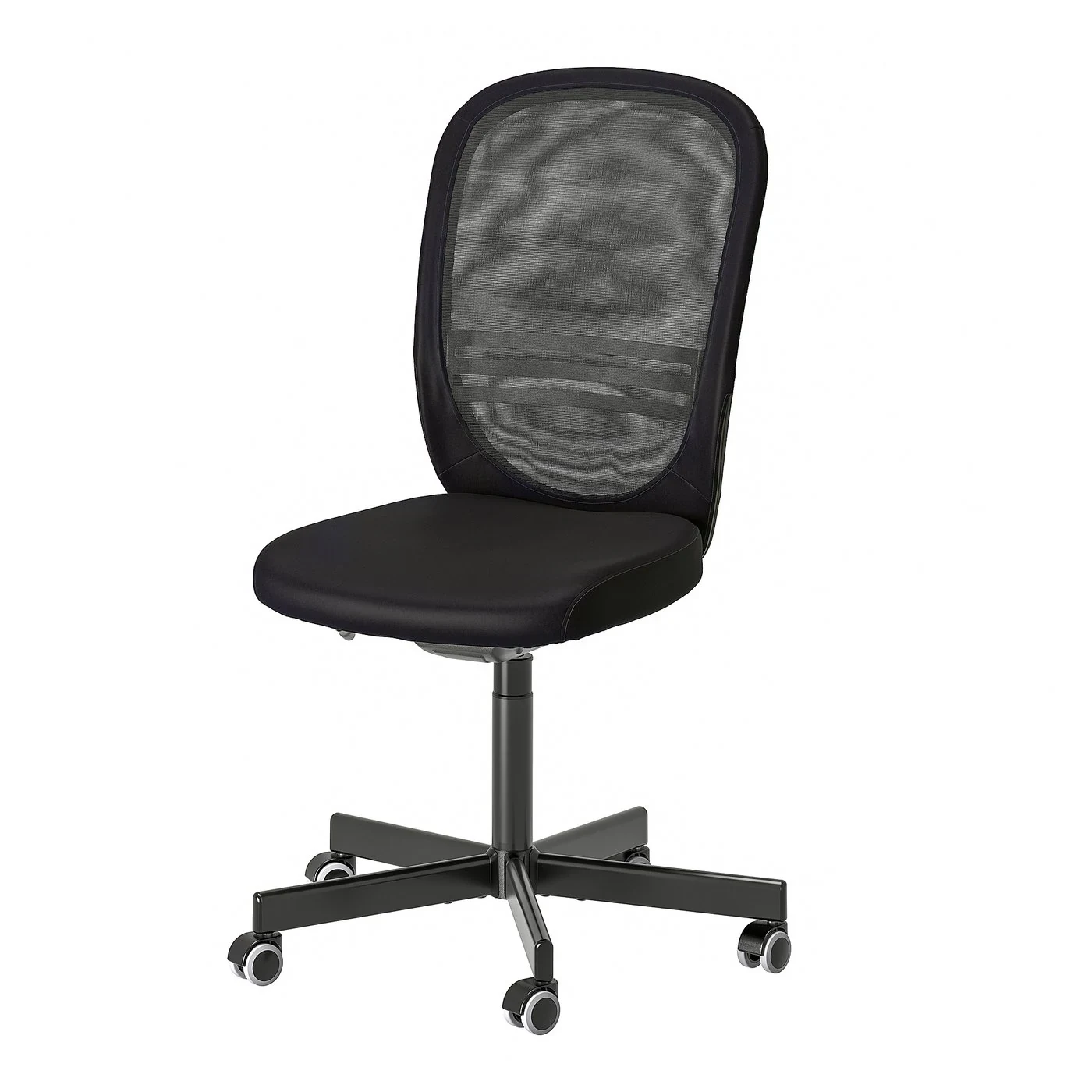
For a concrete comparison, IKEA's US black FLINTAN chair 904.890.29 lists an overall width and depth of 28 inches, but a seat width of 18⅛ inches and depth of 19¼ inches. The selected chair has one package; armrests are an extra option. These overall dimensions do not describe a complete reclining or rotating sweep.
Check the Armrest Combination as One Chair
The black version with armrests, combination 294.244.71, is one chair supplied as two packages: chair 904.890.29 and pair of armrests 104.890.33. Its listed overall width and depth are also 28 inches. Listed armrest heights run from 27⅛ to 32¼ inches; verify the actual relationship at the user's seat setting. Two packages do not mean two chairs.
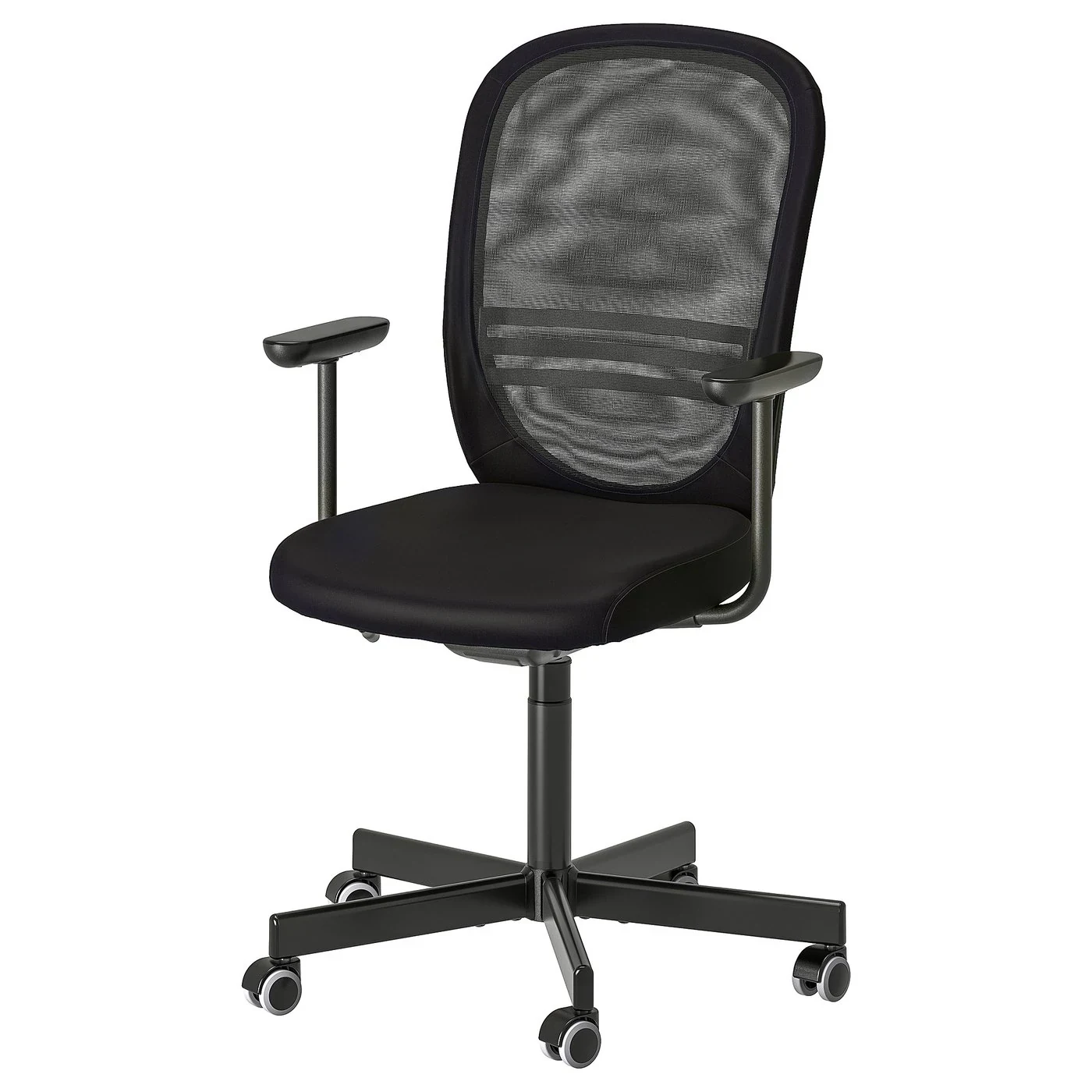
The product photographs identify those two configurations. The generic dimensional drawings do not represent either one's measured movement envelope. Confirm the exact configuration and missing fit details before ordering, then retain the comparison only if both the supported working position and the full stand-and-leave cycle work at your desk.