Compare the space people can actually sit in before deciding that a sofa provides enough seating. Overall width tells you how much room the furniture occupies. The usable seat between its arms tells you something different, and neither measurement alone proves that the intended people will sit comfortably together.
Start with the people and the activity, then check the seat and the complete furniture footprint. A compact sofa with narrow arms may offer more sitting width than an equally wide model with broad arms. It still needs suitable depth, height, support and a room layout that allows everyone to use it.
Define Who Will Use the Sofa Together
List the normal seating group rather than the maximum crowd you might fit for a photograph. Two adults watching television, an adult reading with a child and three adults talking can use the same sofa differently. Include any regular need to turn, reach for something or get up without moving everyone else.
Try sitting together on existing suitable seating as a starting point. Notice the space occupied by shoulders, elbows and ordinary movement, not just the width of a person's hips. Do not ask people to pull their arms in tightly to make a small advertised seat count appear adequate.
Use those observations to compare candidates, rather than adopting a standard inches-per-person allowance. People, preferred positions and activities vary. A seated trial with the intended users provides information that a row of cushion seams cannot.
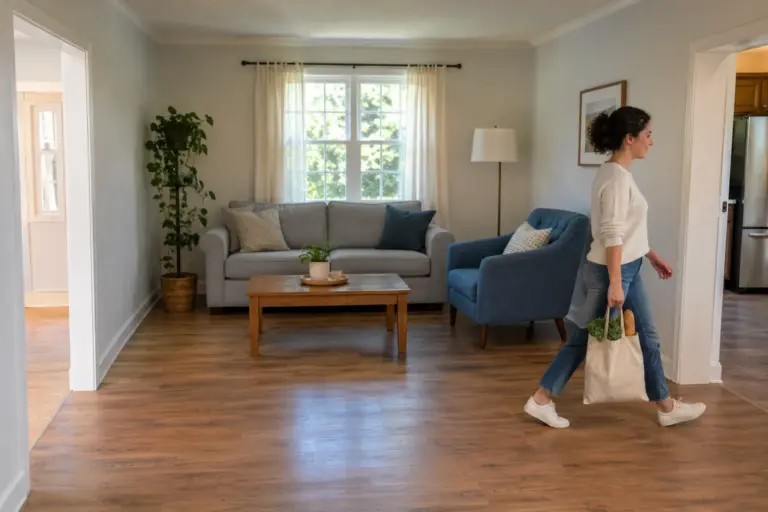
The opening scene shows two people sitting normally on a generic sofa with room to approach the front. It illustrates that user trial; it does not establish the dimensions or capacity of a particular product.
Keep Overall Width and Inside Seat Width Separate
Record the manufacturer's overall width and its published seat width, if available. Check how each measurement is defined. The usable sitting surface may be bounded by padded arm faces or other shapes rather than by a simple vertical line at the frame edge.
If you can inspect the sofa, measure the relevant sitting area between the arms with the normal cushions in place. Check whether the width changes toward the back and whether bolsters or fixed cushions take part of it. Do not calculate usable width from a photograph alone.
In the first hypothetical comparison, both sofas are 72 inches wide overall and 36 inches deep. Sofa A has two 8-inch-wide arms, leaving 56 inches between them. Sofa B has two 4-inch-wide arms, leaving 64 inches. The same outside width produces an 8-inch difference in the simplified usable seat.
That subtraction works because the example deliberately uses simple rectangular arms. On a real sofa, curved padding, angled arms and different measurement points can make that assumption wrong. Use the actual seat measurement rather than guessing both arms from the outside width.
Use a Width Budget to Find Questions, Not Certify Seats
The diagram gives three hypothetical sitting envelopes 20 inches each, with two chosen 2-inch spaces between them. Their total is 64 inches. Those are illustrative planning values, not a standard person width, a recommended gap or a comfortable seating rule.
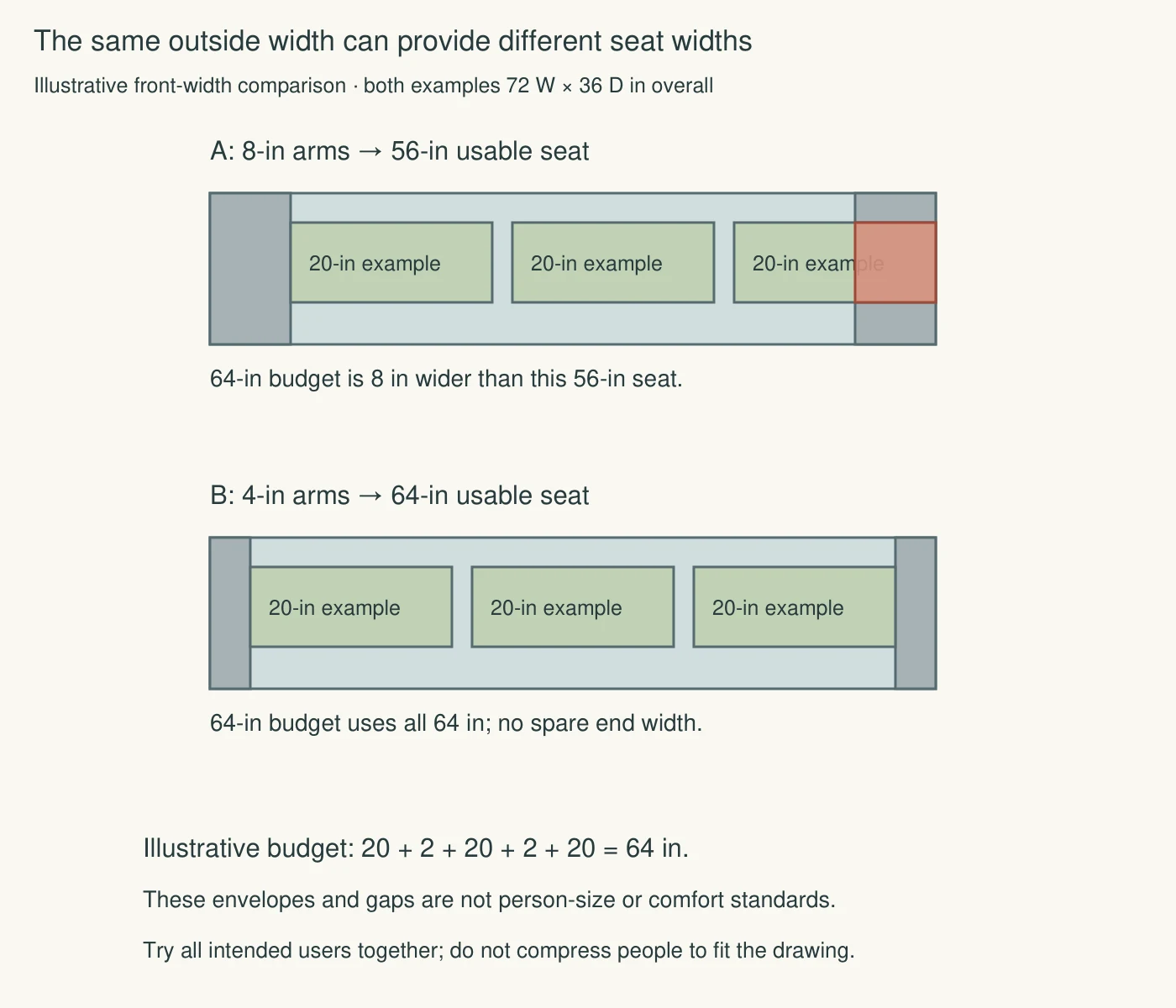
The 56-inch example seat falls 8 inches short of that particular budget. The 64-inch example uses the whole budget exactly, leaving no spare width at its ends. That is a reason to investigate the wider seat, not proof that three actual people will sit comfortably on it.
Repeat the trial with the people who will use the furniture. Sit in the intended positions, rest hands and elbows naturally and try ordinary movements. Check whether someone ends up against a hard arm, squeezed onto an edge or repeatedly asking another person to shift.
Do not treat armrests as extra regular seats to rescue an undersized choice. Use the furniture according to its instructions and stated limits. Likewise, three cushions do not necessarily create three suitable places, and a bench cushion does not establish a particular number of users.
Check Seat Depth and Height in the Same Trial
Record seat depth separately from overall depth. The back structure, back cushions and front profile occupy space without necessarily providing usable sitting depth. An overall depth that fits the room can still produce a seat that feels too deep or shallow for the intended user.
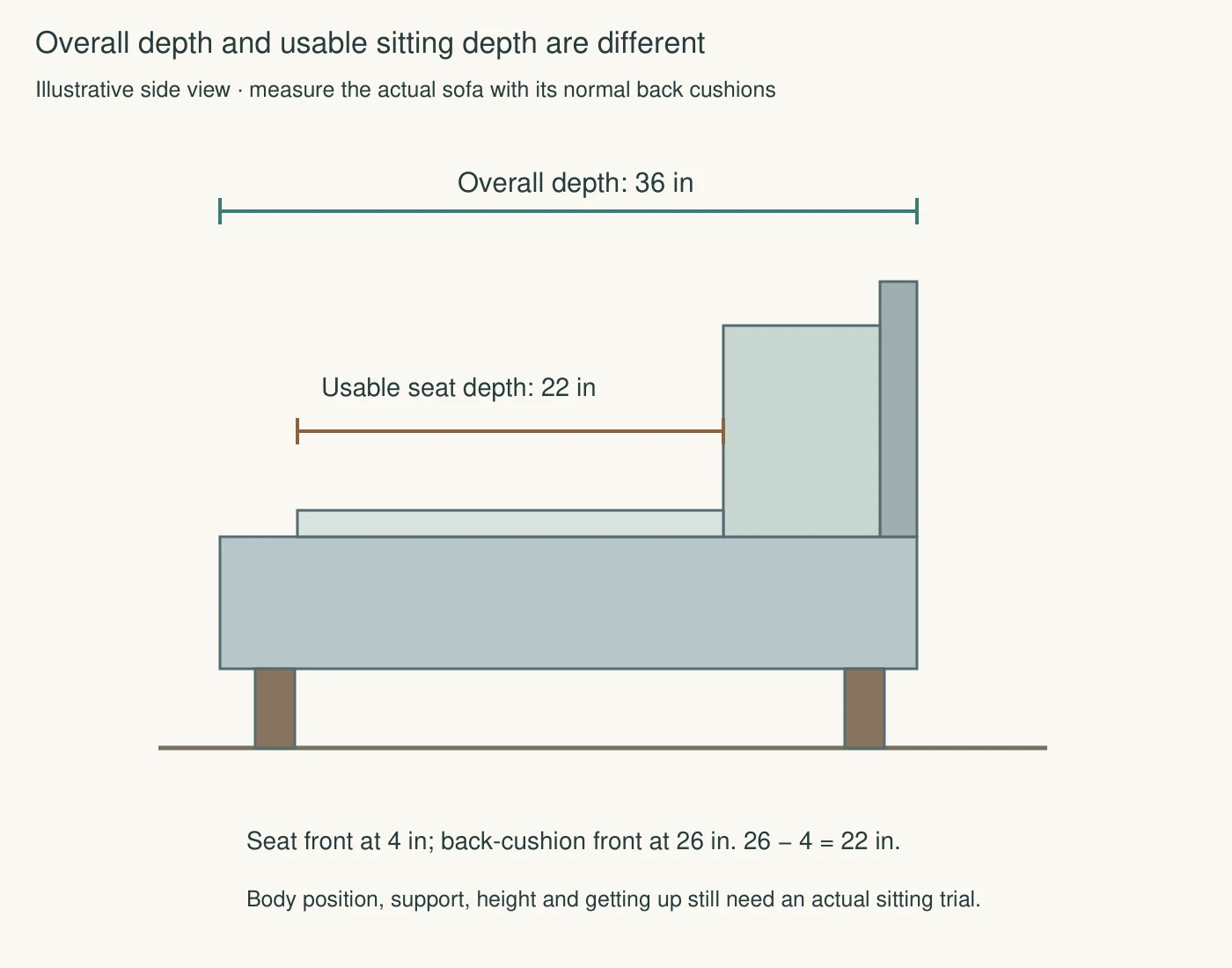
The side-view example has a hypothetical 36-inch overall depth and a 22-inch usable seat measured from its front sitting edge to the front of the back cushion. It keeps those two measurements visible without suggesting a universal sofa depth.
Sit with the normal back cushions in place. Check the position you actually want to use, how your feet are supported and whether you can get up normally. Include the cushion's shape and softness in the trial rather than assuming a published height describes how every person sits under load.
If a suitable additional cushion helps someone, include it when checking the remaining seat depth and width. Do not photograph the sofa without that cushion and then assume the full advertised surface remains available. Every regular addition belongs in the actual-use comparison.
Read a Real Product’s Two Widths
The IKEA US KIVIK loveseat in Gunnared blue, combination 494.996.82, provides a useful published example. Its manufacturer lists a 74¾-inch overall width and a 55⅛-inch seat width. That leaves a 19⅝-inch difference between the two measurements. The difference is not, by itself, an exact measurement of either padded arm.
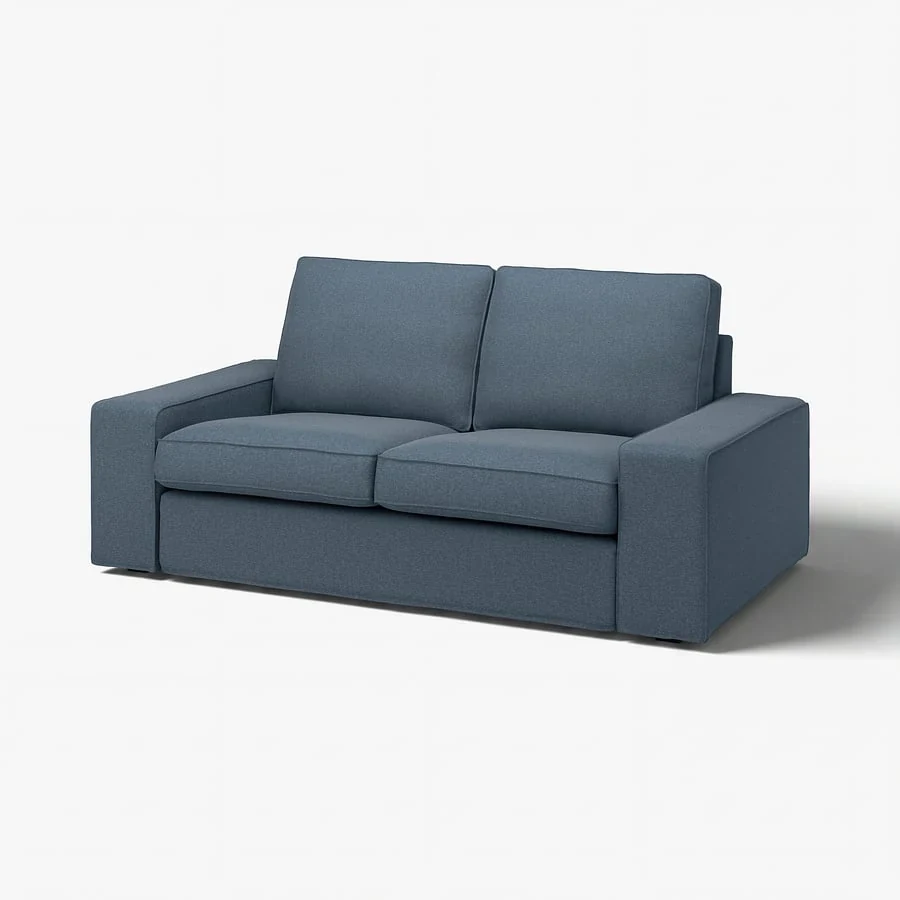
The same page lists a 37⅜-inch overall depth, 23⅝-inch seat depth and 17¾-inch seat height. Compare those fields with your sitting trial and room, rather than choosing from the word “loveseat” or treating the name as a capacity guarantee.
The selected combination includes one loveseat frame, article 305.193.50, and one Gunnared blue cover, article 005.576.78. It arrives in three packages because the frame has two packages and the cover one. A cover-only listing is not the complete loveseat. Confirm the full combination and current local availability when ordering.
The manufacturer photograph identifies that actual blue combination. It is separate from the unbranded user scene and the simplified 72-inch comparison, which do not depict this product's verified geometry or comfort.
Put the Complete Sofa Back Into the Room Plan
Once the seating looks suitable, mark the complete outside footprint in the room. Include legs or other projections that affect placement, the approach to each seat and nearby furniture in its normal use state. Check how people enter, sit and stand up together.
IKEA's small-living-room guidance emphasizes furniture that supports the room's uses. More usable seat width is helpful only when the complete sofa and the rest of the room still work. A narrow-arm design does not remove the need for a walking route or usable nearby storage.
Check delivery and assembly requirements separately from the seated arrangement. A sofa that works in the room may still have a difficult route through the entrance or stairs. Use the actual package and assembly information before purchase rather than assuming that an overall width settles access.
Keep the comparison record simple: overall footprint, usable seat width, usable depth and height, actual shared trial and room access. Choose the sofa that passes those related checks for your household, rather than the one whose outside width or cushion count suggests the largest number.